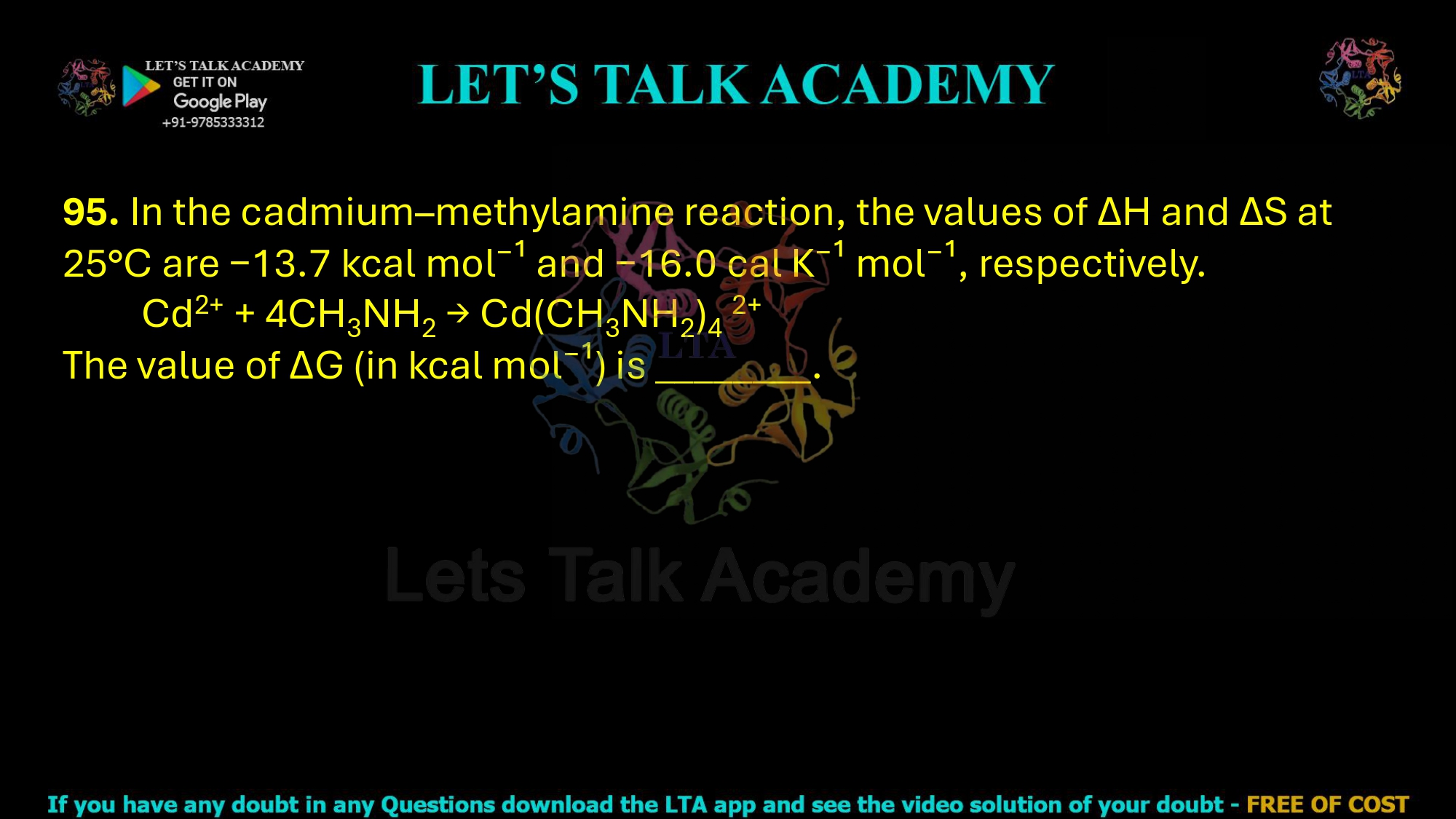
95. In the cadmium–methylamine reaction, the values of ΔH and ΔS at 25°C are −13.7 kcal mol⁻¹ and −16.0 cal K⁻¹ mol⁻¹, respectively.
Cd2+ + 4CH3NH2 → Cd(CH3NH2)4 2+
The value of ΔG (in kcal mol⁻¹) is ________.
Calculation of Gibbs Free Energy (ΔG) for the Cadmium–Methylamine Reaction
Correct Answer
✅ Correct Answer: −8.93 kcal mol−1
Understanding Gibbs Free Energy
Gibbs free energy (ΔG) determines whether a chemical reaction is spontaneous under constant temperature and pressure. A negative value of ΔG indicates that the reaction is thermodynamically spontaneous, whereas a positive value suggests that the reaction is non-spontaneous.
The relationship between Gibbs free energy, enthalpy, and entropy is expressed by the Gibbs–Helmholtz equation:
ΔG = ΔH − TΔS
where:
- ΔG = Gibbs free energy change
- ΔH = Enthalpy change
- T = Absolute temperature (Kelvin)
- ΔS = Entropy change
Step 1: Convert the Units
The enthalpy is given in kcal mol−1, whereas entropy is given in cal K−1 mol−1. Both quantities must have the same energy units before substitution into the equation.
ΔS = −16.0 cal K−1 mol−1
Converting calories to kilocalories:
ΔS = −16.0 / 1000 = −0.016 kcal K−1 mol−1
Step 2: Calculate TΔS
The temperature is:
T = 25°C = 298 K
Therefore,
TΔS = 298 × (−0.016)
TΔS = −4.768 kcal mol−1
Step 3: Calculate ΔG
Substitute the values into the Gibbs equation:
ΔG = ΔH − TΔS
ΔG = (−13.7) − (−4.768)
ΔG = −13.7 + 4.768
ΔG = −8.932 kcal mol−1
Rounded to two decimal places:
ΔG = −8.93 kcal mol−1
Interpretation of the Result
The negative value of ΔG indicates that the formation of the cadmium–methylamine complex is thermodynamically spontaneous at 25°C. Although the reaction is accompanied by a decrease in entropy due to the formation of a more ordered coordination complex, the large negative enthalpy change more than compensates for this unfavorable entropy contribution.
Thus, complex formation is driven primarily by the exothermic nature of the reaction.
Concept Behind the Question
This question tests the application of the Gibbs free energy equation and emphasizes the importance of unit consistency. Students often make mistakes by directly substituting entropy values in calories while enthalpy is given in kilocalories. Always convert both quantities into the same unit before performing calculations.
Final Answer
Using the Gibbs free energy equation,
ΔG = ΔH − TΔS
the Gibbs free energy for the cadmium–methylamine reaction at 25°C is:
ΔG = −8.93 kcal mol−1
✅ Correct Answer: −8.93 kcal mol−1


