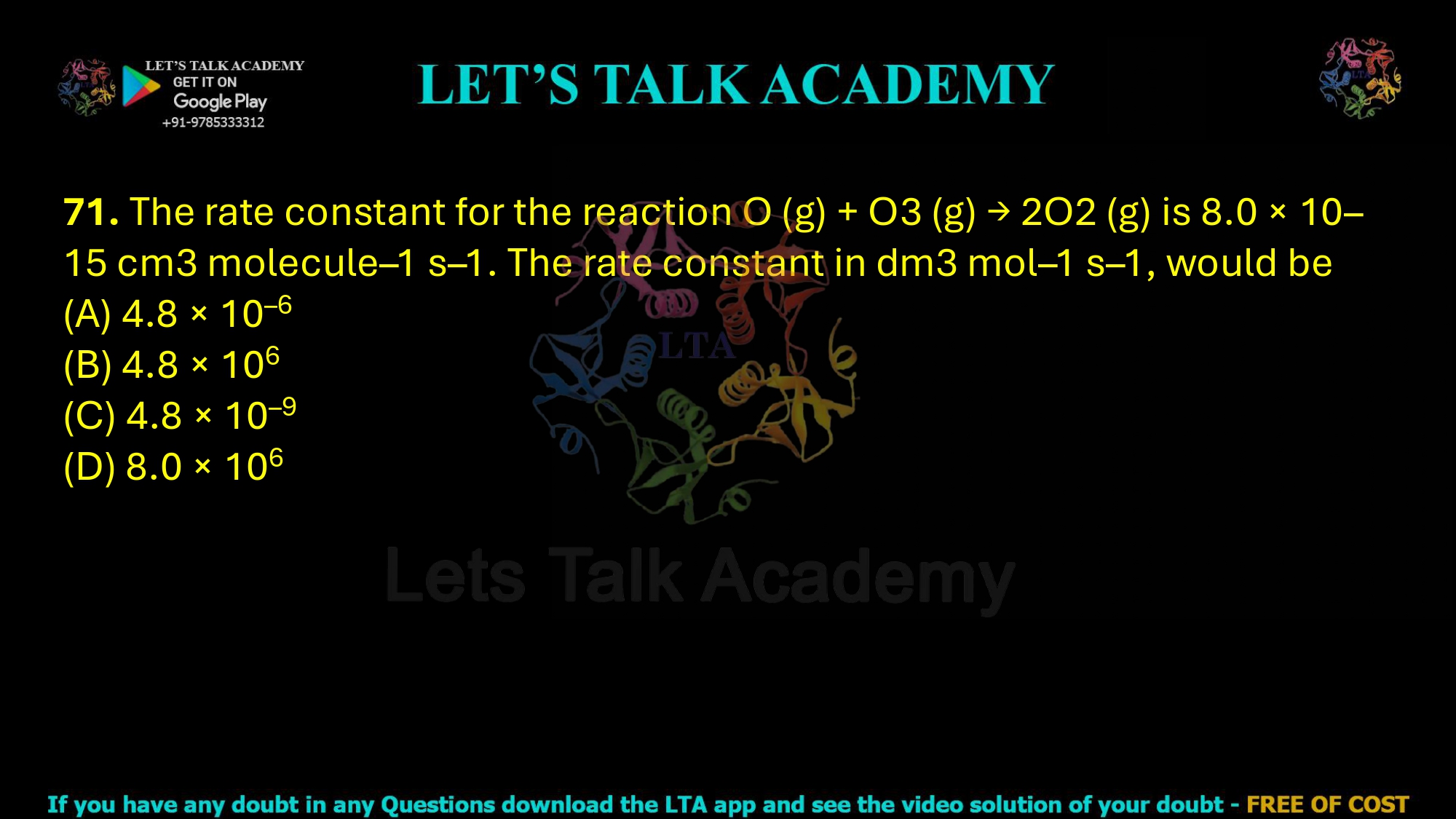
71. The rate constant for the reaction O (g) + O3 (g) → 2O2 (g) is 8.0 × 10⁻¹⁵ cm3 molecule–1 s–1. The rate constant in dm3 mol–1 s–1, would be
(A) 4.8 × 10⁻⁶
(B) 4.8 × 10⁶
(C) 4.8 × 10⁻⁹
(D) 8.0 × 10⁶
How to Convert the Rate Constant from cm³ molecule⁻¹ s⁻¹ to dm³ mol⁻¹ s⁻¹
One of the most common mistakes students make is directly converting cubic centimeters into cubic decimeters without considering that the concentration unit changes from molecules to moles. Since one mole contains an enormous number of molecules, Avogadro’s constant must always be included during the conversion.
This question beautifully combines two important concepts of physical chemistry:
- Conversion of volume units
- Conversion between molecules and moles using Avogadro’s number
Once these concepts are understood, solving similar numerical questions becomes extremely easy.
Understanding the Given Data
The given rate constant is
k = 8.0 × 10⁻¹⁵ cm³ molecule−1 s−1
We have to convert it into
dm³ mol−1 s−1
This conversion requires changing both the volume unit and the amount of substance unit.
Important Conversion Factors
The following conversion factors are essential for solving this problem:
1 dm³ = 1000 cm³
Therefore,
1 cm³ = 10−3 dm³
Also,
1 mole = 6.022 × 10²³ molecules
Whenever molecule−1 is converted into mol−1, the numerical value must be multiplied by Avogadro’s number.
Step-by-Step Calculation
The required conversion is
k = (8.0 × 10−15) × (10−3) × (6.022 × 1023)
First multiply the numerical values:
8.0 × 6.022 = 48.176
Now combine the powers of ten:
10−15 × 10−3 × 1023
= 105
Therefore,
k = 48.176 × 10⁵
Writing in standard scientific notation,
k = 4.8176 × 10⁶ dm³ mol−1 s−1
Rounding appropriately,
k = 4.8 × 10⁶ dm³ mol−1 s−1
Final Calculation
Rate Constant = 4.8 × 10⁶ dm³ mol−1 s−1
Correct Answer
Option (B) 4.8 × 10⁶
Explanation of Every Option
Option (A): 4.8 × 10⁻⁶
This option is incorrect because it results from applying the volume conversion incorrectly or forgetting to multiply by Avogadro’s number. Since the conversion from molecules to moles introduces a factor of approximately 1023, the final value cannot become smaller by twelve orders of magnitude.
Option (B): 4.8 × 10⁶
This is the correct answer. The conversion correctly accounts for both the change from cubic centimeters to cubic decimeters and the conversion from molecules to moles using Avogadro’s constant. The resulting rate constant is approximately 4.8 × 10⁶ dm³ mol−1 s−1.
Option (C): 4.8 × 10⁻⁹
This option is incorrect because it arises from an incorrect manipulation of the powers of ten during the unit conversion. The contribution of Avogadro’s number has either been omitted or applied incorrectly.
Option (D): 8.0 × 10⁶
This option is also incorrect. Although the exponent is close to the correct value, the numerical coefficient ignores multiplication by Avogadro’s number and proper scientific notation. Therefore, the coefficient should be approximately 4.8 rather than 8.0.
Why Avogadro’s Number is Used
Many students wonder why Avogadro’s number appears in this conversion. The reason is that the original rate constant is expressed per molecule, whereas the required unit is per mole. Since one mole contains 6.022 × 10²³ molecules, the numerical value must increase by this factor during the conversion.
This principle is applicable not only to rate constants but also to collision frequencies, molecular cross-sections, and several gas-phase kinetic calculations.
Concept Behind Rate Constant Units
The units of a rate constant depend on the overall order of the reaction. For a second-order reaction such as
O(g) + O3(g) → 2O2(g)
the SI concentration unit is mol dm−3. Consequently, the rate constant has units of
dm³ mol−1 s−1
However, in gas-phase kinetics and atmospheric chemistry, rate constants are often reported in
cm³ molecule−1 s−1
Therefore, students must know how to convert between these two commonly used unit systems.
Key Concepts Covered
This problem reinforces several important concepts of physical chemistry, including second-order reaction kinetics, rate constant units, dimensional analysis, Avogadro’s constant, scientific notation, conversion between cm³ and dm³, conversion between molecules and moles, and unit consistency.


