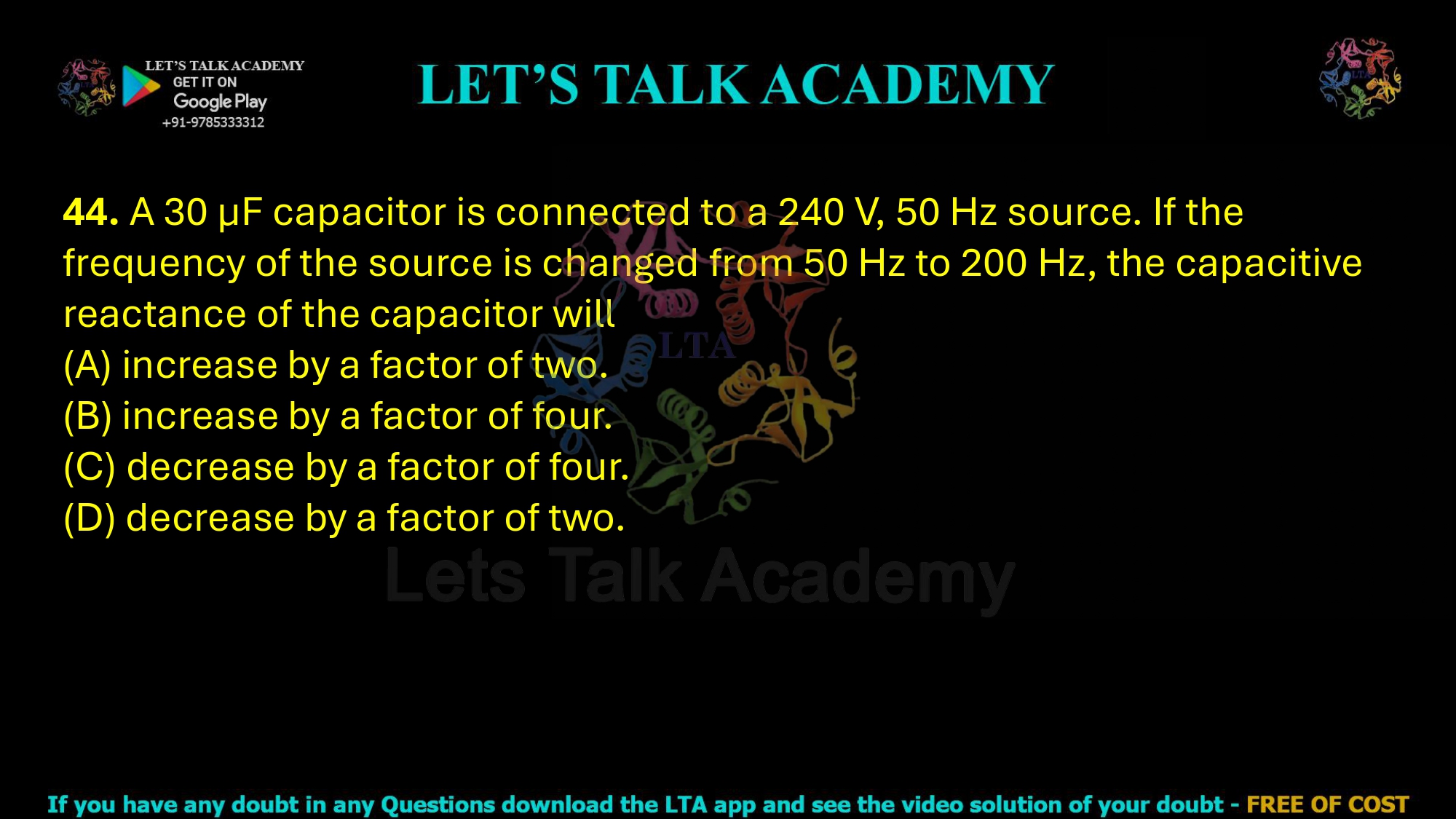
44. A 30 µF capacitor is connected to a 240 V, 50 Hz source. If the frequency of the source is changed from 50 Hz to 200 Hz, the capacitive reactance of the capacitor will
(A) increase by a factor of two.
(B) increase by a factor of four.
(C) decrease by a factor of four.
(D) decrease by a factor of two.
Effect of Frequency on Capacitive Reactance of a 30 µF Capacitor
Understanding the Effect of Frequency on Capacitive Reactance
This question is based on the behaviour of a capacitor in an alternating current circuit. Unlike an ordinary resistor, a capacitor offers a frequency-dependent opposition to the flow of alternating current. This opposition is known as capacitive reactance.
The important point is that capacitive reactance decreases when the frequency of the AC source increases. In this problem, the frequency changes from 50 Hz to 200 Hz, while the capacitance remains constant at 30 µF. Therefore, we only need to examine how the fourfold increase in frequency affects the capacitive reactance.
Formula for Capacitive Reactance
The capacitive reactance of a capacitor connected to an AC source is given by:
XC = 1/(2πfC)
Here, XC represents the capacitive reactance measured in ohms, f is the frequency of the alternating current source measured in hertz, and C is the capacitance measured in farads.
For a capacitor of fixed capacitance, 2π and C remain constant. Therefore:
XC ∝ 1/f
This inverse relationship is the key concept required to solve the question.
Comparing the Initial and Final Frequencies
The initial frequency of the source is:
f1 = 50 Hz
The final frequency is:
f2 = 200 Hz
The factor by which the frequency increases is:
f2/f1 = 200/50
f2/f1 = 4
Thus, the frequency of the AC source becomes four times its original value.
Calculating the Change in Capacitive Reactance
Since capacitive reactance is inversely proportional to frequency:
XC ∝ 1/f
For the two different frequencies:
XC2/XC1 = f1/f2
Substituting the given frequencies:
XC2/XC1 = 50/200
XC2/XC1 = 1/4
Therefore:
XC2 = XC1/4
This means that the final capacitive reactance becomes one-fourth of its initial value. In other words, the capacitive reactance decreases by a factor of four.
Numerical Verification Using the Given Capacitance
Although the question can be solved directly using proportionality, the result can also be verified by calculating the initial and final values of capacitive reactance.
The capacitance is:
C = 30 µF = 30 × 10−6 F
Initial Capacitive Reactance at 50 Hz
Using:
XC1 = 1/(2πf1C)
Substituting f1 = 50 Hz and C = 30 × 10−6 F:
XC1 = 1/[2π × 50 × (30 × 10−6)]
XC1 ≈ 106.1 Ω
Final Capacitive Reactance at 200 Hz
At the new frequency:
XC2 = 1/(2πf2C)
Substituting f2 = 200 Hz:
XC2 = 1/[2π × 200 × (30 × 10−6)]
XC2 ≈ 26.5 Ω
Comparing the two values:
106.1/26.5 ≈ 4
Thus, the final capacitive reactance is one-fourth of the initial capacitive reactance, confirming that it decreases by a factor of four.
Why Does Capacitive Reactance Decrease When Frequency Increases?
A capacitor continuously charges and discharges when connected to an alternating current source. At a low frequency, each AC cycle lasts longer, so the capacitor has more time to build up charge and oppose the flow of current. As a result, the capacitive reactance is relatively large.
When the frequency increases, the direction of the alternating voltage changes more rapidly. The capacitor charges and discharges more frequently and allows a greater alternating current to flow. Therefore, its effective opposition to AC decreases.
This physical behaviour is represented mathematically by the inverse relationship XC ∝ 1/f.
Detailed Analysis of All Options
Option (A): Increase by a Factor of Two
This option is incorrect because capacitive reactance does not increase when frequency increases. The formula XC = 1/(2πfC) shows that capacitive reactance is inversely proportional to frequency. Therefore, increasing the frequency must decrease the capacitive reactance.
Option (B): Increase by a Factor of Four
This option is incorrect. The frequency increases by a factor of four, but capacitive reactance varies inversely with frequency. Therefore, it does not become four times larger. Instead, it becomes one-fourth of its original value.
Option (C): Decrease by a Factor of Four
This is the correct option. The frequency increases from 50 Hz to 200 Hz, which is a fourfold increase. Since XC ∝ 1/f, a fourfold increase in frequency causes the capacitive reactance to become one-fourth of its original value. Therefore, it decreases by a factor of four.
Option (D): Decrease by a Factor of Two
This option is incorrect because the frequency does not merely double. It increases from 50 Hz to 200 Hz, which means it becomes four times its original value. Therefore, the capacitive reactance decreases by a factor of four, not by a factor of two.
Is the Given Voltage of 240 V Required?
The voltage value of 240 V is not required to determine the change in capacitive reactance. Capacitive reactance depends only on the frequency of the AC source and the capacitance of the capacitor, according to XC = 1/(2πfC).
The voltage would be needed if the question asked for the current flowing through the capacitor because the current can be calculated using I = V/XC. However, for comparing capacitive reactance at two frequencies, the voltage does not affect the result.
Effect on Current Through the Capacitor
Since the applied voltage remains the same and the capacitive reactance becomes one-fourth of its original value, the current through the capacitor would become four times larger.
For a purely capacitive AC circuit:
I = V/XC
Therefore, reducing XC by a factor of four increases the current by a factor of four, provided the applied voltage remains unchanged.
Final Answer
Correct Option: (C) Decrease by a factor of four
The capacitive reactance of a capacitor is given by XC = 1/(2πfC), so it is inversely proportional to frequency. When the frequency increases from 50 Hz to 200 Hz, it increases by a factor of four. Therefore, the capacitive reactance becomes one-fourth of its original value and hence decreases by a factor of four.


