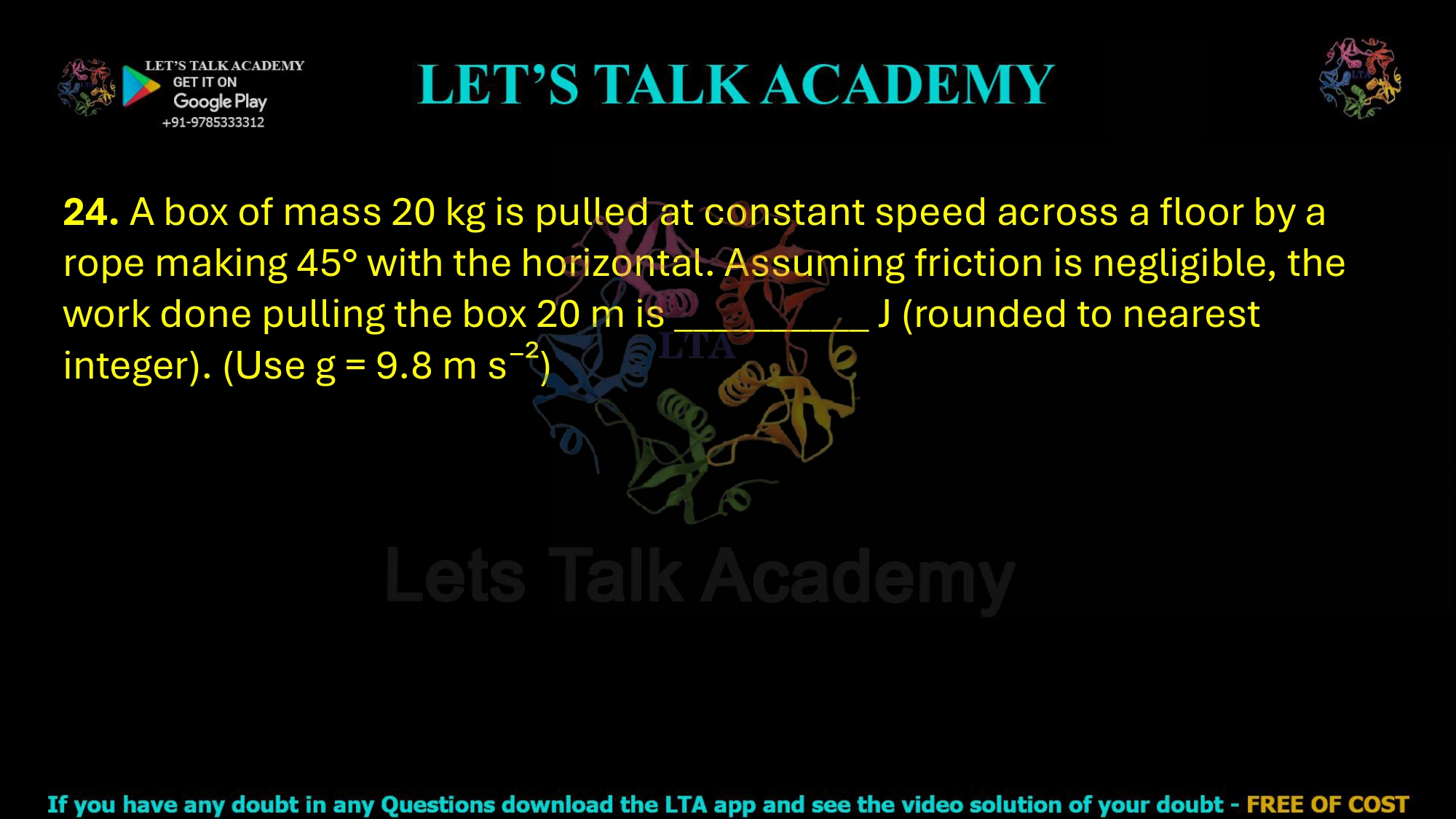
24. A box of mass 20 kg is pulled at constant speed across a floor by a rope making 45° with the horizontal. Assuming friction is negligible, the work done pulling the box 20 m is __________ J (rounded to nearest integer). (Use g = 9.8 m s⁻²)
Work Done Pulling a Box at Constant Speed on a Frictionless Floor
Correct Answer: 0 J
Understanding the Physics of the Problem
This question tests the concepts of constant velocity, Newton’s laws of motion, frictionless motion, and the work-energy theorem. The most important information given in the problem is that the box moves at a constant speed and friction is negligible.
Since the box moves at constant speed in a straight line, its velocity does not change. Therefore, its acceleration is zero. According to Newton’s second law, zero acceleration means that the net horizontal force acting on the box must also be zero.
Because friction is negligible, there is no frictional force opposing the horizontal motion of the box. Therefore, no horizontal force is required to maintain its constant speed.
Forces Acting on the Box
The box is acted upon by its weight, the normal reaction of the floor, and the tension in the rope. The weight of the box acts vertically downward, while the normal reaction acts vertically upward. The rope is inclined at 45° to the horizontal, so its tension can be resolved into horizontal and vertical components.
If the tension in the rope is represented by T, its horizontal component is:
T cos 45°
and its vertical component is:
T sin 45°
However, the box has zero horizontal acceleration because it is moving at constant speed. Therefore, the net horizontal force must be zero.
Applying Newton’s Second Law in the Horizontal Direction
For motion along the horizontal direction:
Net horizontal force = ma
Since the speed is constant:
a = 0
Therefore:
Net horizontal force = 0
The frictional force is also given to be negligible. Hence, there is no opposing horizontal force that the pulling force needs to balance. The horizontal component of the pulling force must therefore be zero.
Thus:
T cos 45° = 0
Since cos 45° is not zero:
T = 0
Therefore, under the ideal conditions stated in the question, no pulling force is required to maintain the constant speed of the box.
Calculating the Work Done in Pulling the Box
The work done by a constant force is given by:
W = Fs cos θ
where F is the applied force, s is the displacement, and θ is the angle between the force and displacement.
For the rope:
W = T × 20 × cos 45°
Since the required tension is zero:
W = 0 × 20 × cos 45°
Therefore:
W = 0 J
Solution Using the Work-Energy Theorem
The same answer can be obtained more directly using the work-energy theorem. According to this theorem, the net work done on an object is equal to the change in its kinetic energy.
Since the box moves at constant speed, its initial and final speeds are equal. Therefore, its kinetic energy remains unchanged.
Change in kinetic energy = 0
Hence:
Net work done = 0 J
The weight and normal force do no work because the displacement is horizontal while these forces act vertically. Since friction is negligible and there is no change in kinetic energy, no work is required to maintain the box’s constant horizontal motion under the ideal conditions described.
Why the Mass and Value of g Are Not Required
The question provides the mass of the box as 20 kg and the acceleration due to gravity as 9.8 m s−2. However, these values are not required to calculate the answer.
The weight of the box is:
mg = 20 × 9.8 = 196 N
This gravitational force acts vertically downward, while the displacement of the box is horizontal. Since the angle between the weight and displacement is 90°, the work done by gravity is zero.
The presence of extra numerical information is often used to test whether the correct physical principle has been identified. In this case, the decisive facts are that the box moves at constant speed and friction is negligible.
Why Constant Speed Is the Key Information
A constant speed means that the magnitude of the velocity does not change. For straight-line motion across the floor, this means the acceleration is zero. According to Newton’s first law, an object already in motion continues moving at constant velocity without requiring a net force when no resistive force acts on it.
Therefore, on an ideal frictionless horizontal surface, a box does not need a continuous force to keep moving at constant speed. A force would be needed to accelerate the box or overcome friction, but neither situation occurs here.
Role of the 45° Angle
The rope makes an angle of 45° with the horizontal, which means that only the horizontal component of the tension could contribute to work during the horizontal displacement.
Normally, the work done by the rope would be calculated using:
W = Ts cos 45°
However, because friction is negligible and the box has zero acceleration, the required horizontal pulling force is zero. Therefore, the rope angle does not produce a non-zero work value under the ideal conditions given in the question.
Final Answer
The work done in pulling the box through a distance of 20 m is 0 J.
Therefore, the required answer rounded to the nearest integer is 0.
Conclusion
The box moves at constant speed, so its acceleration and change in kinetic energy are zero. Since friction is negligible, no horizontal force is needed to maintain the motion. Consequently, the required pulling force is zero, and the work done in pulling the box through 20 m is 0 J. The mass of the box, the value of gravitational acceleration, and the 45° rope angle do not change this result under the ideal conditions stated in the problem.


