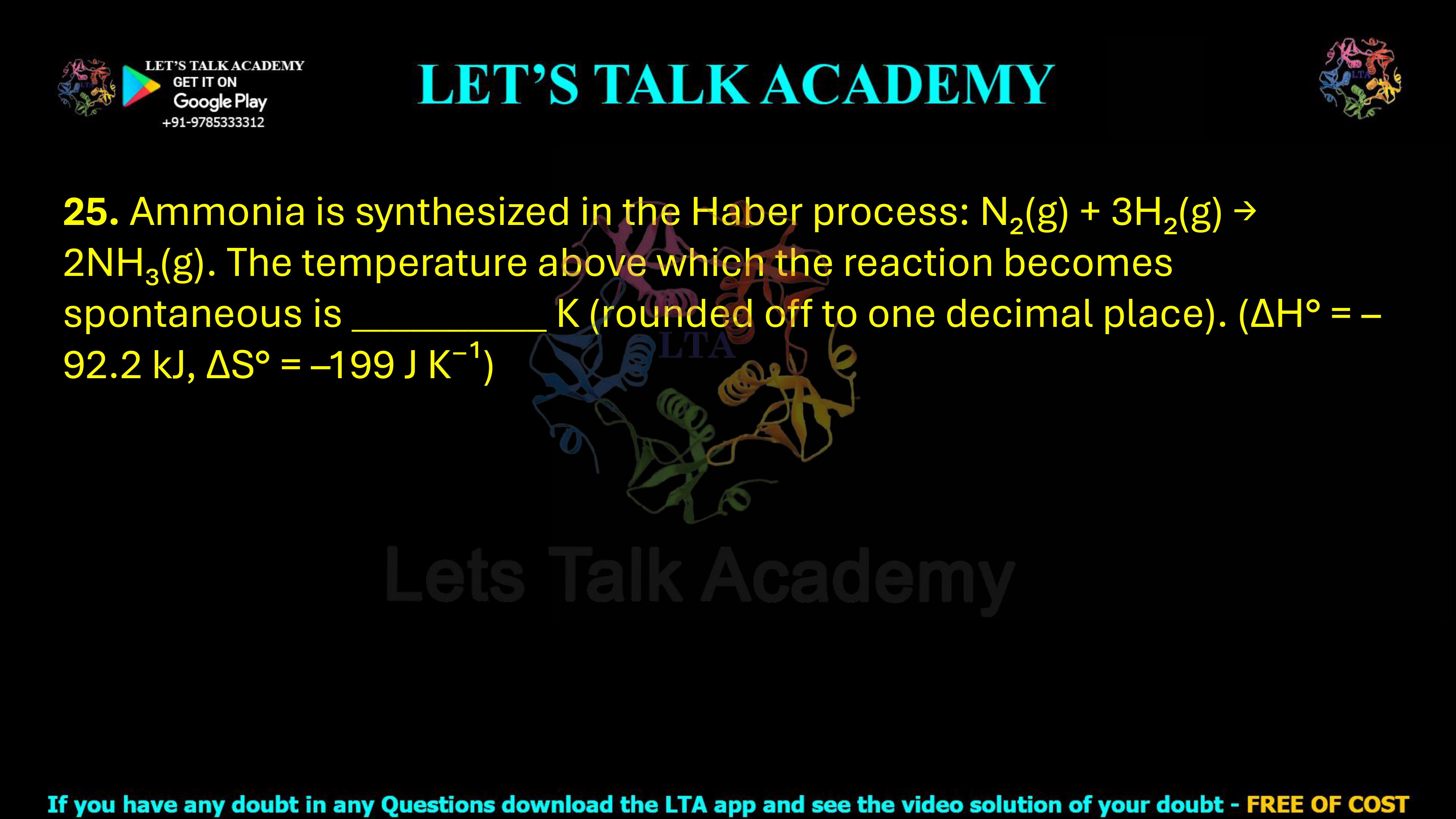
25. Ammonia is synthesized in the Haber process:
N2(g) + 3H2(g) → 2NH3(g)
The temperature above which the reaction becomes spontaneous is _____ K, rounded off to one decimal place.
Given:
ΔH° = −92.2 kJ mol−1
ΔS° = −199 J K−1 mol−1
Calculate the Critical Temperature for Spontaneity of Ammonia Synthesis in the Haber Process
Calculated Critical Temperature: 463.3 K
Important thermodynamic conclusion: With the given negative values of ΔH° and ΔS°, the reaction is actually spontaneous below 463.3 K and becomes non-spontaneous above 463.3 K. Therefore, if the question literally says “above which the reaction becomes spontaneous,” that wording is thermodynamically reversed. The required crossover or critical temperature is still 463.3 K.
Detailed Solution Using the Gibbs Free Energy Equation
The spontaneity of a chemical reaction at constant temperature and pressure is determined by the change in Gibbs free energy, represented by ΔG. For the synthesis of ammonia in the Haber process, both the enthalpy change and entropy change are negative. This combination makes the temperature particularly important in deciding whether the reaction is thermodynamically spontaneous.
The Gibbs free energy equation is:
ΔG = ΔH − TΔS
A reaction is spontaneous when:
ΔG < 0
A reaction is at the thermodynamic crossover point when:
ΔG = 0
A reaction is non-spontaneous under the specified conditions when:
ΔG > 0
The temperature at which the reaction changes from spontaneous to non-spontaneous, or vice versa, is found by setting ΔG = 0.
Step 1: Set ΔG Equal to Zero
At the critical or crossover temperature:
ΔG = 0
Substituting this condition into the Gibbs free energy equation gives:
0 = ΔH − TΔS
Rearranging the equation:
TΔS = ΔH
Therefore:
T = ΔH ÷ ΔS
This equation gives the temperature at which the reaction is at the boundary between spontaneous and non-spontaneous behaviour.
Step 2: Convert the Units of ΔH
The given enthalpy change is expressed in kilojoules per mole, whereas the entropy change is expressed in joules per kelvin per mole. Before performing the calculation, both quantities must be expressed using compatible energy units.
The given value is:
ΔH° = −92.2 kJ mol−1
Since:
1 kJ = 1000 J
Therefore:
ΔH° = −92.2 × 1000 J mol−1
ΔH° = −92,200 J mol−1
The entropy change is already given in joules:
ΔS° = −199 J K−1 mol−1
Step 3: Substitute the Values into the Temperature Equation
Using:
T = ΔH ÷ ΔS
Substitute the given values:
T = (−92,200 J mol−1) ÷ (−199 J K−1 mol−1)
The negative signs cancel:
T = 92,200 ÷ 199 K
T = 463.3165… K
Rounded off to one decimal place:
T = 463.3 K
Why Is the Critical Temperature 463.3 K?
At 463.3 K, the enthalpy and entropy contributions to Gibbs free energy exactly balance each other. Therefore:
ΔG = 0
This is the thermodynamic boundary temperature. At this temperature, the reaction is at the point separating the temperature region in which it is spontaneous from the region in which it is non-spontaneous under standard-state assumptions.
The calculated answer is therefore:
463.3 K
Determining Whether the Reaction Is Spontaneous Above or Below 463.3 K
The signs of ΔH and ΔS must be examined carefully. For the Haber process reaction given:
ΔH < 0
ΔS < 0
Substituting these signs into the Gibbs free energy equation:
ΔG = ΔH − TΔS
Because ΔS is negative, the term −TΔS becomes positive. Therefore, the equation can be understood as:
ΔG = negative enthalpy contribution + positive temperature-dependent contribution
At low temperature, the positive −TΔS contribution is relatively small, so the negative value of ΔH dominates and ΔG remains negative. Therefore, the reaction is spontaneous at sufficiently low temperatures.
At high temperature, the positive −TΔS term becomes larger. Above the critical temperature, this positive contribution becomes greater than the favourable negative enthalpy contribution, causing ΔG to become positive. Therefore, the reaction becomes non-spontaneous above the critical temperature.
Hence:
T < 463.3 K → ΔG < 0 → Spontaneous
T = 463.3 K → ΔG = 0 → Critical crossover condition
T > 463.3 K → ΔG > 0 → Non-spontaneous
Verification at a Temperature Below 463.3 K
To understand the result more clearly, consider a temperature of 300 K. The Gibbs free energy change is:
ΔG = ΔH − TΔS
ΔG = −92,200 − [300 × (−199)]
ΔG = −92,200 + 59,700
ΔG = −32,500 J mol−1
Since ΔG is negative at 300 K, the reaction is thermodynamically spontaneous at this temperature.
Verification at a Temperature Above 463.3 K
Now consider a temperature of 500 K:
ΔG = −92,200 − [500 × (−199)]
ΔG = −92,200 + 99,500
ΔG = +7,300 J mol−1
Since ΔG is positive at 500 K, the forward ammonia synthesis reaction is non-spontaneous under standard conditions at this temperature. This numerical verification confirms that the reaction is spontaneous below, rather than above, the calculated critical temperature.
Why Is ΔH Negative for the Haber Process?
The synthesis of ammonia from nitrogen and hydrogen is an exothermic reaction. The negative enthalpy change, ΔH° = −92.2 kJ mol−1, indicates that heat is released during the formation of ammonia.
An exothermic reaction is thermodynamically favoured by lower temperatures because increasing the temperature makes the positive entropy-dependent contribution more significant when ΔS is negative. This is why lower temperatures favour the thermodynamic spontaneity of ammonia formation.
Why Is ΔS Negative for Ammonia Synthesis?
The balanced reaction is:
N2(g) + 3H2(g) → 2NH3(g)
On the reactant side, there are four moles of gaseous molecules:
1 mol N2 + 3 mol H2 = 4 mol of gas
On the product side, there are only two moles of gaseous ammonia:
2 mol NH3 = 2 mol of gas
The number of gas molecules decreases from four moles to two moles. This reduction in the number of gaseous particles decreases the number of possible molecular arrangements and therefore decreases entropy. As a result:
ΔS° < 0
This negative entropy change explains why increasing the temperature eventually makes the forward reaction thermodynamically unfavourable.
Thermodynamic Sign Analysis for Spontaneity
For a reaction with ΔH < 0 and ΔS < 0, spontaneity depends on temperature. Such a reaction is generally spontaneous at low temperatures and non-spontaneous at high temperatures.
The Haber process in this question follows exactly this thermodynamic pattern. The negative enthalpy change favours spontaneity, while the negative entropy change becomes increasingly unfavourable as temperature rises. The competition between these two factors produces the crossover temperature of 463.3 K.
Understanding the Wording of the Question
The numerical value obtained from the given thermodynamic data is unquestionably 463.3 K. However, the phrase “temperature above which the reaction becomes spontaneous” is inconsistent with the signs of the supplied ΔH° and ΔS° values.
Because both ΔH° and ΔS° are negative, the correct thermodynamic statement is:
The reaction is spontaneous below 463.3 K and becomes non-spontaneous above 463.3 K under standard conditions.
Therefore, 463.3 K should be reported as the required critical temperature, while the direction of spontaneity should be interpreted correctly from the Gibbs free energy equation.
Final Answer
The critical temperature is 463.3 K. Using the condition ΔG = 0 and the equation T = ΔH ÷ ΔS, we obtain:
T = (−92,200) ÷ (−199) = 463.3 K
Thus, the numerical answer is 463.3 K. Thermodynamically, because both ΔH° and ΔS° are negative, the Haber process reaction is spontaneous below 463.3 K and non-spontaneous above 463.3 K under standard conditions.


