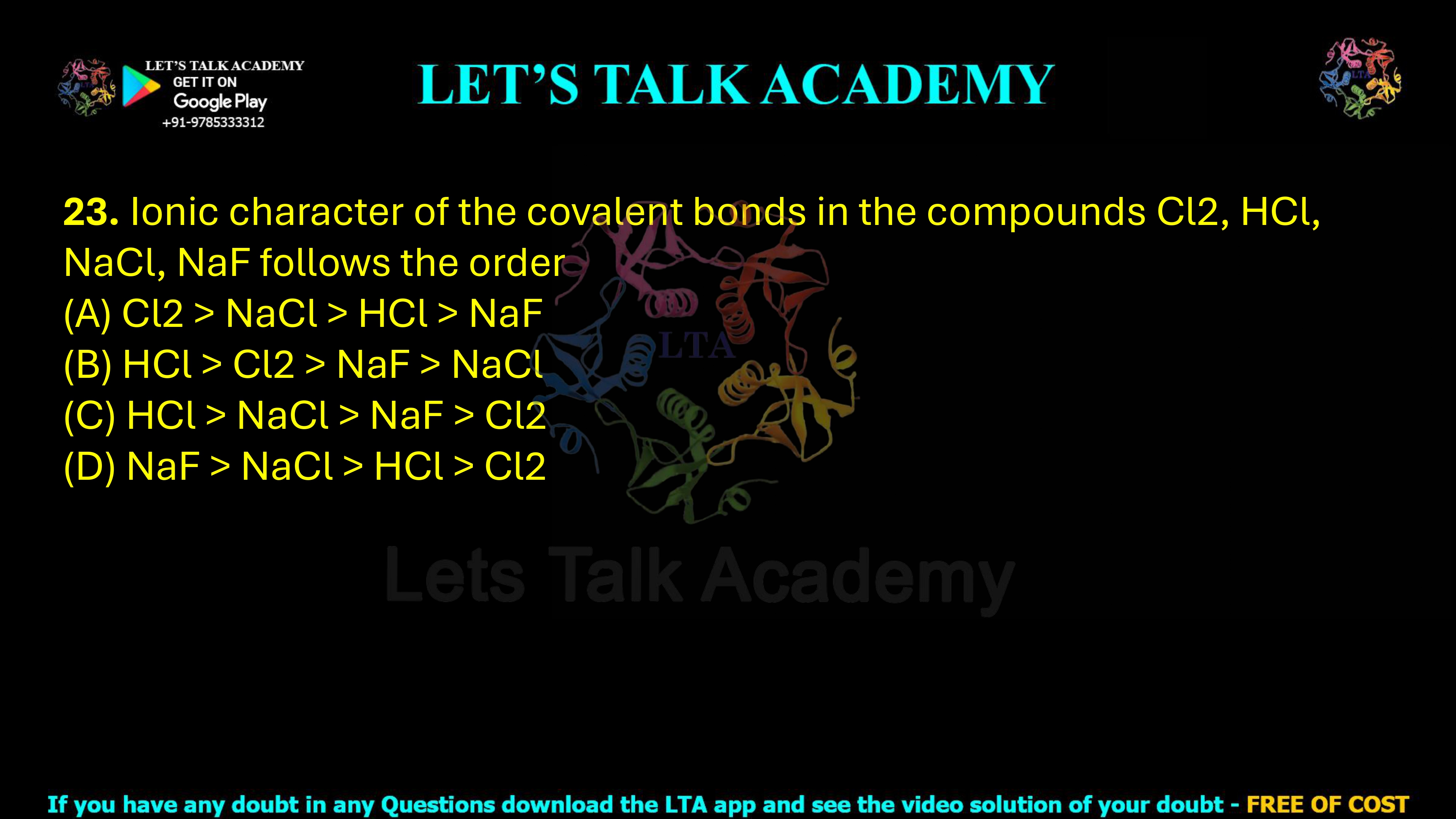
23. Ionic character of the bonds in the compounds Cl2, HCl, NaCl and NaF follows the order:
(A) Cl2 > NaCl > HCl > NaF
(B) HCl > Cl2 > NaF > NaCl
(C) HCl > NaCl > NaF > Cl2
(D) NaF > NaCl > HCl > Cl2
Ionic Character of the Bonds in Cl₂, HCl, NaCl and NaF – Detailed Order and Explanation
Correct Answer: Option (D) NaF > NaCl > HCl > Cl2
How to Determine the Order of Ionic Character
To determine the ionic character order of Cl2, HCl, NaCl and NaF, we must understand that chemical bonds are rarely completely ionic or completely covalent. The degree of ionic character mainly depends on how unequally the bonding electrons are distributed between the bonded atoms.
The most important factor is the difference in electronegativity between the two bonded atoms. When the electronegativity difference is large, the more electronegative atom attracts the bonding electrons much more strongly. This produces greater charge separation and therefore greater ionic character. When the electronegativity difference is zero or very small, the electrons are shared more equally and the bond has greater covalent character.
For the given substances, the bond with the greatest ionic character is present in NaF, followed by NaCl. HCl is a polar covalent molecule with considerably lower ionic character, while Cl2 is a non-polar covalent molecule and has the least ionic character.
Step-by-Step Comparison of Ionic Character
Ionic Character of NaF
Sodium fluoride, NaF, is formed between sodium, which is a highly electropositive metal, and fluorine, which is the most electronegative element. Sodium readily loses one electron to form Na+, while fluorine readily accepts one electron to form F−.
Na → Na+ + e−
F + e− → F−
The very large electronegativity difference between sodium and fluorine causes extensive charge separation. Therefore, the Na–F bond has very high ionic character.
Another important factor is that the fluoride ion, F−, is relatively small and difficult to polarize compared with the chloride ion. According to Fajans’ rule, lower polarization means lower covalent character and consequently greater ionic character. Therefore, NaF has the highest ionic character among the substances given.
Ionic Character of NaCl
Sodium chloride, NaCl, is also predominantly ionic. Sodium loses an electron to form Na+, and chlorine accepts an electron to form Cl−. The electrostatic attraction between these oppositely charged ions forms the Na–Cl bond.
However, the chloride ion is larger and more polarizable than the fluoride ion. The electron cloud of Cl− can therefore be distorted more easily by the Na+ ion. This distortion introduces slightly more covalent character into NaCl than into NaF.
As a result, NaCl has less ionic character than NaF, although it remains much more ionic than HCl and Cl2.
NaF > NaCl
Ionic Character of HCl
Hydrogen chloride, HCl, contains a polar covalent bond. Hydrogen and chlorine share a pair of electrons, but the electrons are not shared equally because chlorine is more electronegative than hydrogen.
The shared electron density is pulled toward chlorine, producing partial charges:
Hδ+–Clδ−
This charge separation gives the H–Cl bond some ionic character. However, the bond is still fundamentally covalent because the bonding electron pair is shared between hydrogen and chlorine rather than being completely transferred to form a purely ionic pair.
Therefore, HCl has less ionic character than the predominantly ionic compounds NaF and NaCl, but it has more ionic character than the non-polar Cl–Cl bond.
Ionic Character of Cl₂
In Cl2, the bond is formed between two identical chlorine atoms. Since both atoms have exactly the same electronegativity, neither chlorine atom attracts the shared electron pair more strongly than the other.
Therefore, the bonding electrons are shared equally:
Cl–Cl
The electronegativity difference between the two atoms is zero, so there is no permanent charge separation in the bond. Consequently, Cl2 contains a non-polar covalent bond and has the lowest ionic character among the given substances.
Role of Electronegativity Difference in Ionic Character
The general relationship between electronegativity difference and ionic character is straightforward: as the electronegativity difference between two bonded atoms increases, the ionic character of the bond generally increases.
In NaF, the difference between the highly electropositive sodium atom and the extremely electronegative fluorine atom is very large. Therefore, NaF shows the greatest ionic character. In NaCl, the electronegativity difference is also large, but the bond has slightly more covalent character than NaF.
In HCl, the electronegativity difference creates a polar covalent bond rather than a predominantly ionic bond. In Cl2, the electronegativity difference is zero because both atoms are identical, so the bond has essentially no ionic character.
Why NaF Has Greater Ionic Character Than NaCl
The comparison between NaF and NaCl can be understood more clearly using Fajans’ rule. Both compounds contain the same cation, Na+, so the difference arises mainly from the nature of the anions F− and Cl−.
The F− ion is smaller and less polarizable, whereas the Cl− ion is larger and more polarizable. A more polarizable anion develops greater covalent character because its electron cloud is more easily distorted by the cation. Therefore, NaCl has greater covalent character than NaF.
Since greater covalent character means lower ionic character, the correct comparison is:
NaF > NaCl
Complete Order of Ionic Character
The four substances can now be arranged from highest to lowest ionic character. NaF has the highest ionic character because of its large electronegativity difference and low polarization. NaCl is also predominantly ionic but has slightly more covalent character than NaF. HCl is polar covalent and therefore has lower ionic character than the sodium halides. Cl2 is non-polar covalent and has the least ionic character.
NaF > NaCl > HCl > Cl2
Explanation of Each Option
Option (A): Cl₂ > NaCl > HCl > NaF
This option is incorrect because it places Cl2 at the highest position and NaF at the lowest position. Cl2 contains two identical atoms and has zero electronegativity difference, making it the least ionic. NaF has the greatest ionic character among the given substances.
Option (B): HCl > Cl₂ > NaF > NaCl
This option is incorrect because the predominantly ionic sodium halides must have greater ionic character than the covalent molecules HCl and Cl2. It also incorrectly places Cl2 above ionic compounds.
Option (C): HCl > NaCl > NaF > Cl₂
This option correctly places Cl2 at the lowest position but incorrectly places HCl above NaCl and NaF. HCl contains a polar covalent bond, whereas NaCl and NaF are predominantly ionic compounds.
Option (D): NaF > NaCl > HCl > Cl₂
This is the correct order. NaF has the greatest ionic character, followed by NaCl. HCl has a polar covalent bond with partial ionic character, while Cl2 has a non-polar covalent bond and the least ionic character.
Final Answer
The ionic character of a bond generally increases with increasing electronegativity difference and decreases with increasing covalent character. NaF is the most ionic, NaCl is slightly less ionic, HCl is polar covalent and Cl2 is non-polar covalent.
Therefore, the correct order of ionic character is:
NaF > NaCl > HCl > Cl2
Correct Option: (D)


