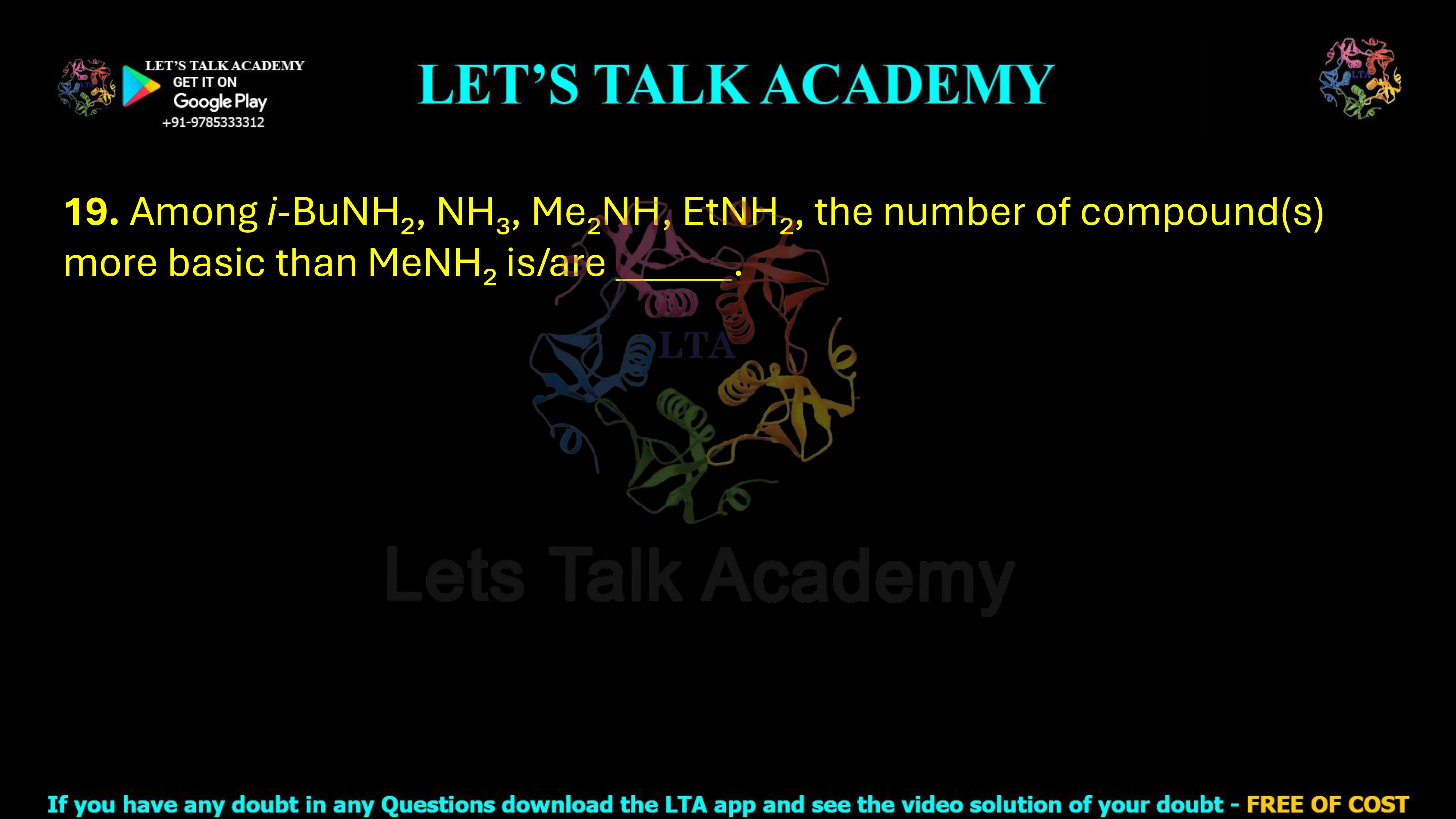
19. Among i-BuNH2, NH3, Me2NH and EtNH2, the number of compound(s) more basic than MeNH2 is/are _____.
Number of Compounds More Basic Than Methylamine – Detailed Basicity Order of Amines
How to Determine Which Compounds Are More Basic Than MeNH₂
To find the number of compounds more basic than methylamine, each given compound must be compared individually with MeNH2. The basicity of an amine depends mainly on the availability of the lone pair of electrons present on the nitrogen atom. A nitrogen atom with a more available lone pair can accept a proton more readily and therefore behaves as a stronger base.
Alkyl groups generally show a positive inductive effect, commonly written as the +I effect. Through this effect, an alkyl group pushes electron density toward the nitrogen atom. The increased electron density makes the nitrogen lone pair more available for protonation and generally increases the basic character of the amine.
The compounds given for comparison are i-BuNH2, NH3, Me2NH and EtNH2. Each of these must be compared with the reference compound MeNH2, or methylamine.
Basicity of Methylamine as the Reference Compound
Why MeNH₂ Is More Basic Than NH₃
Methylamine, MeNH2, contains one methyl group attached to the nitrogen atom. The methyl group has a +I effect and pushes electron density toward nitrogen. This increases the availability of the nitrogen lone pair for accepting a proton.
Ammonia, NH3, has no electron-releasing alkyl group attached to nitrogen. Therefore, the lone pair on nitrogen in methylamine is generally more available for protonation than the lone pair in ammonia.
Thus, MeNH2 serves as the reference compound, and the basicity of each given substance can be compared with it.
Detailed Comparison of Each Compound with MeNH₂
1. Basicity of i-BuNH₂ Compared with MeNH₂
i-BuNH2 represents isobutylamine. It contains an isobutyl group attached to the amino group. The alkyl group exerts an electron-releasing inductive effect and increases the electron density on the nitrogen atom.
Compared with the methyl group in MeNH2, the isobutyl group provides a stronger overall electron-releasing effect. As a result, the lone pair on nitrogen becomes more available for proton acceptance.
Therefore:
i-BuNH2 is more basic than MeNH2.
2. Basicity of NH₃ Compared with MeNH₂
Ammonia contains no alkyl group. Therefore, it does not receive the electron-releasing +I effect that is present in methylamine. In MeNH2, the methyl group pushes electron density toward nitrogen and increases the availability of its lone pair.
Consequently, methylamine accepts a proton more readily than ammonia.
Therefore:
NH3 is less basic than MeNH2.
3. Basicity of Me₂NH Compared with MeNH₂
Me2NH is dimethylamine, a secondary amine containing two methyl groups attached to the nitrogen atom. Both methyl groups exert a +I effect and increase the electron density on nitrogen.
In methylamine, only one methyl group donates electron density toward nitrogen, whereas dimethylamine has two electron-releasing methyl groups. Under the usual aqueous basicity comparison, dimethylamine is more basic than methylamine because the combined electron-releasing effect increases the tendency of nitrogen to accept a proton.
Therefore:
Me2NH is more basic than MeNH2.
4. Basicity of EtNH₂ Compared with MeNH₂
EtNH2 is ethylamine. Both ethylamine and methylamine are primary amines, but the ethyl group has a stronger electron-releasing inductive effect than the methyl group.
The stronger +I effect of the ethyl group increases the electron density on the nitrogen atom and makes its lone pair more available for accepting a proton. Therefore, ethylamine is more basic than methylamine.
Thus:
EtNH2 is more basic than MeNH2.
Counting the Compounds More Basic Than MeNH₂
We can now compare all four compounds with methylamine:
i-BuNH2 > MeNH2 → More basic
NH3 < MeNH2 → Less basic
Me2NH > MeNH2 → More basic
EtNH2 > MeNH2 → More basic
Therefore, the compounds more basic than MeNH2 are i-BuNH2, Me2NH and EtNH2. The total number of such compounds is:
Number of compounds = 3
Role of the Positive Inductive Effect in Amine Basicity
The +I effect is an important factor in explaining the basicity of aliphatic amines. Alkyl groups release electron density through sigma bonds toward the nitrogen atom. As the electron density on nitrogen increases, its lone pair becomes more capable of forming a bond with H+.
This explains why ammonia is less basic than methylamine and why ethylamine and isobutylamine are more basic than methylamine in the comparison given. Dimethylamine also has two electron-releasing methyl groups and is more basic than methylamine under the usual aqueous conditions considered in such questions.
Final Answer
Among i-BuNH2, NH3, Me2NH and EtNH2, three compounds are more basic than MeNH2. These are i-BuNH2, Me2NH and EtNH2, while NH3 is less basic than methylamine.
Therefore, the number of compounds more basic than MeNH2 is 3.
Correct Answer: 3


