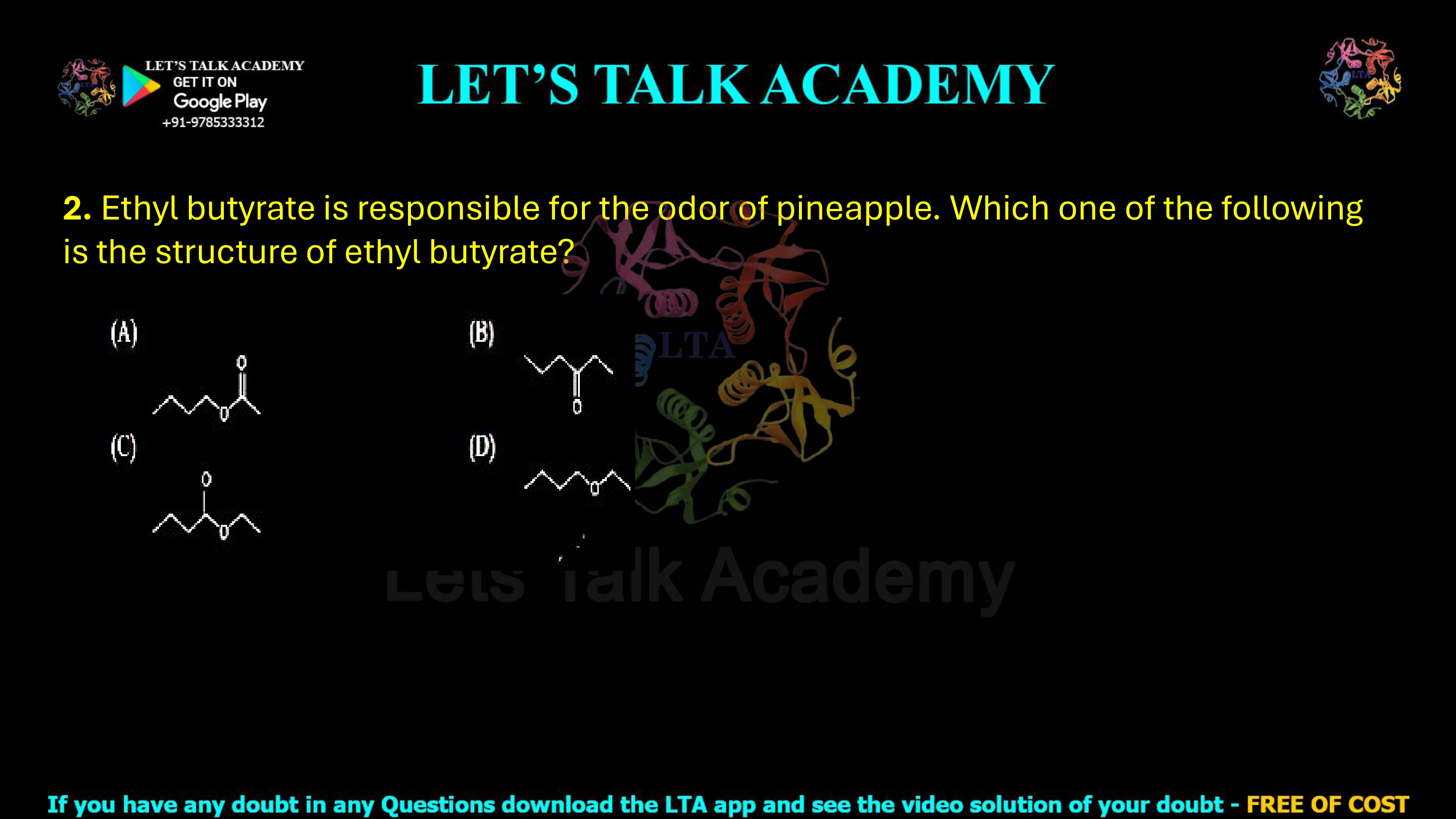
2. Ethyl butyrate is responsible for the odor of pineapple. Which one of the following is the structure of ethyl butyrate?
Ethyl Butyrate Structure: Which Structure Is Responsible for the Odor of Pineapple?
Detailed Explanation of the Ethyl Butyrate Structure
Ethyl butyrate is a sweet-smelling organic compound that belongs to the ester functional group. It is well known for producing a pleasant fruity aroma similar to that of pineapple. To identify the correct structure of ethyl butyrate, we first need to understand its name and then construct its chemical structure step by step.
The compound ethyl butyrate is also known by its systematic IUPAC name, ethyl butanoate. The name can be divided into two important parts: ethyl and butyrate. In the nomenclature of esters, the first part of the name represents the alkyl group attached to the oxygen atom, while the second part represents the carboxylate portion derived from a carboxylic acid.
How Is Ethyl Butyrate Formed?
Ethyl butyrate is formed by an esterification reaction between butyric acid, also called butanoic acid, and ethanol. During esterification, the carboxylic acid and alcohol combine to form an ester and water.
Butanoic acid + Ethanol → Ethyl butyrate + Water
The structural formula of butanoic acid is CH3CH2CH2COOH, while ethanol has the formula CH3CH2OH. After ester formation, the resulting structure becomes:
CH3–CH2–CH2–C(=O)–O–CH2–CH3
This structure contains the characteristic ester linkage –C(=O)–O–. On the carbonyl side, there is a three-carbon chain attached to the carbonyl carbon, making the acid-derived portion a butyrate group. On the oxygen side, there is a two-carbon ethyl group. Therefore, this structure is correctly identified as ethyl butyrate or ethyl butanoate.
Why Is Option (C) the Correct Answer?
Option (C) shows the correct arrangement required for ethyl butyrate. The structure contains a carbonyl group, C=O, directly bonded to an oxygen atom, which confirms the presence of an ester functional group. The carbonyl-containing side corresponds to the four-carbon butyrate portion, while the group attached to the ester oxygen contains two carbon atoms and therefore represents an ethyl group.
The complete structural arrangement in Option (C) is CH3CH2CH2COOCH2CH3. This exactly matches the required structure of ethyl butyrate. For this reason, Option (C) is the correct answer.
Explanation of All Options
Option (A)
Option (A) contains an ester functional group, so it may initially appear similar to ethyl butyrate. However, identifying an ester requires more than simply locating the –COO– linkage. The number of carbon atoms on both sides of the ester group must also match the compound name. The alkyl group attached to the oxygen and the acid-derived carbon chain shown in this option do not give the correct combination required for ethyl butyrate. Therefore, Option (A) is incorrect.
Option (B)
Option (B) does not show the characteristic ester linkage –C(=O)–O– required for ethyl butyrate. The displayed oxygen functionality and carbon skeleton do not correspond to an ester formed from butanoic acid and ethanol. Since ethyl butyrate must contain both a carbonyl group and a directly connected single-bonded oxygen atom, Option (B) can be eliminated.
Option (C)
Option (C) correctly shows the ester functional group and the required carbon arrangement. Its structure can be written as CH3CH2CH2COOCH2CH3. The acid-derived portion contains four carbon atoms in total, corresponding to butanoate, and the oxygen is attached to a two-carbon ethyl group. Therefore, Option (C) represents ethyl butyrate and is the correct answer.
Option (D)
Option (D) shows an oxygen atom within a carbon chain but does not contain a carbonyl group, C=O. Such a structure represents an ether rather than an ester. Because ethyl butyrate is an ester and must contain the –COO– functional group, Option (D) is incorrect.
Understanding the Ester Functional Group in Ethyl Butyrate
The general structural formula of an ester is R–C(=O)–O–R′, where R represents the carbon chain derived from the carboxylic acid and R′ represents the alkyl group derived from the alcohol. In ethyl butyrate, the acid component is butanoic acid and the alcohol component is ethanol.
Therefore, the butanoate part contributes CH3CH2CH2COO–, while the ethyl part contributes –CH2CH3. Combining these two parts gives CH3CH2CH2COOCH2CH3.
Molecular Formula and Important Properties of Ethyl Butyrate
The molecular formula of ethyl butyrate is C6H12O2. It is a volatile organic ester with a characteristic sweet and fruity smell. Its pineapple-like aroma is the reason this compound is commonly discussed in organic chemistry questions dealing with esters, functional groups, natural odors, and ester nomenclature.
Esters are widely associated with pleasant fruity odors. Different esters may produce aromas resembling banana, apple, pear, pineapple, and other fruits. However, the exact smell depends on the molecular structure of the ester, so correctly identifying the carbon chains attached to the ester functional group is essential.
How to Identify Ethyl Butyrate in a Structural Formula
To identify the ethyl butyrate structure, first locate the ester linkage –C(=O)–O–. Next, examine the group directly attached to the single-bonded oxygen atom. For an ethyl ester, this group must be –CH2CH3. Finally, examine the carbonyl side and count four carbon atoms in the complete acid-derived portion, including the carbonyl carbon. If all these structural features are present, the compound is ethyl butyrate.
Final Answer
The correct answer is Option (C). Ethyl butyrate, also called ethyl butanoate, has the structural formula CH3CH2CH2COOCH2CH3. It contains a four-carbon butyrate portion and a two-carbon ethyl group connected through the ester functional group –C(=O)–O–. This ester is responsible for the characteristic fruity odor associated with pineapple.


