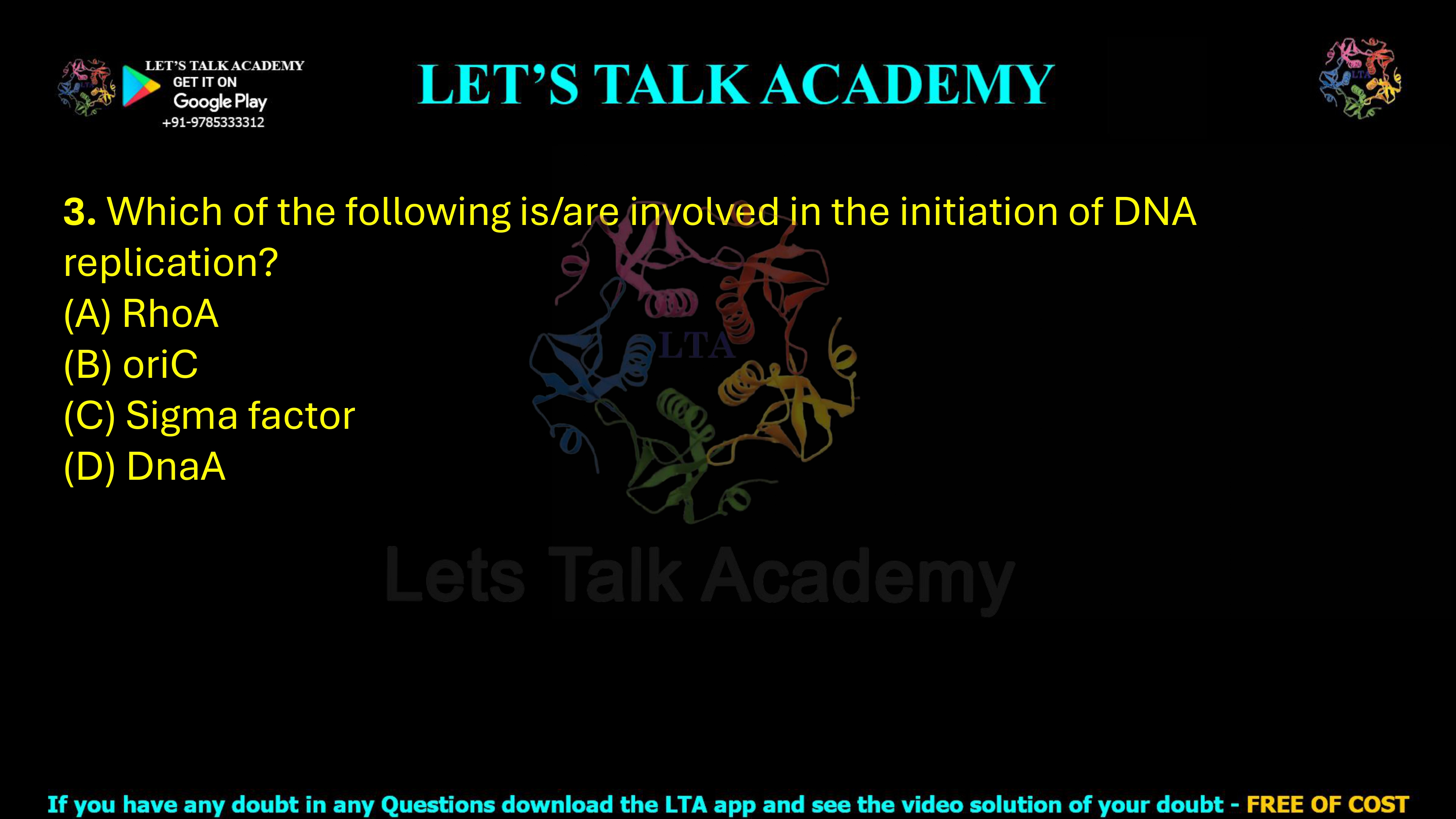
3. Which of the following is/are involved in the initiation of DNA replication?
(A) RhoA
(B) oriC
(C) Sigma factor
(D) DnaA
Initiation of DNA Replication: Role of oriC and DnaA
Introduction
DNA replication is one of the most tightly regulated biological processes because it ensures that every daughter cell receives an accurate copy of the genetic material. Before a cell divides, its DNA must be duplicated precisely once during each cell cycle. The initiation phase is the most highly regulated step of DNA replication because it determines where replication begins and prevents multiple rounds of replication from occurring within the same cell cycle.
In bacteria such as Escherichia coli, DNA replication starts at a specific chromosomal region called the origin of replication (oriC). Specialized initiator proteins recognize this DNA sequence, unwind the DNA double helix, and recruit additional replication proteins to form the replication machinery. Among these proteins, DnaA acts as the master initiator protein that binds to oriC and triggers DNA unwinding.
Correct Answer
Correct Answer: (B) oriC and (D) DnaA
Detailed Explanation
The initiation of bacterial DNA replication requires two essential components: the origin of replication (oriC) and the DnaA initiator protein. The oriC sequence serves as the specific chromosomal site where replication begins, while DnaA recognizes and binds to conserved DnaA boxes within oriC. ATP-bound DnaA then induces local DNA unwinding, allowing helicase loading and assembly of the replication fork.
The other two options, RhoA and Sigma factor, participate in completely different cellular processes and are not involved in DNA replication initiation.
Explanation of Option (A): RhoA
This option is incorrect.
In bacteria, the Rho protein is a transcription termination factor. It binds to nascent RNA molecules and moves along the RNA in an ATP-dependent manner until it reaches RNA polymerase, causing transcription to terminate.
It has no role in initiating DNA replication.
It is important not to confuse bacterial Rho with the eukaryotic RhoA GTPase, which regulates cytoskeletal organization and cell signaling.
Explanation of Option (B): oriC
This option is correct.
oriC is the chromosomal origin of replication in bacteria. It contains multiple DnaA-binding sequences known as DnaA boxes along with an AT-rich region that is easier to unwind.
The replication process begins when DnaA binds to oriC, causing localized melting of the DNA duplex. This allows helicase loading and the subsequent recruitment of the remaining replication proteins.
Without oriC, replication cannot be initiated.
Explanation of Option (C): Sigma Factor
This option is incorrect.
The Sigma (σ) factor is a bacterial transcription initiation factor. It associates with RNA polymerase and enables recognition of promoter sequences such as the -10 and -35 regions before transcription begins.
Its function is limited to transcription initiation and it does not participate in DNA replication.
Explanation of Option (D): DnaA
This option is correct.
DnaA is the primary initiator protein of bacterial DNA replication. ATP-bound DnaA binds specifically to DnaA boxes within oriC, oligomerizes, and induces local unwinding of the adjacent AT-rich DNA region.
Following DNA opening, DnaA recruits the DnaB helicase with the assistance of DnaC, allowing the replication fork to assemble and DNA synthesis to begin.
Because DnaA initiates this entire sequence of events, it is indispensable for DNA replication initiation.
Summary of Each Option
| Option | Correct/Incorrect | Reason |
|---|---|---|
| (A) RhoA | Incorrect | Functions in transcription termination, not DNA replication. |
| (B) oriC | Correct | Chromosomal origin where DNA replication begins. |
| (C) Sigma factor | Incorrect | Initiates transcription, not DNA replication. |
| (D) DnaA | Correct | Initiator protein that binds oriC and starts replication. |
Major Components of Bacterial DNA Replication Initiation
| Component | Function |
|---|---|
| oriC | Origin of chromosomal replication. |
| DnaA | Binds oriC and initiates DNA unwinding. |
| DnaB | DNA helicase that unwinds the DNA duplex. |
| DnaC | Loads DnaB helicase onto DNA. |
| SSB Proteins | Stabilize single-stranded DNA. |
| Primase (DnaG) | Synthesizes RNA primers. |
DNA Replication vs Transcription
| Feature | DNA Replication | Transcription |
|---|---|---|
| Initiation Site | oriC | Promoter |
| Initiator Protein | DnaA | Sigma factor |
| Main Enzyme | DNA Polymerase | RNA Polymerase |
| Termination Protein | Tus (in E. coli termination region) | Rho protein (Rho-dependent termination) |
Sequence of DNA Replication Initiation
The initiation of DNA replication follows a highly ordered sequence of molecular events. First, ATP-bound DnaA recognizes and binds to multiple DnaA boxes present within the oriC region. This interaction induces local melting of the adjacent AT-rich DNA sequence because adenine-thymine base pairs are held together by only two hydrogen bonds and are easier to separate than GC-rich regions. Once the DNA strands are opened, DnaC loads the DnaB helicase onto each DNA strand. DnaB then unwinds the DNA further, while single-stranded DNA-binding proteins stabilize the separated strands. Finally, primase synthesizes RNA primers, allowing DNA polymerase III to begin DNA synthesis.
Biological Significance
The initiation stage is the most tightly controlled step of DNA replication because it ensures that every chromosome is duplicated exactly once during each cell cycle. Accurate regulation of oriC activation and DnaA activity prevents incomplete replication, over-replication, and genomic instability. These mechanisms are essential for chromosome maintenance, faithful cell division, bacterial growth, and genome integrity.
Final Answer
The components directly involved in the initiation of bacterial DNA replication are:
(B) oriC
(D) DnaA
Correct Answer: (B) and (D)


