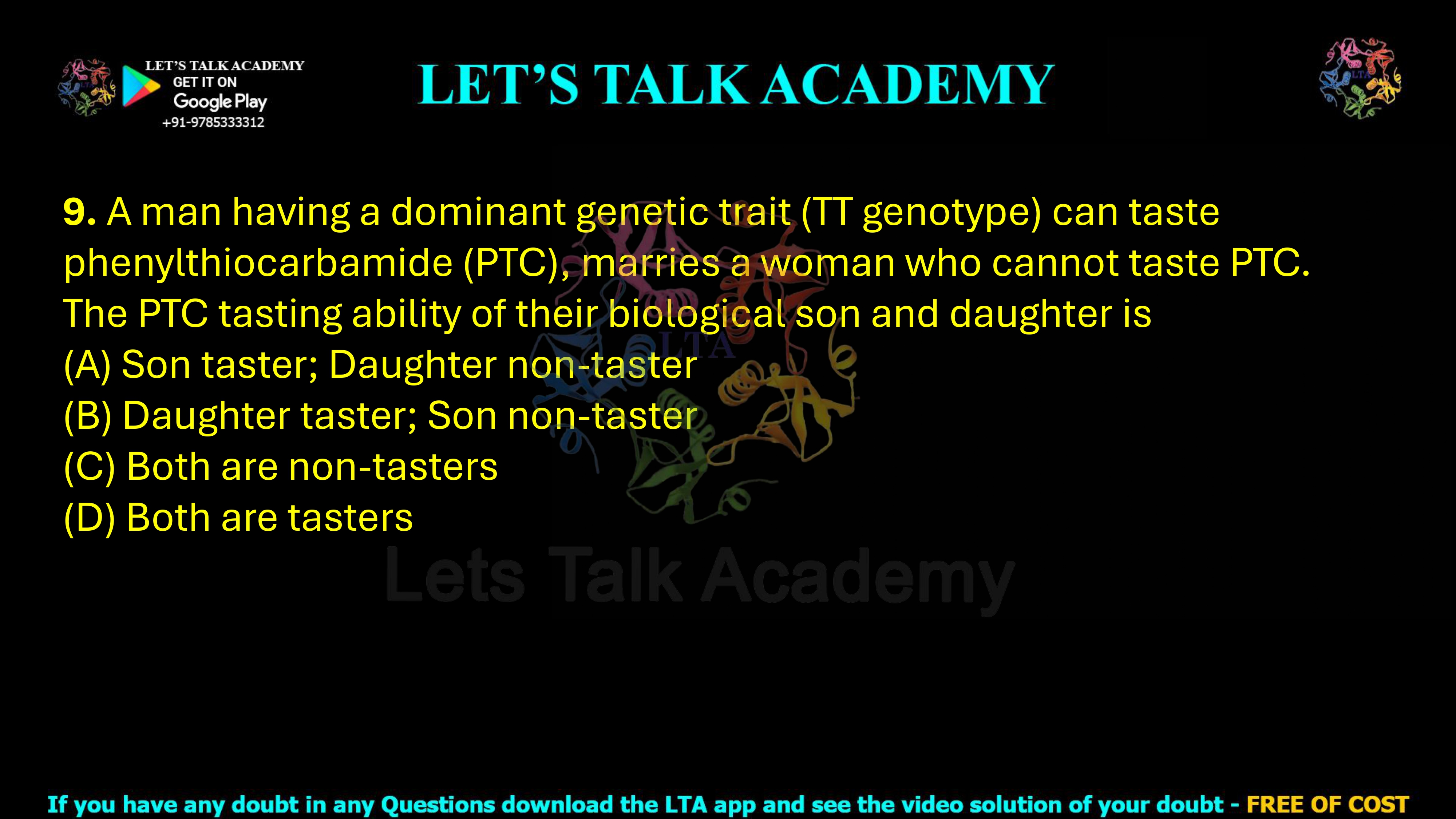
9. A man having a dominant genetic trait (TT genotype) can taste phenylthiocarbamide (PTC), marries a woman who cannot taste PTC. The PTC tasting ability of their biological son and daughter is
(A) Son taster; Daughter non-taster
(B) Daughter taster; Son non-taster
(C) Both are non-tasters
(D) Both are tasters
Phenylthiocarbamide (PTC) Tasting Inheritance Explained: Why All Children are Tasters
Introduction
Phenylthiocarbamide (PTC) tasting is one of the most widely studied examples of Mendelian inheritance in humans. The ability to taste PTC is determined primarily by variations in the TAS2R38 gene, which encodes a bitter taste receptor found on the tongue. Individuals carrying the dominant allele can perceive the bitter taste of PTC, whereas individuals who inherit two recessive alleles are unable to taste it.
This trait provides an excellent example of complete dominance. The dominant allele T confers the ability to taste PTC, while the recessive allele t results in the non-taster phenotype only when present in the homozygous condition (tt). Because only one dominant allele is sufficient for expression, both homozygous dominant (TT) and heterozygous (Tt) individuals are tasters.
Correct Answer
Correct Option: (D) Both are tasters
Detailed Explanation
The father has genotype TT, meaning he possesses two dominant alleles for PTC tasting. Therefore, every sperm produced by the father carries only the dominant allele T.
The mother cannot taste PTC, so her genotype must be tt. Consequently, every egg produced by the mother carries only the recessive allele t.
During fertilization, every offspring receives one allele from each parent. Since the father always contributes T and the mother always contributes t, every child will have the genotype Tt.
Because T is dominant over t, all offspring will express the PTC tasting phenotype regardless of whether they are male or female. The gene responsible for PTC tasting is located on an autosome, so inheritance is identical in sons and daughters.
Punnett Square Analysis
| T | T | |
|---|---|---|
| t | Tt | Tt |
| t | Tt | Tt |
The Punnett square shows that 100% of the offspring have genotype Tt, making every child a PTC taster.
Explanation of Each Option
Option (A): Son Taster; Daughter Non-Taster
This option is incorrect. The PTC tasting gene is autosomal, not sex-linked. Sons and daughters inherit the trait with equal probability.
Option (B): Daughter Taster; Son Non-Taster
This option is incorrect. Since the trait is not linked to the sex chromosomes, there is no difference between inheritance in males and females.
Option (C): Both are Non-Tasters
This option is incorrect. Every offspring receives one dominant T allele from the father, making all children tasters.
Option (D): Both are Tasters
This option is correct. Every offspring has genotype Tt, which expresses the dominant tasting phenotype.
Why Option (D) is Correct
The genetic cross is:
Father: TT × Mother: tt
All offspring inherit:
- T from the father
- t from the mother
Thus, every child has genotype Tt and can taste PTC.
Comparison of All Options
| Option | Prediction | Status |
|---|---|---|
| A | Son taster; Daughter non-taster | Incorrect |
| B | Daughter taster; Son non-taster | Incorrect |
| C | Both non-tasters | Incorrect |
| D | Both tasters | Correct |
Genotype and Phenotype Relationship
| Genotype | Phenotype |
|---|---|
| TT | PTC Taster |
| Tt | PTC Taster |
| tt | PTC Non-Taster |
Expected Offspring from TT × tt Cross
| Genotype | Percentage | Phenotype |
|---|---|---|
| Tt | 100% | PTC Taster |
Biological Significance
PTC tasting is controlled primarily by the TAS2R38 gene, which encodes a bitter taste receptor. Variations in this gene influence an individual’s ability to detect bitter compounds found in certain vegetables and naturally occurring plant toxins. This trait has become an important model in human genetics for demonstrating dominant inheritance, genetic variation, and genotype-phenotype relationships.
Final Answer
Father’s genotype: TT
Mother’s genotype: tt
All offspring genotype: Tt
Since T is dominant, both the son and the daughter will be able to taste PTC.
Correct Option: (D) Both are tasters


