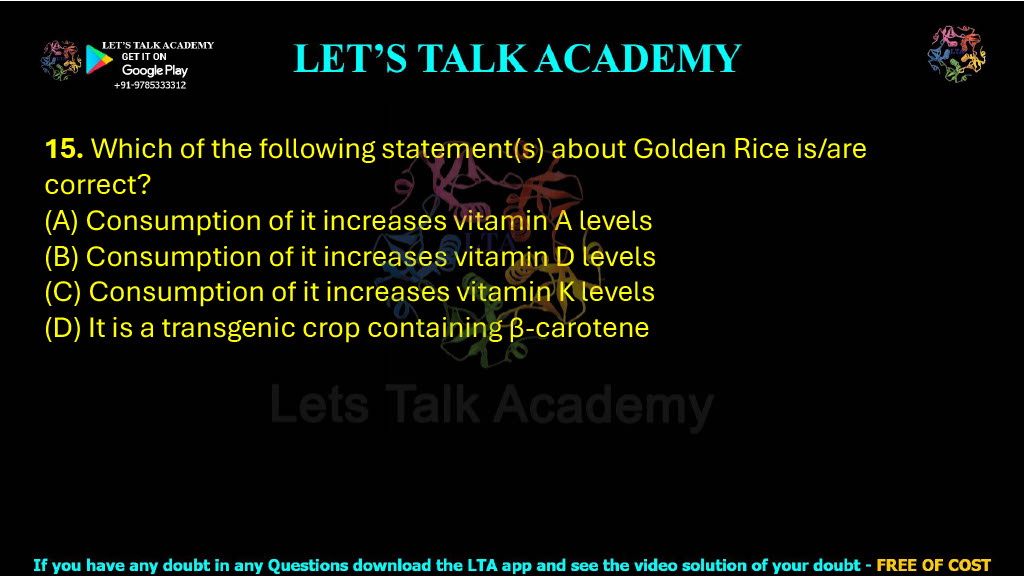
15. Which of the following statement(s) about Golden Rice is/are correct?
(A) Consumption of it increases vitamin A levels
(B) Consumption of it increases vitamin D levels
(C) Consumption of it increases vitamin K levels
(D) It is a transgenic crop containing β-carotene
Golden Rice Explained: Vitamin A Biofortification and β-Carotene
Introduction
Vitamin A deficiency is one of the most widespread nutritional disorders in developing countries and is responsible for millions of cases of childhood blindness, weakened immunity, and increased susceptibility to infections every year. Since rice is the staple food for a large proportion of the world’s population, scientists developed a genetically engineered variety known as Golden Rice to improve its nutritional value. Unlike conventional rice, Golden Rice produces β-carotene (beta-carotene) in the edible endosperm, giving the grains their characteristic golden-yellow color.
Golden Rice is considered one of the most successful examples of biofortification through genetic engineering. It was developed by introducing genes involved in the carotenoid biosynthetic pathway into rice endosperm so that the grain can synthesize β-carotene, the precursor of vitamin A. After consumption, β-carotene is converted into vitamin A in the human body, thereby helping reduce vitamin A deficiency.
Correct Answer
Correct Options: (A) and (D)
Detailed Explanation
Golden Rice is a genetically modified (transgenic) rice variety developed specifically to combat vitamin A deficiency. Normal rice endosperm does not synthesize β-carotene because the carotenoid biosynthetic pathway is inactive in the edible grain. Through recombinant DNA technology, scientists introduced genes encoding enzymes of the carotenoid biosynthetic pathway into rice endosperm, enabling the grains to accumulate β-carotene.
β-carotene is a provitamin A, meaning that it is converted into vitamin A (retinol) after consumption. Therefore, regular consumption of Golden Rice can improve vitamin A status in populations where rice is the primary staple food. Vitamin A plays essential roles in vision, immune function, epithelial tissue maintenance, embryonic development, and normal growth.
Golden Rice does not increase vitamin D or vitamin K levels because it specifically accumulates β-carotene and not these vitamins. Therefore, only statements (A) and (D) are correct.
Explanation of Each Option
Option (A): Consumption of it Increases Vitamin A Levels
This statement is correct. Golden Rice contains β-carotene, which serves as the precursor of vitamin A. After digestion, β-carotene is converted into vitamin A in the intestinal cells and liver, helping prevent vitamin A deficiency.
Option (B): Consumption of it Increases Vitamin D Levels
This statement is incorrect. Golden Rice has no relationship with vitamin D production or metabolism. Vitamin D is synthesized primarily in human skin after exposure to sunlight or obtained from dietary sources such as fish, eggs, and fortified foods.
Option (C): Consumption of it Increases Vitamin K Levels
This statement is incorrect. Golden Rice does not contain increased levels of vitamin K. Vitamin K is mainly obtained from green leafy vegetables and intestinal microbial synthesis.
Option (D): It is a Transgenic Crop Containing β-Carotene
This statement is correct. Golden Rice is a genetically engineered crop that synthesizes β-carotene in the rice endosperm, giving the grains their golden appearance.
Why Options (A) and (D) are Correct
Golden Rice was specifically developed to address vitamin A deficiency by producing β-carotene in the edible grain. Since β-carotene is converted into vitamin A after consumption, Golden Rice increases vitamin A availability and serves as a successful example of nutritional biofortification through genetic engineering.
Why the Other Options are Incorrect
Why Option (B) is Incorrect
Golden Rice does not synthesize vitamin D or influence vitamin D metabolism.
Why Option (C) is Incorrect
The transgenic modification in Golden Rice targets β-carotene production and has no effect on vitamin K content.
Comparison of All Options
| Option | Statement | Correct or Incorrect |
|---|---|---|
| A | Consumption increases vitamin A levels | Correct |
| B | Consumption increases vitamin D levels | Incorrect |
| C | Consumption increases vitamin K levels | Incorrect |
| D | It is a transgenic crop containing β-carotene | Correct |
Important Features of Golden Rice
| Feature | Description |
|---|---|
| Crop | Rice (Oryza sativa) |
| Technology | Genetic engineering |
| Major Nutrient Produced | β-Carotene (Provitamin A) |
| Purpose | Reduce vitamin A deficiency |
| Grain Color | Golden-yellow due to β-carotene |
Functions of Vitamin A
| Function | Importance |
|---|---|
| Vision | Essential for formation of rhodopsin and normal vision |
| Immune Function | Strengthens immune defenses |
| Epithelial Tissue Maintenance | Maintains healthy skin and mucous membranes |
| Growth and Development | Supports normal growth in children |
| Embryonic Development | Important during fetal development |
Golden Rice Compared with Conventional Rice
| Feature | Golden Rice | Conventional Rice |
|---|---|---|
| β-Carotene | Present | Absent in endosperm |
| Vitamin A Source | Yes (through β-carotene) | No |
| Genetic Modification | Yes | No |
| Purpose | Biofortification | Staple food production |
Examples of Important Genetically Modified Crops
| GM Crop | Major Trait |
|---|---|
| Golden Rice | β-Carotene enrichment |
| Bt Cotton | Insect resistance |
| Bt Brinjal | Resistance to fruit and shoot borer |
| Herbicide-Tolerant Soybean | Herbicide resistance |
Biological Significance
Golden Rice represents one of the most important achievements in plant biotechnology and nutritional biofortification. By enriching rice grains with β-carotene, it provides an affordable dietary source of provitamin A for populations that rely heavily on rice as their staple food. The technology has the potential to reduce childhood blindness, improve immune function, lower mortality associated with vitamin A deficiency, and enhance overall public health in regions where nutritional deficiencies are common.
Final Answer
Correct Answers: (A) and (D)
Golden Rice is a transgenic rice variety engineered to produce β-carotene in its endosperm. Since β-carotene is converted into vitamin A in the human body, regular consumption of Golden Rice helps improve vitamin A levels and reduces the risk of vitamin A deficiency.


