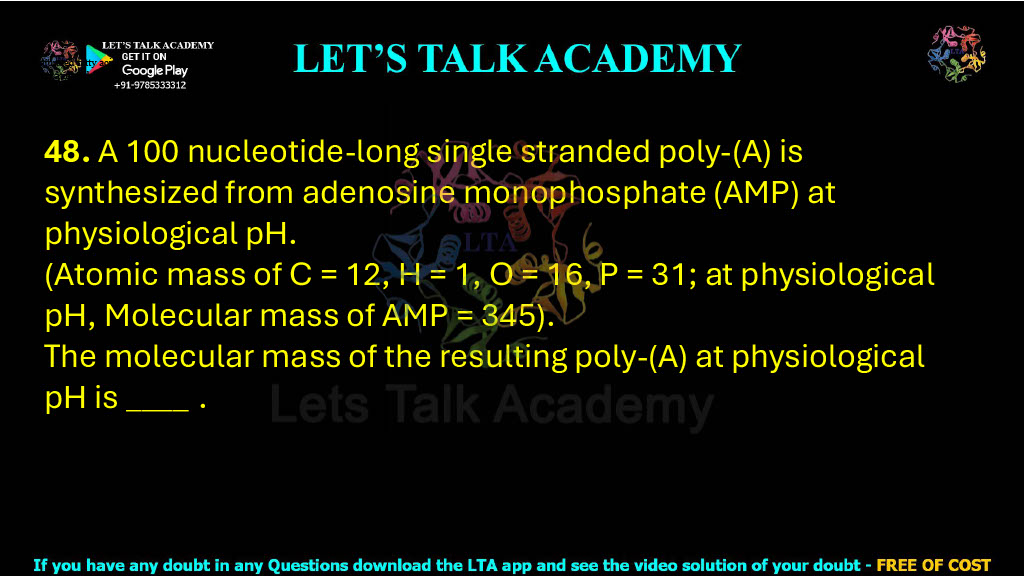
48. A 100 nucleotide-long single stranded poly-(A) is synthesized from adenosine monophosphate (AMP) at physiological pH.
(Atomic mass of C = 12, H = 1, O = 16, P = 31; at physiological pH, Molecular mass of AMP = 345).
The molecular mass of the resulting poly-(A) at physiological pH is ____ .
How to Calculate the Molecular Mass of a 100-Nucleotide Poly(A) RNA?
Correct Answer
34,218 Da (g mol⁻¹)
Introduction
The synthesis of nucleic acids is one of the most fundamental biochemical processes occurring in every living cell. During RNA synthesis, individual ribonucleotides are linked together through phosphodiester bonds, producing a long polynucleotide chain. Although each nucleotide contributes its own molecular mass to the growing RNA molecule, the total molecular mass of the polymer is not simply the sum of the masses of all nucleotides. This is because every phosphodiester bond formation is a condensation reaction, during which one molecule of water (H₂O) is eliminated.
Consequently, calculating the molecular mass of an RNA polymer requires accounting for both the molecular masses of the nucleotide monomers and the number of water molecules lost during polymerization.
Understanding the Concept Behind the Question
A 100-nucleotide poly(A) molecule is synthesized using 100 molecules of AMP.
Initially,
Total mass = 100 × Molecular mass of AMP
However, during polymerization, adjacent nucleotides are joined by phosphodiester bonds.
For a polymer containing n nucleotides, the number of phosphodiester bonds formed is:
Number of phosphodiester bonds = n − 1
Therefore,
For 100 nucleotides,
Phosphodiester bonds = 100 − 1 = 99
Each phosphodiester bond formation removes one molecule of water (H₂O).
Since:
Molecular mass of H₂O = 18 Da
the total mass lost must be subtracted from the combined mass of the nucleotides.
Step 1. Calculate the Total Mass of AMP Molecules
Number of AMP molecules:
100
Mass of one AMP molecule:
345 Da
Therefore,
Total mass = 100 × 345
= 34,500 Da
Step 2. Calculate the Number of Water Molecules Lost
Number of phosphodiester bonds:
100 − 1 = 99
Each bond releases:
1 molecule of H₂O
Therefore,
Water molecules lost = 99
Mass of one water molecule:
18 Da
Hence,
Total mass lost = 99 × 18
= 1,782 Da
Step 3. Calculate the Molecular Mass of Poly(A)
Using the formula:
Molecular Mass = Total nucleotide mass − Water lost
Substituting the values:
= 34,500 − 1,782
= 32,718 Da
Final Calculation
Molecular Mass of Poly(A) = 32,718 Da
Final Answer
32,718 g mol⁻¹ (Da)
Why Is Water Lost During RNA Synthesis?
RNA polymerization is a condensation reaction. During the formation of each phosphodiester bond, the hydroxyl group from one nucleotide reacts with the phosphate group of the next nucleotide. This reaction releases one molecule of water, allowing the nucleotides to become covalently linked into a continuous sugar-phosphate backbone.
Because every phosphodiester bond eliminates one water molecule, the molecular mass of the final RNA polymer is always less than the sum of the individual nucleotide masses.
Phosphodiester Bond Formation
For a polymer containing n nucleotides:
Number of phosphodiester bonds = n − 1
Therefore,
| Number of Nucleotides | Phosphodiester Bonds |
|---|---|
| 10 | 9 |
| 25 | 24 |
| 50 | 49 |
| 100 | 99 |
This relationship is extremely important for numerical problems involving DNA and RNA molecular mass calculations.
Formula Used
Total Molecular Mass
Total Mass = (Number of nucleotides × Molecular mass of one nucleotide) − [(Number of nucleotides − 1) × 18]
where,
18 Da = Molecular mass of one water molecule
Biological Importance
The formation of phosphodiester bonds creates the stable sugar-phosphate backbone that gives RNA its structural integrity. Every RNA molecule, including messenger RNA (mRNA), transfer RNA (tRNA), ribosomal RNA (rRNA), and many regulatory RNAs, is synthesized through this same condensation mechanism. Understanding how molecular mass changes during polymerization is important in molecular biology, nucleic acid chemistry, sequencing technologies, and biotechnology applications.
High-Yield Exam Points
- RNA synthesis involves condensation reactions.
- Every phosphodiester bond releases one molecule of water.
- A polymer of n nucleotides contains n − 1 phosphodiester bonds.
- Water molecular mass = 18 Da.
- Total polymer mass is less than the sum of nucleotide masses because of water loss.
- The same principle applies to DNA polymerization.
Frequently Asked Questions
Why is one water molecule lost during phosphodiester bond formation?
Formation of the phosphodiester linkage is a condensation reaction in which the 3′-hydroxyl group of one nucleotide reacts with the 5′-phosphate group of the next nucleotide, releasing one molecule of water.
Why are there only 99 phosphodiester bonds in a 100-nucleotide RNA?
A polymer containing n nucleotides always contains n − 1 linkages, because each bond joins two adjacent nucleotides.
Does this calculation apply to DNA as well?
Yes. DNA polymerization follows the same principle, with one molecule of water effectively lost for each phosphodiester bond formed when calculating polymer mass from nucleotide monomers.
Key Takeaways
The molecular mass of a nucleic acid polymer is calculated by adding the masses of all nucleotide monomers and subtracting the mass of the water molecules released during phosphodiester bond formation. A 100-nucleotide poly(A) chain contains 99 phosphodiester bonds, resulting in the loss of 99 water molecules. Starting from 100 AMP molecules (34,500 Da) and subtracting the mass of 99 water molecules (1,782 Da) gives the final molecular mass of the RNA polymer:
32,718 Da (g mol⁻¹)
Final Answer
Molecular Mass = 32,718 Da (g mol⁻¹)
Explanation
A 100-nucleotide poly(A) molecule is synthesized from 100 AMP molecules, each having a molecular mass of 345 Da. Therefore, the total mass of the nucleotide monomers is 100 × 345 = 34,500 Da. During polymerization, 99 phosphodiester bonds are formed, and each bond releases one molecule of water (18 Da). Thus, the total mass lost is 99 × 18 = 1,782 Da. Subtracting this from the total nucleotide mass gives the molecular mass of the RNA polymer:
34,500 − 1,782 = 32,718 Da (g mol⁻¹).


