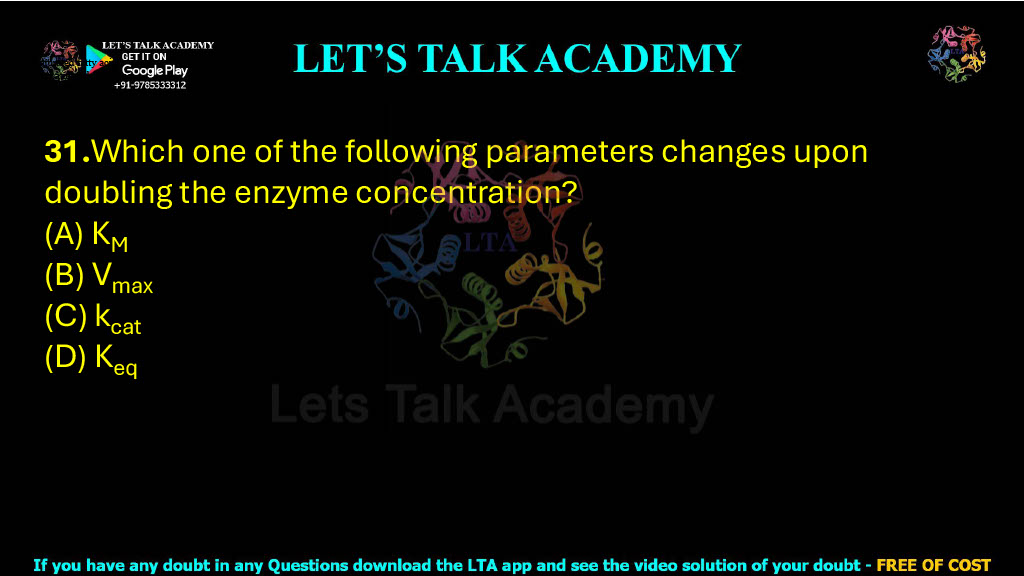
31.Which one of the following parameters changes upon doubling the enzyme concentration?
(A) KM
(B) Vmax
(C) kcat
(D) Keq
Which Enzyme Kinetic Parameter Changes When Enzyme Concentration Is Doubled?
Correct Answer
(B) Vmax
Introduction
Enzymes are biological catalysts that accelerate biochemical reactions without being consumed during the process. The rate at which an enzyme catalyzes a reaction depends on several factors, including substrate concentration, enzyme concentration, temperature, pH, and the intrinsic catalytic properties of the enzyme. Among these, enzyme concentration has a particularly straightforward effect on reaction velocity because increasing the number of enzyme molecules increases the number of available active sites capable of converting substrate into product.
One of the most important concepts in enzyme kinetics is the Michaelis-Menten model, which describes how reaction velocity changes with substrate concentration. This model introduces several key kinetic parameters, including Vmax, KM, and kcat, each representing a different property of the enzyme.
Understanding the Concept Behind the Question
The Michaelis-Menten equation is:
V = (Vmax × [S]) / (KM + [S])
where:
- V = Initial reaction velocity
- Vmax = Maximum reaction velocity
- [S] = Substrate concentration
- KM = Michaelis constant
Among these parameters, Vmax is directly proportional to the total enzyme concentration.
Mathematically,
Vmax = kcat × [E]total
where:
- kcat = Turnover number
- [E]total = Total enzyme concentration
If the enzyme concentration is doubled,
Vmax also doubles.
However:
- KM remains unchanged because it reflects substrate affinity.
- kcat remains unchanged because it is an intrinsic property of each enzyme molecule.
- Keq remains unchanged because equilibrium constants depend only on thermodynamics, not catalyst concentration.
Therefore, the only parameter that changes is Vmax.
Hence, Option (B) is correct.
Why Option (A) Is Incorrect
KM
The Michaelis constant (KM) is defined as the substrate concentration at which the reaction velocity equals half of Vmax.
It reflects the apparent affinity between an enzyme and its substrate.
- Low KM → High substrate affinity
- High KM → Low substrate affinity
Since doubling enzyme concentration does not alter the chemical interaction between the enzyme and substrate, the value of KM remains exactly the same.
Even though the maximum velocity increases, the substrate concentration required to reach half of that maximum remains unchanged.
Therefore,
Option (A) is incorrect.
Why Option (B) Is Correct
Vmax
The maximum reaction velocity (Vmax) is achieved when every enzyme molecule is saturated with substrate.
Because each enzyme molecule possesses an active site capable of catalysis, increasing enzyme concentration increases the total number of active sites available.
Mathematically,
Vmax = kcat × [E]total
If enzyme concentration doubles,
New Vmax = kcat × (2[E])
Therefore,
New Vmax = 2 × Original Vmax
This direct proportionality makes Vmax the only parameter among the options that changes when enzyme concentration changes.
Therefore,
Option (B) is correct.
Why Option (C) Is Incorrect
kcat
The turnover number (kcat) represents the maximum number of substrate molecules converted into product by one enzyme molecule per second when the enzyme is fully saturated.
Mathematically,
kcat = Vmax / [E]total
Suppose enzyme concentration doubles:
- Vmax doubles.
- Enzyme concentration also doubles.
Since both numerator and denominator increase proportionally,
kcat remains constant.
Thus, doubling enzyme concentration does not alter the catalytic efficiency of an individual enzyme molecule.
Therefore,
Option (C) is incorrect.
Why Option (D) Is Incorrect
Keq
The equilibrium constant (Keq) describes the ratio of products to reactants when a chemical reaction reaches equilibrium.
Catalysts, including enzymes, accelerate the rate at which equilibrium is reached but do not change the position of equilibrium.
Consequently,
- Increasing enzyme concentration speeds up both forward and reverse reactions.
- The equilibrium ratio remains exactly the same.
Therefore,
Keq does not change when enzyme concentration changes.
Hence,
Option (D) is incorrect.
Relationship Between Enzyme Concentration and Vmax
The relationship is given by:
Vmax = kcat × [E]total
This equation clearly shows:
- Double enzyme concentration → Double Vmax
- Triple enzyme concentration → Triple Vmax
- Half enzyme concentration → Half Vmax
Thus, Vmax is directly proportional to enzyme concentration.
Graphical Interpretation
Imagine plotting reaction velocity against substrate concentration.
When enzyme concentration doubles:
- The entire Michaelis-Menten curve shifts upward.
- The maximum velocity increases.
- The substrate concentration corresponding to KM remains exactly the same.
Therefore:
- Vmax changes
- KM does not change
This is one of the most important graphical interpretations in enzyme kinetics.
Comparison of the Given Parameters
| Parameter | Changes When Enzyme Concentration Doubles? | Reason |
|---|---|---|
| KM | No | Depends on enzyme-substrate affinity |
| Vmax | Yes | Directly proportional to enzyme concentration |
| kcat | No | Property of a single enzyme molecule |
| Keq | No | Thermodynamic constant |
Biological Importance
Cells regulate enzyme concentration to control metabolic flux. During periods of increased metabolic demand, organisms synthesize additional enzyme molecules, thereby increasing Vmax and allowing reactions to proceed more rapidly. Conversely, decreasing enzyme concentration lowers the maximum reaction rate.
However, the intrinsic catalytic ability of each enzyme molecule (kcat) and its affinity for substrate (KM) remain unchanged unless the enzyme itself is chemically modified or mutated. This distinction enables cells to regulate metabolism efficiently by altering enzyme abundance without changing enzyme structure.
Common Mistakes in Competitive Examinations
One of the most common mistakes is selecting KM because students assume that increasing enzyme concentration increases substrate affinity. In reality, affinity depends on the enzyme’s active site and is independent of the number of enzyme molecules present.
Another frequent mistake is choosing kcat. Although Vmax increases with enzyme concentration, kcat represents the catalytic rate of a single enzyme molecule, which remains unchanged.
Students should also remember that enzymes never alter equilibrium constants. They accelerate the attainment of equilibrium but do not shift the equilibrium position.
High-Yield Exam Points
- Vmax = kcat × [E]total
- Vmax is directly proportional to enzyme concentration.
- KM is independent of enzyme concentration.
- kcat is an intrinsic property of the enzyme.
- Keq is unaffected by catalysts.
- Doubling enzyme concentration doubles Vmax.
Frequently Asked Questions
Why does Vmax increase when enzyme concentration increases?
Because increasing enzyme concentration increases the total number of active sites available for catalysis, allowing more substrate molecules to be converted into product per unit time.
Why doesn’t KM change?
KM reflects the affinity between one enzyme molecule and its substrate. Since the active site remains unchanged, substrate affinity remains constant regardless of enzyme concentration.
Does enzyme concentration affect equilibrium?
No. Enzymes accelerate both forward and reverse reactions equally, allowing equilibrium to be reached faster without changing the equilibrium constant.
Key Takeaways
Doubling enzyme concentration increases the number of available catalytic sites, thereby increasing the maximum reaction velocity (Vmax) in direct proportion to enzyme concentration. In contrast, KM remains unchanged because substrate affinity is an intrinsic property of the enzyme, kcat remains constant because it describes the catalytic efficiency of an individual enzyme molecule, and Keq remains unchanged because enzymes do not alter thermodynamic equilibrium. Understanding these distinctions is fundamental for interpreting enzyme kinetics and solving competitive examination questions accurately.
Final Answer
Correct Option: (B) Vmax
Explanation
The maximum reaction velocity (Vmax) is directly proportional to the total enzyme concentration according to the equation:
Vmax = kcat × [E]total
Therefore, when the enzyme concentration is doubled, the total number of active sites also doubles, causing Vmax to double. In contrast, KM remains unchanged because it reflects the enzyme’s affinity for its substrate, kcat remains constant because it is the turnover number of a single enzyme molecule, and Keq remains unaffected because enzymes do not alter the equilibrium constant of a reaction. Hence, Vmax is the only parameter that changes when enzyme concentration is doubled, making Option (B) the correct answer.


