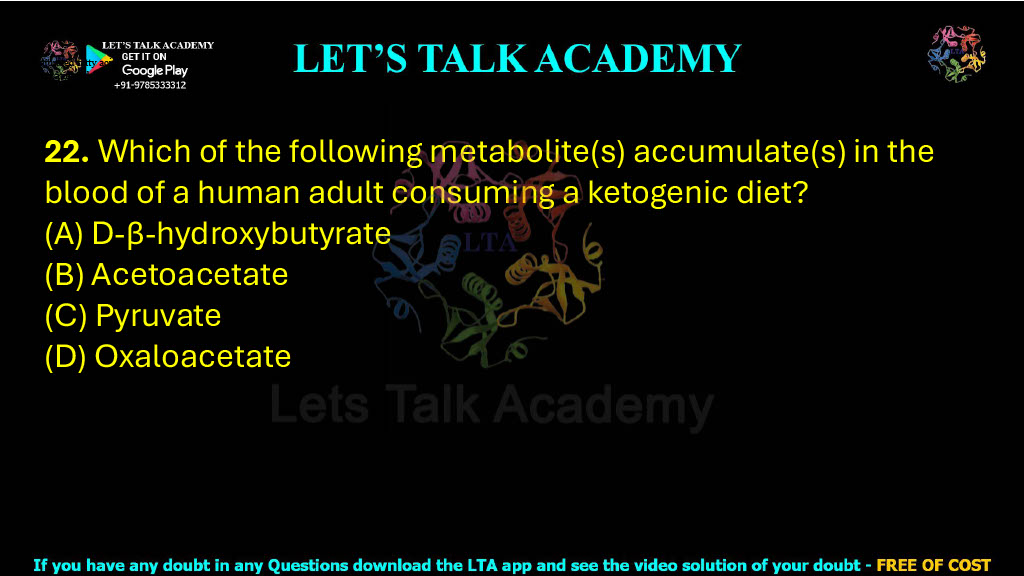
22. Which of the following metabolite(s) accumulate(s) in the blood of a human adult consuming a ketogenic diet?
(A) D-β-hydroxybutyrate
(B) Acetoacetate
(C) Pyruvate
(D) Oxaloacetate
Which Metabolites Accumulate in the Blood During a Ketogenic Diet? | Complete Ketone Body
Correct Answer
(A) D-β-hydroxybutyrate
(B) Acetoacetate
Introduction
The ketogenic diet is a high-fat, moderate-protein, and very low-carbohydrate dietary regimen that shifts the body’s primary source of energy from glucose to fatty acids and ketone bodies. Under normal dietary conditions, glucose serves as the major fuel for most tissues. However, when carbohydrate intake becomes extremely limited, the liver begins converting fatty acids into ketone bodies through a metabolic process known as ketogenesis. These ketone bodies are then released into the bloodstream and serve as alternative energy sources for the brain, heart, skeletal muscles, and other tissues.
One of the most important biochemical consequences of a ketogenic diet is the accumulation of ketone bodies in the blood, a physiological condition known as nutritional ketosis. The principal ketone bodies produced are acetoacetate and D-β-hydroxybutyrate, while acetone is generated in smaller amounts as a spontaneous breakdown product of acetoacetate. Questions related to ketone body metabolism are commonly asked in CSIR NET Life Sciences, GATE Biotechnology, IIT JAM, CUET PG, NEET PG, and university examinations because they integrate concepts of lipid metabolism, gluconeogenesis, and energy production.
Understanding the Concept Behind the Question
A ketogenic diet drastically reduces carbohydrate availability, leading to decreased insulin secretion and increased glucagon release. This hormonal shift stimulates lipolysis, causing adipose tissue to release large quantities of free fatty acids into the bloodstream. These fatty acids are transported to the liver, where they undergo β-oxidation to generate acetyl-CoA.
Normally, acetyl-CoA enters the citric acid (TCA) cycle by combining with oxaloacetate. However, during carbohydrate restriction, much of the available oxaloacetate is diverted toward gluconeogenesis to maintain blood glucose levels. As oxaloacetate becomes limiting, acetyl-CoA cannot be efficiently oxidized through the TCA cycle and instead enters the ketogenesis pathway, producing ketone bodies.
The major ketone bodies synthesized in the liver are:
- Acetoacetate
- D-β-hydroxybutyrate
- Acetone
Among the options given in the question, only D-β-hydroxybutyrate and acetoacetate accumulate significantly in the blood during a ketogenic diet.
Therefore, the correct answers are Options (A) and (B).
Why Option (A) Is Correct
D-β-Hydroxybutyrate
D-β-hydroxybutyrate is the most abundant ketone body circulating in the blood during prolonged fasting or a ketogenic diet. Although it is technically not a true ketone because it contains a hydroxyl group instead of a ketone group, it is universally classified as one of the three physiological ketone bodies.
In the liver, acetoacetate is reduced to D-β-hydroxybutyrate by the enzyme β-hydroxybutyrate dehydrogenase, using NADH as the reducing agent. Because β-oxidation produces large amounts of NADH, the equilibrium strongly favors the formation of D-β-hydroxybutyrate. As a result, this metabolite often becomes the predominant ketone body present in blood during nutritional ketosis.
Peripheral tissues such as the brain, heart, and skeletal muscles readily convert D-β-hydroxybutyrate back into acetoacetate and subsequently into acetyl-CoA for ATP production. Therefore, D-β-hydroxybutyrate accumulates significantly during a ketogenic diet.
Hence, Option (A) is correct.
Why Option (B) Is Correct
Acetoacetate
Acetoacetate is the first ketone body produced during ketogenesis and serves as the precursor for both D-β-hydroxybutyrate and acetone. It is synthesized from acetyl-CoA molecules within the mitochondria of liver cells when carbohydrate availability is limited.
Although a considerable portion of acetoacetate is converted into D-β-hydroxybutyrate, a substantial amount still enters the bloodstream and serves as an important energy source for extrahepatic tissues. Once transported to target organs, acetoacetate is converted into acetyl-CoA and enters the citric acid cycle to generate ATP.
Because acetoacetate is one of the principal ketone bodies synthesized during ketosis, it accumulates in the blood of individuals consuming a ketogenic diet.
Therefore, Option (B) is also correct.
Why Option (C) Is Incorrect
Pyruvate
Pyruvate is the end product of glycolysis and serves as an important metabolic intermediate connecting carbohydrate metabolism with the citric acid cycle. During a ketogenic diet, carbohydrate intake is drastically reduced, resulting in a marked decrease in glycolytic activity.
Since glucose availability is low, pyruvate production decreases rather than increases. In addition, any pyruvate that is formed is preferentially utilized for gluconeogenesis to maintain blood glucose levels. Consequently, pyruvate does not accumulate in the blood during ketosis.
Therefore, Option (C) is incorrect.
Why Option (D) Is Incorrect
Oxaloacetate
Oxaloacetate is a critical intermediate of the citric acid cycle and an essential substrate for gluconeogenesis. During a ketogenic diet, oxaloacetate is continuously withdrawn from the TCA cycle to produce glucose, particularly for tissues that depend on glucose, such as red blood cells.
The depletion of oxaloacetate is one of the major reasons why acetyl-CoA cannot enter the citric acid cycle efficiently. Instead, excess acetyl-CoA is diverted toward ketone body synthesis. Therefore, oxaloacetate levels tend to decrease rather than accumulate during a ketogenic diet.
Hence, Option (D) is incorrect.
Ketogenesis Pathway
The formation of ketone bodies occurs exclusively in the mitochondria of liver cells.
Fatty Acids
↓
β-Oxidation
↓
Acetyl-CoA
↓
Acetoacetate
↓
D-β-Hydroxybutyrate
↓
Acetone (small amount)
Both acetoacetate and D-β-hydroxybutyrate are released into the bloodstream and transported to peripheral tissues for energy production.
Comparison of the Given Metabolites
| Metabolite | Accumulates During Ketogenic Diet? | Biological Role |
|---|---|---|
| D-β-Hydroxybutyrate | Yes | Major circulating ketone body |
| Acetoacetate | Yes | Primary ketone body produced in liver |
| Pyruvate | No | End product of glycolysis |
| Oxaloacetate | No | TCA cycle intermediate and gluconeogenic precursor |
Biological Importance of Ketone Bodies
Ketone bodies represent an important adaptive mechanism that allows humans to survive prolonged fasting and carbohydrate deprivation. During ketosis, the brain gradually shifts from relying almost exclusively on glucose to utilizing ketone bodies for a significant portion of its energy requirements. This adaptation reduces the need for excessive protein breakdown because fewer amino acids are required for gluconeogenesis.
The heart and skeletal muscles also efficiently oxidize ketone bodies, conserving glucose for tissues that absolutely require it. This metabolic flexibility explains why ketogenic diets have therapeutic applications in conditions such as refractory epilepsy and are being investigated for potential benefits in neurodegenerative diseases.
Nutritional Ketosis vs Diabetic Ketoacidosis
Students frequently confuse physiological ketosis with diabetic ketoacidosis (DKA). In a ketogenic diet, ketone body production is carefully regulated by insulin, and blood ketone concentrations remain within a safe physiological range.
In contrast, diabetic ketoacidosis results from severe insulin deficiency, leading to uncontrolled ketone production, profound metabolic acidosis, dehydration, and electrolyte imbalance. Although both conditions involve elevated ketone bodies, nutritional ketosis is a normal metabolic adaptation, whereas diabetic ketoacidosis is a medical emergency.
Common Mistakes in Competitive Examinations
A common mistake is selecting pyruvate because students associate it with energy metabolism. However, pyruvate is primarily produced during glycolysis, which is greatly reduced during carbohydrate restriction.
Another frequent error is choosing oxaloacetate, assuming that all metabolic intermediates increase during ketosis. In reality, oxaloacetate is consumed in gluconeogenesis, and its depletion actually promotes ketone body synthesis.
Students also forget that D-β-hydroxybutyrate, despite lacking a true ketone functional group, is still classified as a physiological ketone body.
High-Yield Points
- Ketogenic diet → High fat, very low carbohydrate.
- Liver converts fatty acids into ketone bodies.
- Major ketone bodies:
- Acetoacetate
- D-β-Hydroxybutyrate
- Acetone
- D-β-Hydroxybutyrate is the major circulating ketone body.
- Oxaloacetate is consumed in gluconeogenesis.
- Reduced oxaloacetate promotes ketogenesis.
Frequently Asked Questions
Why does D-β-hydroxybutyrate increase more than acetoacetate?
β-Oxidation generates high concentrations of NADH in liver mitochondria. High NADH shifts the equilibrium toward the reduction of acetoacetate into D-β-hydroxybutyrate, making it the predominant circulating ketone body.
Why doesn’t pyruvate accumulate during ketosis?
Because glycolysis is reduced due to limited carbohydrate intake, pyruvate production decreases. Any pyruvate formed is rapidly utilized for gluconeogenesis.
Why is oxaloacetate depleted during a ketogenic diet?
Oxaloacetate is diverted toward gluconeogenesis to maintain blood glucose levels, reducing its availability for the citric acid cycle and promoting ketone body synthesis.
Key Takeaways
A ketogenic diet shifts energy metabolism from carbohydrates to fatty acids, resulting in increased hepatic ketogenesis. The two principal metabolites that accumulate in the bloodstream are acetoacetate and D-β-hydroxybutyrate, which serve as alternative fuels for the brain, heart, and skeletal muscles. In contrast, pyruvate production decreases because glycolysis is suppressed, while oxaloacetate is consumed during gluconeogenesis rather than accumulating. Understanding these metabolic adaptations is fundamental for mastering lipid metabolism and answering competitive examination questions accurately.
Final Answer
Correct Answers: (A) D-β-Hydroxybutyrate and (B) Acetoacetate
Explanation
During a ketogenic diet, carbohydrate restriction stimulates fatty acid β-oxidation in the liver, producing large amounts of acetyl-CoA. Because oxaloacetate is diverted toward gluconeogenesis, acetyl-CoA cannot enter the citric acid cycle efficiently and is instead converted into ketone bodies through ketogenesis. The two major ketone bodies that accumulate in the blood are acetoacetate and D-β-hydroxybutyrate, with D-β-hydroxybutyrate being the predominant circulating form. Pyruvate does not accumulate because glycolysis is reduced, and oxaloacetate decreases because it is consumed during gluconeogenesis. Therefore, the correct answers are Options (A) and (B).


