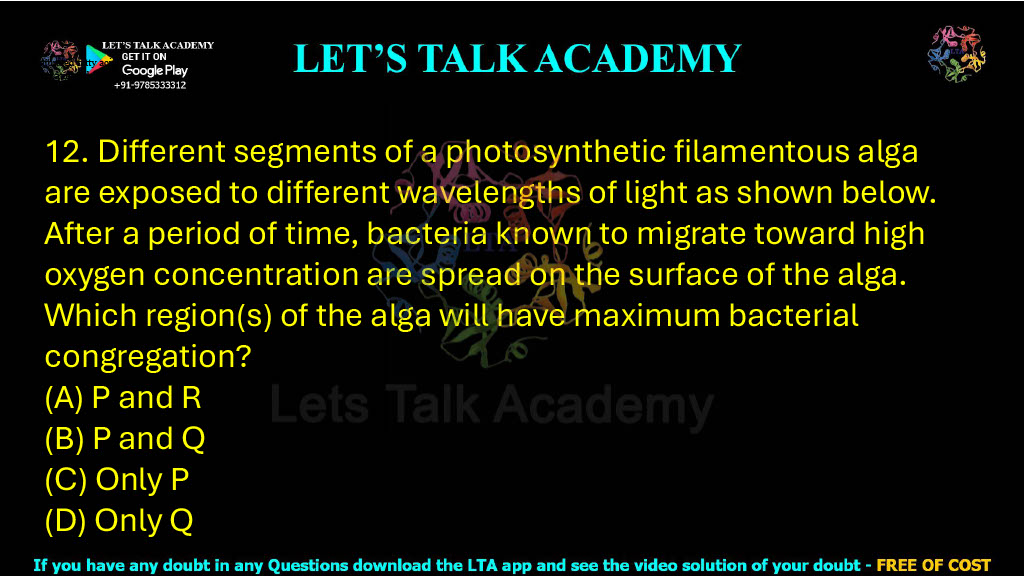
12. Different segments of a photosynthetic filamentous alga are exposed to different wavelengths of light as shown below. After a period of time, bacteria known to migrate toward high oxygen concentration are spread on the surface of the alga. Which region(s) of the alga will have maximum bacterial congregation?
(A) P and R
(B) P and Q
(C) Only P
(D) Only Q
Photosynthetic Action Spectrum Experiment: Which Algal Region Shows Maximum Bacterial Congregation?
Correct Answer
Correct Option: (A) P and R
Introduction to the Experiment
This question is based on the famous Engelmann experiment, one of the most important classical experiments in plant physiology. It demonstrated that different wavelengths of visible light are not equally effective in driving photosynthesis. Engelmann used a filamentous green alga and aerobic bacteria that naturally move toward regions with a high concentration of oxygen. Since oxygen is released during photosynthesis, the location where bacteria accumulate indicates the regions where photosynthetic activity is highest.
The experiment established the action spectrum of photosynthesis, showing that blue and red wavelengths are the most efficient for photosynthesis because chlorophyll pigments absorb these wavelengths most effectively. Questions based on this experiment are frequently asked in CSIR NET, GATE, IIT JAM, NEET PG, CUET PG, and MSc entrance examinations because they combine concepts of pigment absorption, oxygen evolution, and photosynthetic efficiency.
Understanding the Figure
The filamentous alga is exposed to four different wavelengths of visible light:
- 400 nm (violet-blue region)
- 500 nm (green region)
- 600 nm (orange region)
- 700 nm (deep red region)
The labeled regions are:
- Region P lies between 400 nm and 500 nm
- Region Q lies between 500 nm and 600 nm
- Region R lies between 600 nm and 700 nm
Aerobic bacteria migrate toward areas where oxygen concentration is highest. Therefore, the greatest bacterial accumulation will occur in the regions where photosynthesis produces the maximum amount of oxygen.
Why Option (A) is the Correct Answer
The correct answer is Option (A): P and R because these regions receive wavelengths that correspond to the strongest absorption peaks of chlorophyll pigments.
In Region P, the alga is exposed to blue-violet light near 400 nm. Chlorophyll a and chlorophyll b absorb blue wavelengths very efficiently. As a result, the rate of photosynthesis is very high, leading to greater oxygen evolution. The aerobic bacteria migrate toward this oxygen-rich region and accumulate there.
Similarly, Region R receives light close to 700 nm, which lies in the red region of the visible spectrum. Chlorophyll pigments also absorb red light very effectively, making this another region of high photosynthetic activity and oxygen production. Consequently, bacteria gather in large numbers in Region R as well.
Since Regions P and R correspond to the major peaks in the action spectrum of photosynthesis, they show the maximum bacterial congregation.
Understanding the Action Spectrum of Photosynthesis
The action spectrum represents the effectiveness of different wavelengths of light in driving photosynthesis. It closely resembles the absorption spectrum of chlorophyll pigments because photosynthesis depends on the light absorbed by these pigments.
Blue light, ranging approximately from 430–450 nm, is highly energetic and is strongly absorbed by chlorophyll molecules. Red light, between 650–700 nm, is also efficiently absorbed and drives photosynthesis effectively. In contrast, green light around 500–550 nm is poorly absorbed because most of it is reflected, which is why leaves appear green. Consequently, oxygen production is minimal under green light, leading to fewer bacteria in those regions.
Detailed Explanation of Every Option
Option (A): P and R
This is the correct answer because Regions P and R correspond to blue and red wavelengths, respectively. Chlorophyll pigments absorb these wavelengths most efficiently, resulting in the highest rate of photosynthesis and maximum oxygen evolution. Since aerobic bacteria are attracted to oxygen-rich areas, they accumulate predominantly in these two regions.
Option (B): P and Q
This option is incorrect because although Region P experiences strong photosynthetic activity due to blue light absorption, Region Q is associated primarily with green to orange wavelengths. Green light is reflected rather than absorbed by chlorophyll, leading to comparatively lower oxygen production. Therefore, bacterial accumulation in Region Q is much less than in Region R.
Option (C): Only P
This option is incorrect because it ignores the contribution of red light. While blue light certainly promotes high photosynthetic activity, red light is equally important and is one of the two major absorption peaks of chlorophyll. Therefore, bacteria accumulate not only in Region P but also in Region R.
Option (D): Only Q
This option is incorrect because Region Q mainly receives green wavelengths, which chlorophyll absorbs very poorly. Since photosynthesis is relatively low in this region, oxygen production is minimal, and aerobic bacteria will not show maximum congregation here.
Why Do Aerobic Bacteria Accumulate Near Certain Regions?
The bacteria used in Engelmann’s experiment are aerobic, meaning they require oxygen for respiration. These bacteria possess chemotactic mechanisms that allow them to move toward regions with higher oxygen concentrations. Wherever photosynthesis is occurring at the highest rate, more oxygen is released into the surrounding medium. The bacteria detect this oxygen gradient and migrate toward those regions. Therefore, bacterial distribution serves as a biological indicator of photosynthetic activity.
Chlorophyll Absorption Spectrum vs Action Spectrum
Students often confuse the absorption spectrum with the action spectrum. The absorption spectrum shows the wavelengths of light absorbed by chlorophyll pigments, whereas the action spectrum measures the effectiveness of different wavelengths in driving photosynthesis. Although they are not identical, they are remarkably similar because photosynthesis depends directly on the light absorbed by chlorophyll.
Both spectra exhibit two major peaks:
- Blue region around 430–450 nm
- Red region around 650–700 nm
These peaks explain why oxygen evolution is greatest in Regions P and R.
Scientific Principle Behind Engelmann’s Experiment
Engelmann demonstrated that oxygen evolution directly reflects the rate of photosynthesis. By exposing different parts of a filamentous alga to different wavelengths and observing bacterial movement, he concluded that photosynthesis is most efficient under blue and red light. This experiment provided the first experimental evidence linking chlorophyll absorption with photosynthetic efficiency and remains one of the landmark experiments in plant physiology.
Common Mistakes Students Make
Many students mistakenly choose Region Q because they remember that visible light supports photosynthesis but forget that chlorophyll reflects green light instead of absorbing it. Another common mistake is assuming that only blue light is effective while overlooking the equally important role of red light. Some candidates also confuse the absorption spectrum with the action spectrum and fail to connect oxygen production with bacterial movement. Remember that bacterial congregation depends on oxygen evolution, not simply on light exposure.
Final Answer
The aerobic bacteria migrate toward regions where oxygen concentration is highest, and oxygen is released most abundantly where photosynthesis occurs at the highest rate. Chlorophyll pigments absorb blue (around 400–450 nm) and red (around 650–700 nm) wavelengths most efficiently, leading to maximum photosynthetic activity in Regions P and R. Therefore, these two regions produce the greatest amount of oxygen and attract the highest number of aerobic bacteria.
Correct Answer: (A) P and R


