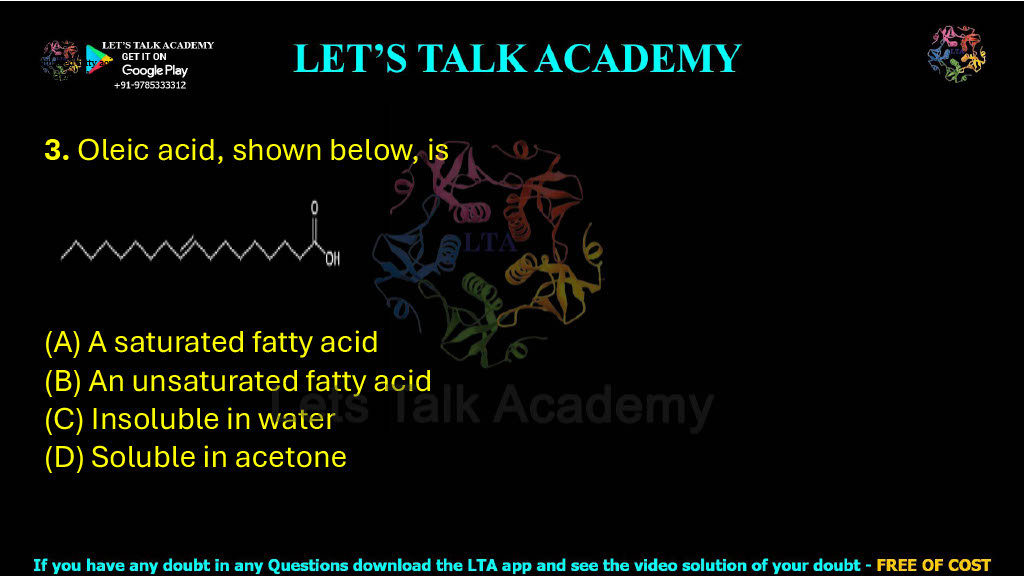
3. Oleic acid, shown below, is
(A) A saturated fatty acid
(B) An unsaturated fatty acid
(C) Insoluble in water
(D) Soluble in acetone
Oleic Acid Is an Unsaturated Fatty Acid
Correct Answer
(B) An unsaturated fatty acid
Introduction
Oleic acid is one of the most important naturally occurring fatty acids found in plants and animals. It is the major fatty acid present in olive oil, canola oil, sunflower oil, peanut oil, avocado, nuts, and many biological membranes. Because of its health benefits and widespread occurrence, oleic acid is frequently asked about in competitive examinations such as CSIR NET, GATE Biotechnology, IIT JAM, CUET PG, NEET PG, UPSC, and university entrance examinations.
The key feature that distinguishes oleic acid from saturated fatty acids is the presence of one carbon-carbon double bond (C=C) in its hydrocarbon chain. This single double bond classifies oleic acid as a monounsaturated fatty acid (MUFA).
Understanding the structure of oleic acid makes it easy to solve similar MCQs in biochemistry and lipid chemistry.
Understanding the Structure of Oleic Acid
Oleic acid is chemically known as:
cis-9-Octadecenoic acid
Its molecular formula is
C₁₈H₃₄O₂
Important structural characteristics include:
- 18 carbon atoms
- One carboxyl (-COOH) group
- One carbon-carbon double bond
- Long hydrocarbon chain
- Cis configuration of the double bond
The double bond introduces a bend (kink) in the molecule, preventing close packing of adjacent molecules.
This is why oils rich in oleic acid remain liquid at room temperature.
Why Option (B) Is Correct
Oleic Acid Is an Unsaturated Fatty Acid
The defining feature of an unsaturated fatty acid is the presence of at least one carbon-carbon double bond (C=C).
Oleic acid contains one double bond, making it a monounsaturated fatty acid (MUFA).
Characteristics include:
- Contains one C=C bond
- Lower melting point
- Liquid at room temperature
- More flexible hydrocarbon chain
- Healthier dietary fat compared to many saturated fats
Therefore,
✅ Option (B) is the correct answer.
Detailed Explanation of Every Option
H3: Option (A) A Saturated Fatty Acid
Why It Is Incorrect
A saturated fatty acid contains only single carbon-carbon bonds throughout its hydrocarbon chain.
General features include:
- No double bonds
- Straight hydrocarbon chain
- Molecules pack tightly together
- Usually solid at room temperature
Examples include:
- Palmitic acid
- Stearic acid
Since oleic acid clearly contains one C=C double bond, it cannot be classified as saturated.
Therefore, Option (A) is incorrect.
Option (B) An Unsaturated Fatty Acid
Why It Is Correct
Unsaturated fatty acids possess one or more double bonds.
Oleic acid has:
- One double bond
- Cis configuration
- Bent molecular structure
- Lower melting point
- Greater membrane fluidity
Since there is exactly one double bond, oleic acid belongs to the category of monounsaturated fatty acids (MUFA).
Examples of monounsaturated fatty acids include:
- Oleic acid
- Palmitoleic acid
Hence,
Option (B) is correct.
Option (C) Insoluble in Water
Scientific Explanation
Oleic acid contains:
- One small polar carboxyl group
- One very long non-polar hydrocarbon chain
The hydrocarbon chain dominates the molecule, making it hydrophobic.
Water is highly polar.
According to the principle:
“Like dissolves like.”
Polar substances dissolve in polar solvents.
Non-polar substances dissolve in non-polar solvents.
Therefore, oleic acid is practically insoluble in water.
Why This Option Is Not the Best Answer
Although this statement is true, the question asks:
Oleic acid is
The primary classification based on structure is that it is an unsaturated fatty acid.
Hence examiners expect the structural identity rather than an additional physical property.
Option (D) Soluble in Acetone
Scientific Explanation
Acetone is an organic solvent.
Oleic acid dissolves well in:
- Acetone
- Ether
- Chloroform
- Benzene
- Alcohol
Therefore,
the statement is scientifically true.
Why It Is Not the Correct Choice
The question focuses on identifying the chemical nature of oleic acid rather than one of its physical properties.
Hence Option (D) is not considered the best answer.
What Makes Oleic Acid Unsaturated?
The carbon-carbon double bond reduces the number of hydrogen atoms attached to the carbon chain.
Compare:
Saturated fatty acid
No double bond
Maximum hydrogen atoms
Example:
Stearic acid
Unsaturated fatty acid
Contains one or more double bonds
Fewer hydrogen atoms
Example:
Oleic acid
Types of Fatty Acids
| Type | Double Bonds | Example |
|---|---|---|
| Saturated Fatty Acid | 0 | Palmitic acid, Stearic acid |
| Monounsaturated Fatty Acid | 1 | Oleic acid |
| Polyunsaturated Fatty Acid | 2 or more | Linoleic acid, Linolenic acid, Arachidonic acid |
Properties of Oleic Acid
| Property | Value |
|---|---|
| Chemical Name | cis-9-Octadecenoic acid |
| Molecular Formula | C18H34O2 |
| Carbon Atoms | 18 |
| Double Bonds | One |
| Classification | Monounsaturated fatty acid |
| Room Temperature | Liquid |
| Water Solubility | Insoluble |
| Organic Solvent Solubility | Soluble |
| Major Source | Olive oil |
Biological Importance of Oleic Acid
Oleic acid performs several important biological functions.
Energy Storage
Stored in triglycerides and used as an energy source.
Cell Membrane Fluidity
Its double bond increases membrane flexibility.
Heart Health
Oleic acid is associated with:
- Reduced LDL cholesterol
- Improved HDL cholesterol
- Better cardiovascular health
Signal Molecule
Acts as a precursor for several biologically active molecules.
Sources of Oleic Acid
Natural sources include:
- Olive oil
- Avocado
- Canola oil
- Peanut oil
- Almonds
- Hazelnuts
- Sunflower oil
- Sesame oil
Saturated vs Unsaturated Fatty Acids
| Feature | Saturated | Unsaturated |
|---|---|---|
| Double Bond | No | Yes |
| Shape | Straight | Bent |
| Packing | Tight | Loose |
| Melting Point | Higher | Lower |
| State | Solid | Liquid |
| Example | Stearic acid | Oleic acid |
Why Competitive Exams Ask This Question
This MCQ tests whether students can identify fatty acids from their chemical structures.
Students should immediately recognize:
- Double bond present → Unsaturated
- No double bond → Saturated
This concept is repeatedly tested in:
- CSIR NET Life Sciences
- GATE Biotechnology
- IIT JAM Biotechnology
- CUET PG
- NEET PG
- M.Sc. Entrance Exams
- University Biochemistry Papers
Key Takeaways
- Oleic acid contains 18 carbon atoms.
- It possesses one carbon-carbon double bond.
- It is classified as a monounsaturated fatty acid (MUFA).
- It is insoluble in water because of its long hydrophobic hydrocarbon chain.
- It is soluble in organic solvents such as acetone.
- The presence of one double bond is the key feature used to identify it in structure-based MCQs.


