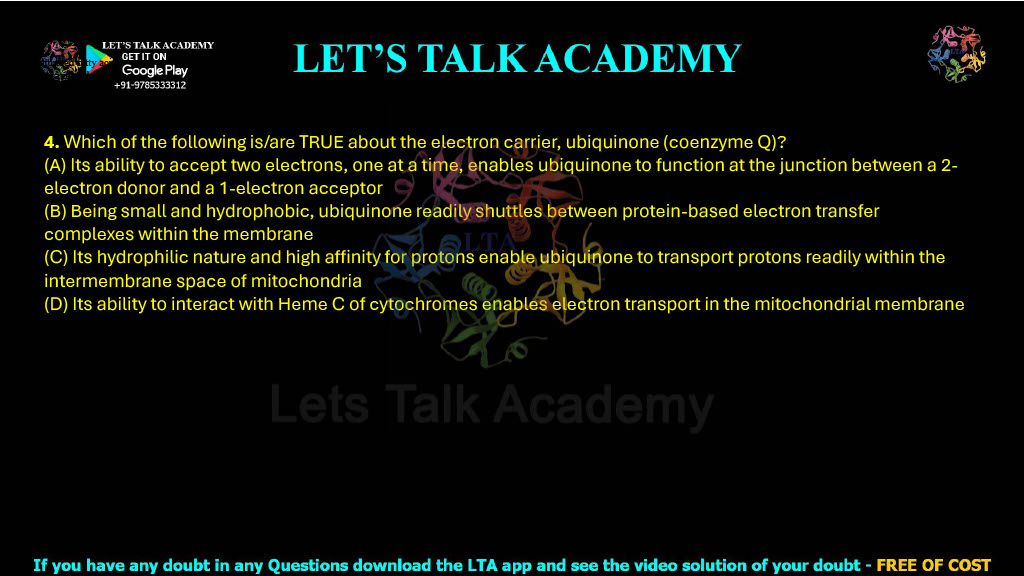
4. Which of the following is/are TRUE about the electron carrier, ubiquinone (coenzyme Q)?
(A) Its ability to accept two electrons, one at a time, enables ubiquinone to function at the junction between a 2-electron donor and a 1-electron acceptor
(B) Being small and hydrophobic, ubiquinone readily shuttles between protein-based electron transfer complexes within the membrane
(C) Its hydrophilic nature and high affinity for protons enable ubiquinone to transport protons readily within the intermembrane space of mitochondria
(D) Its ability to interact with Heme C of cytochromes enables electron transport in the mitochondrial membrane
Which Statements About Ubiquinone (Coenzyme Q) Are True? Complete MCQ Explanation with Electron Transport Chain (ETC), Functions & Detailed Option Analysis
Correct Answer
Correct Options: (A) and (B)
Introduction
Ubiquinone, commonly known as Coenzyme Q (CoQ), is one of the most important molecules involved in cellular respiration. It serves as a mobile electron carrier within the inner mitochondrial membrane, transferring electrons between Complex I (NADH dehydrogenase), Complex II (Succinate dehydrogenase), and Complex III (Cytochrome bc₁ complex).
Unlike protein-bound electron carriers, ubiquinone is a small lipid-soluble molecule that diffuses freely within the lipid bilayer. Its unique ability to accept two electrons and two protons while transferring electrons one at a time makes it indispensable in oxidative phosphorylation and ATP synthesis.
What Is Ubiquinone (Coenzyme Q)?
Ubiquinone is a lipid-soluble quinone molecule found in the inner mitochondrial membrane.
Key Characteristics
- Lipid-soluble (hydrophobic)
- Small and highly mobile
- Diffuses freely within membranes
- Accepts electrons from Complex I and II
- Delivers electrons to Complex III
- Participates in proton transport across the inner mitochondrial membrane
- Essential for ATP production
Structure of Ubiquinone
Ubiquinone consists of:
- A benzoquinone ring, which undergoes oxidation and reduction.
- A long isoprenoid side chain, which anchors it within the hydrophobic core of the inner mitochondrial membrane.
This hydrophobic tail allows ubiquinone to move laterally within the membrane while carrying electrons and protons.
Role of Ubiquinone in the Electron Transport Chain
The electron transport chain (ETC) comprises four major protein complexes and ATP synthase.
Electron Flow
NADH → Complex I → Ubiquinone (CoQ) → Complex III → Cytochrome c → Complex IV → Oxygen
Succinate (FADH₂) → Complex II → Ubiquinone (CoQ) → Complex III
Ubiquinone acts as the central mobile electron carrier connecting Complexes I and II with Complex III.
Why Options (A) and (B) Are Correct
Ubiquinone possesses two remarkable biochemical properties:
- It can accept two electrons but donate them one at a time, allowing it to bridge two-electron donors (such as NADH and FADH₂) with one-electron carriers (such as cytochromes).
- Its small size and hydrophobic nature enable it to diffuse rapidly within the inner mitochondrial membrane, efficiently transporting electrons between ETC complexes.
Therefore, Options (A) and (B) are correct.
Detailed Explanation of Every Option
Option (A) Its Ability to Accept Two Electrons, One at a Time
Why It Is Correct
One of the most important features of ubiquinone is its ability to exist in three oxidation states:
- Oxidized form (Q)
- Semiquinone radical (Q•⁻)
- Reduced form (QH₂ or ubiquinol)
This allows ubiquinone to:
- Accept two electrons together.
- Release them individually.
This unique property enables it to function between:
- Two-electron donors (NADH, FADH₂)
- One-electron acceptors (cytochromes)
Without this capability, electron transfer through the ETC would not proceed efficiently.
Therefore, Option (A) is correct.
Option (B) Being Small and Hydrophobic, Ubiquinone Readily Shuttles Between Protein-Based Electron Transfer Complexes Within the Membrane
Why It Is Correct
Unlike cytochromes, which are protein-bound, ubiquinone is:
- Small
- Non-proteinaceous
- Lipid-soluble
- Highly hydrophobic
Because of its long isoprenoid tail, it dissolves within the lipid bilayer of the inner mitochondrial membrane and diffuses rapidly between Complex I, Complex II, and Complex III.
This mobility makes ubiquinone the primary mobile electron carrier of the electron transport chain.
Therefore, Option (B) is correct.
Option (C) Its Hydrophilic Nature and High Affinity for Protons Enable Ubiquinone to Transport Protons Readily Within the Intermembrane Space
Why It Is Incorrect
This statement contains two major errors.
Error 1: Ubiquinone Is Not Hydrophilic
Ubiquinone is strongly hydrophobic because of its long isoprenoid side chain. This property allows it to remain embedded within the inner mitochondrial membrane.
Error 2: Proton Transport Does Not Occur Within the Intermembrane Space
Although ubiquinone carries protons as ubiquinol (QH₂), it transports them within the inner mitochondrial membrane as part of the Q cycle. It does not freely transport protons within the aqueous intermembrane space.
Therefore, describing ubiquinone as hydrophilic and stating that it transports protons within the intermembrane space is incorrect.
Therefore, Option (C) is incorrect.
Option (D) Its Ability to Interact with Heme C of Cytochromes Enables Electron Transport in the Mitochondrial Membrane
Why It Is Incorrect
Ubiquinone does not transfer electrons directly to Heme c.
Instead:
- Ubiquinone transfers electrons to Complex III (Cytochrome bc₁ complex).
- Within Complex III, electrons are relayed through cytochrome b, the Rieske iron–sulfur protein, and cytochrome c₁.
- The small soluble protein cytochrome c (which contains Heme c) then carries electrons from Complex III to Complex IV.
Thus, ubiquinone does not directly interact with Heme c to mediate electron transport.
Therefore, Option (D) is incorrect.
Oxidation States of Ubiquinone
| Form | Symbol | Description |
|---|---|---|
| Oxidized | Q | Accepts electrons |
| Semiquinone | Q•⁻ | Intermediate free radical carrying one electron |
| Reduced | QH₂ | Ubiquinol carrying two electrons and two protons |
These oxidation states enable ubiquinone to participate in sequential one-electron transfer reactions.
Ubiquinone vs Cytochrome c
| Feature | Ubiquinone (CoQ) | Cytochrome c |
|---|---|---|
| Nature | Lipid-soluble quinone | Water-soluble protein |
| Mobility | Diffuses within membrane | Diffuses in intermembrane space |
| Electron Capacity | Two electrons (released one at a time) | One electron |
| Location | Inner mitochondrial membrane | Intermembrane space |
| Associated Complexes | I, II, III | III and IV |
Biological Importance of Ubiquinone
Electron Transport
Transfers electrons from Complex I and II to Complex III.
ATP Production
Supports oxidative phosphorylation by facilitating electron flow and proton translocation.
Antioxidant Activity
In its reduced form (ubiquinol), Coenzyme Q acts as an antioxidant, protecting membrane lipids and proteins from oxidative damage.
Energy Metabolism
Essential for efficient ATP synthesis in almost all aerobic cells.
Clinical Significance
Coenzyme Q deficiency can lead to:
- Muscle weakness
- Exercise intolerance
- Neurological disorders
- Mitochondrial diseases
Coenzyme Q10 supplements are used in certain mitochondrial disorders and are also studied for cardiovascular health.
High-Yield Exam Points
- Ubiquinone is the only lipid-soluble mobile electron carrier in the ETC.
- It connects Complex I and II to Complex III.
- It accepts two electrons and two protons but can transfer electrons one at a time.
- It exists in three oxidation states: ubiquinone (Q), semiquinone (Q•⁻), and ubiquinol (QH₂).
- Its long isoprenoid tail makes it highly hydrophobic and membrane-bound.
Key Takeaways
- Ubiquinone (Coenzyme Q) is a hydrophobic, lipid-soluble mobile electron carrier.
- It diffuses within the inner mitochondrial membrane.
- It links Complexes I and II with Complex III.
- It can accept two electrons and transfer them one at a time, enabling communication between two-electron donors and one-electron acceptors.
- It participates in the Q cycle, contributing to proton translocation across the inner mitochondrial membrane.
- It does not directly interact with Heme c of cytochromes for electron transfer.
Final Answer
Correct Options: (A) and (B)
Explanation
Ubiquinone (Coenzyme Q) is a small, hydrophobic, lipid-soluble electron carrier that diffuses freely within the inner mitochondrial membrane. It can accept two electrons and two protons while releasing electrons one at a time, allowing it to connect two-electron donors (NADH and FADH₂) with one-electron acceptors (cytochromes). These properties make Options (A) and (B) correct. Option (C) is incorrect because ubiquinone is hydrophobic, not hydrophilic, and it does not transport protons freely within the intermembrane space. Option (D) is incorrect because ubiquinone transfers electrons to Complex III, not directly to Heme c of cytochromes.


