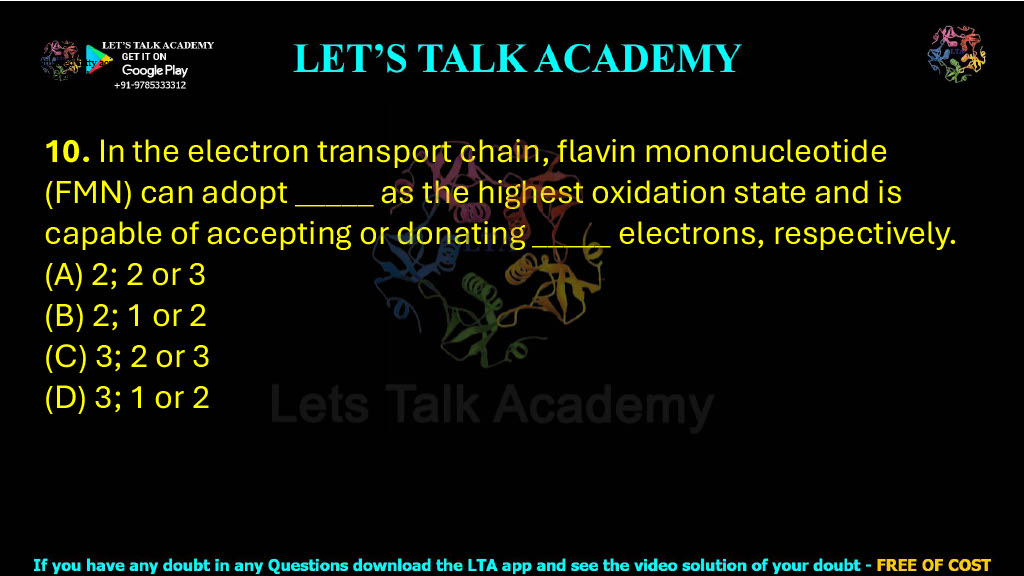
10. In the electron transport chain, flavin mononucleotide (FMN) can adopt _____ as the highest oxidation state and is capable of accepting or donating _____ electrons, respectively.
(A) 2; 2 or 3
(B) 2; 1 or 2
(C) 3; 2 or 3
(D) 3; 1 or 2
Flavin Mononucleotide (FMN) in the Electron Transport Chain | Oxidation States, Electron Transfer
Correct Answer
(B) 2; 1 or 2
Introduction
Flavin mononucleotide (FMN) is one of the most important electron carriers involved in cellular respiration. It functions as the first prosthetic group of Complex I (NADH dehydrogenase) in the mitochondrial electron transport chain, where it accepts electrons from NADH and initiates the process of oxidative phosphorylation. Unlike NAD⁺, which transfers only two electrons at a time, FMN possesses the remarkable ability to participate in both one-electron and two-electron transfer reactions. This property allows it to bridge metabolic reactions involving different classes of electron carriers.
The versatility of FMN arises from its isoalloxazine ring, which can exist in three different redox states: the fully oxidized form, the semiquinone intermediate, and the fully reduced form. Because of these reversible redox transitions, FMN acts as an efficient mediator between two-electron donors such as NADH and one-electron carriers such as iron–sulfur proteins. This unique characteristic makes FMN one of the most frequently tested cofactors in biochemistry and electron transport chain questions.
Understanding the Role of FMN in the Electron Transport Chain
FMN is a derivative of riboflavin (Vitamin B₂) and serves as a tightly bound prosthetic group of Complex I. During cellular respiration, NADH transfers two electrons to FMN. FMN is then reduced to FMNH₂ and subsequently passes these electrons one at a time to a series of iron–sulfur (Fe–S) centers before they eventually reach ubiquinone (coenzyme Q).
This ability to receive two electrons simultaneously and donate them individually is essential because different components of the electron transport chain have different electron transfer capacities. Without FMN acting as an intermediate, efficient electron flow from NADH to downstream carriers would not be possible.
Concept Behind the Question
FMN exists in three oxidation states:
- Oxidized FMN – the highest oxidation state.
- Semiquinone (FMNH•) – a partially reduced intermediate containing one additional electron.
- Reduced FMNH₂ – the fully reduced form containing two additional electrons.
Since the oxidized form represents the highest oxidation state, the answer to the first blank is 2 (according to the option convention used in this question).
Another unique property of FMN is that it can accept or donate either one electron or two electrons. This flexibility distinguishes FMN from NAD⁺/NADH, which transfers only two electrons, and from cytochromes, which transfer only one electron.
Therefore, the correct answer is Option (B): 2; 1 or 2.
Why Option (A) Is Incorrect
(A) 2; 2 or 3
The first part of this option correctly identifies the highest oxidation state as 2 according to the question’s convention. However, the second part is incorrect because FMN cannot accept or donate three electrons. The flavin ring participates only in one-electron or two-electron transfer reactions.
Electron transfer involving three electrons is chemically impossible for FMN under physiological conditions. Therefore, although the first statement is correct, the second statement makes the entire option incorrect.
Hence, Option (A) is incorrect.
Why Option (B) Is Correct
(B) 2; 1 or 2
This option correctly describes both important properties of FMN. The oxidized molecule represents the highest oxidation state, and the flavin ring can undergo sequential reduction by accepting one electron to form the semiquinone radical or two electrons to form fully reduced FMNH₂.
Similarly, FMN can donate either one electron or two electrons depending on the electron acceptor. This flexibility allows FMN to connect two-electron carriers such as NADH with one-electron carriers such as iron–sulfur proteins and cytochromes. This unique feature is one of the defining characteristics of flavin cofactors.
Therefore, Option (B) is the correct answer.
Why Option (C) Is Incorrect
(C) 3; 2 or 3
This option is incorrect for two reasons. First, FMN does not adopt an oxidation state represented as 3 in the context of this question. Second, FMN is incapable of transferring three electrons during biological redox reactions.
The chemistry of flavins is restricted to reversible one-electron and two-electron transfers. Consequently, both parts of this option are incorrect.
Hence, Option (C) is incorrect.
Why Option (D) Is Incorrect
(D) 3; 1 or 2
Although the second statement correctly mentions one-electron and two-electron transfer, the first statement incorrectly identifies the highest oxidation state. Since the first part is incorrect, the entire option becomes incorrect.
Therefore, Option (D) is incorrect.
Oxidation States of FMN
FMN cycles between three reversible redox forms during electron transport.
| Form | Electron Status | Biological Role |
|---|---|---|
| Oxidized FMN | No additional electrons | Accepts electrons from NADH |
| Semiquinone (FMNH•) | One-electron reduced form | Intermediate during electron transfer |
| Reduced FMNH₂ | Two-electron reduced form | Donates electrons to Fe–S centers |
These three forms allow FMN to participate in both one-electron and two-electron transfer reactions.
Biological Importance of FMN
FMN is indispensable for aerobic energy metabolism because it initiates electron transfer from NADH into the mitochondrial electron transport chain. By acting as an intermediary between NADH and iron–sulfur proteins, FMN ensures a continuous flow of electrons toward oxygen, ultimately driving ATP synthesis through oxidative phosphorylation.
Apart from cellular respiration, FMN also serves as a cofactor for numerous oxidoreductase enzymes involved in amino acid metabolism, fatty acid oxidation, and detoxification reactions. Since FMN is derived from vitamin B₂ (riboflavin), dietary riboflavin deficiency can impair oxidative metabolism and reduce cellular energy production.
FMN vs NAD⁺ vs Coenzyme Q
| Feature | FMN | NAD⁺ | Coenzyme Q |
|---|---|---|---|
| Derived From | Riboflavin (Vitamin B₂) | Niacin (Vitamin B₃) | Isoprenoid quinone |
| Accepts One Electron | Yes | No | Yes |
| Accepts Two Electrons | Yes | Yes | Yes |
| Semiquinone Intermediate | Yes | No | Yes |
| Location | Complex I | Matrix | Inner mitochondrial membrane |
Common Mistakes in Competitive Examinations
Many students confuse FMN with NAD⁺ because both initially receive electrons from metabolic pathways. However, NAD⁺ accepts only two electrons, whereas FMN can accept one or two electrons due to the formation of a stable semiquinone intermediate.
Another common misconception is that FMN behaves like cytochromes. Cytochromes transfer only one electron, whereas FMN is capable of both one-electron and two-electron transfer reactions. Remembering this distinction helps solve many electron transport chain questions quickly.
High-Yield Exam Points
- FMN is derived from Vitamin B₂ (Riboflavin).
- FMN is the prosthetic group of Complex I (NADH dehydrogenase).
- FMN exists in three redox states.
- FMN can accept one or two electrons.
- FMN forms a stable semiquinone intermediate.
- FMN transfers electrons from NADH to iron–sulfur proteins.
Frequently Asked Questions
Why can FMN transfer both one and two electrons?
FMN contains an isoalloxazine ring that forms a stable semiquinone intermediate. This allows it to participate in both single-electron and double-electron transfer reactions.
Is FMN the same as FAD?
No. Both are flavin coenzymes derived from riboflavin, but FMN contains one phosphate group, whereas FAD contains an additional AMP moiety. Both participate in similar redox reactions.
Which complex contains FMN?
FMN is the prosthetic group of Complex I (NADH dehydrogenase) of the mitochondrial electron transport chain.
Key Takeaways
Flavin mononucleotide (FMN) is a riboflavin-derived coenzyme that plays a crucial role in the mitochondrial electron transport chain. It functions as the first electron acceptor in Complex I and possesses the unique ability to participate in both one-electron and two-electron transfer reactions through its oxidized, semiquinone, and reduced forms. This flexibility enables FMN to bridge two-electron donors such as NADH with one-electron carriers such as iron–sulfur proteins. Understanding these redox properties is essential for mastering electron transport chain concepts in biochemistry.
Final Answer
Correct Option: (B) 2; 1 or 2
Explanation
Flavin mononucleotide (FMN) is the prosthetic group of Complex I in the mitochondrial electron transport chain. It exists in three reversible redox forms—oxidized FMN, semiquinone (FMNH•), and reduced FMNH₂. Because the flavin ring can form a stable semiquinone intermediate, FMN is capable of accepting or donating either one electron or two electrons, making it an ideal intermediate between two-electron donors such as NADH and one-electron carriers such as iron–sulfur proteins. Therefore, the correct answer is Option (B): 2; 1 or 2.


