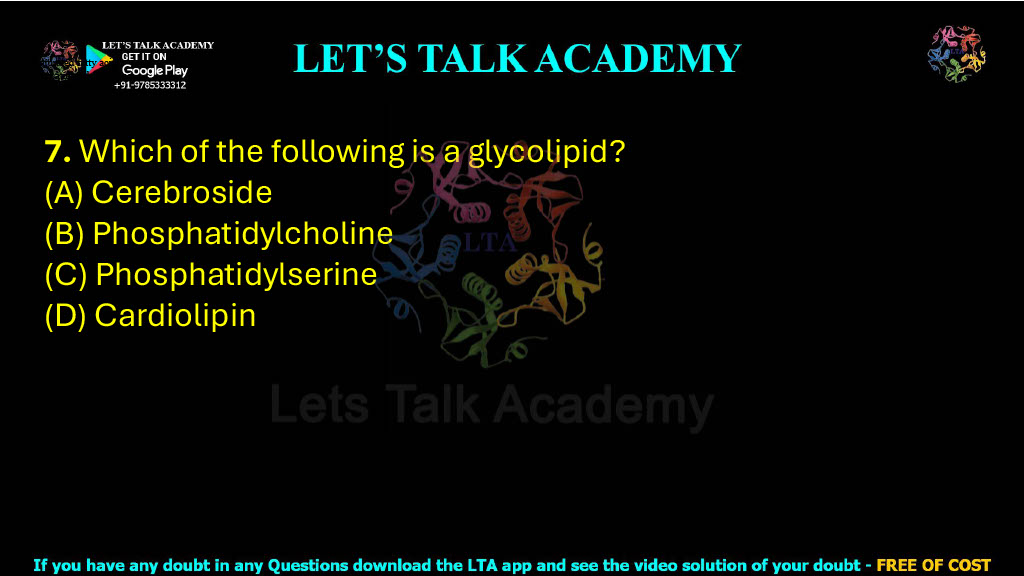
7. Which of the following is a glycolipid?
(A) Cerebroside
(B) Phosphatidylcholine
(C) Phosphatidylserine
(D) Cardiolipin
Which of the Following Is a Glycolipid? C
Correct Answer
(A) Cerebroside
Introduction
Lipids are one of the most important classes of biological molecules because they perform a wide range of structural, metabolic, and signaling functions in living organisms. The plasma membrane of every cell is primarily composed of different types of lipids, including phospholipids, glycolipids, and cholesterol. Among these, glycolipids are unique because they contain one or more carbohydrate molecules attached to a lipid backbone. These carbohydrate groups are exposed on the outer surface of the cell membrane and participate in numerous biological processes, including cell recognition, immune responses, cell-to-cell communication, and membrane stability.
Questions related to the classification of membrane lipids are frequently asked in competitive examinations because students often confuse glycolipids with phospholipids. Although both are important membrane components, their structures differ significantly. Glycolipids contain carbohydrates as their polar head groups, whereas phospholipids possess phosphate-containing head groups. Understanding this structural difference is sufficient to answer many examination questions correctly.
In the given question, the objective is to identify which molecule belongs to the glycolipid family. To answer this accurately, it is necessary to understand the structure and biological role of each lipid mentioned in the options.
Understanding the Concept of Glycolipids
A glycolipid is a lipid molecule in which one or more carbohydrate residues are attached to the lipid portion through a glycosidic bond. In animal cells, glycolipids are generally derived from ceramide, which consists of a sphingosine molecule linked to a fatty acid. When one or more sugar molecules are attached to ceramide, glycosphingolipids are formed.
Unlike phospholipids, glycolipids do not contain a phosphate group. Instead, their hydrophilic region is formed by sugar molecules such as glucose or galactose. These sugar residues extend toward the extracellular surface of the plasma membrane, allowing glycolipids to participate in cell recognition and communication. Because of this unique arrangement, glycolipids are particularly abundant in nerve tissue and play an essential role in maintaining the structure and function of the nervous system.
Why Option (A) Is Correct
Cerebroside
Cerebrosides are the simplest members of the glycosphingolipid family. They are composed of a ceramide molecule attached to a single monosaccharide, usually either glucose or galactose. Since their polar head group is a carbohydrate rather than a phosphate-containing compound, cerebrosides are classified as glycolipids.
Cerebrosides are abundant in the myelin sheath, the insulating layer surrounding nerve fibers. This sheath enables rapid transmission of nerve impulses and protects neurons from damage. In addition to providing structural stability to cell membranes, cerebrosides participate in cell recognition, membrane organization, and signal transduction. Because they contain a sugar molecule attached to ceramide and lack a phosphate group, cerebrosides are true glycolipids.
Therefore, Option (A) is the correct answer.
Why Option (B) Is Incorrect
Phosphatidylcholine
Phosphatidylcholine is one of the most abundant phospholipids found in eukaryotic cell membranes. It consists of a glycerol backbone attached to two fatty acids, one phosphate group, and a choline molecule. Since the polar head contains a phosphate group, phosphatidylcholine belongs to the glycerophospholipid family rather than the glycolipid family.
This lipid plays an essential role in maintaining membrane fluidity and integrity. It is also a major constituent of lipoproteins and pulmonary surfactant. Although phosphatidylcholine is an important membrane lipid, it does not contain a carbohydrate head group and therefore cannot be classified as a glycolipid.
Hence, Option (B) is incorrect.
Why Option (C) Is Incorrect
Phosphatidylserine
Phosphatidylserine is another important phospholipid that contains glycerol, two fatty acids, phosphate, and the amino acid serine as its head group. Like all glycerophospholipids, it possesses a phosphate group that distinguishes it from glycolipids.
This phospholipid is primarily located on the inner surface of the plasma membrane. During apoptosis, phosphatidylserine becomes exposed on the outer surface of the membrane, serving as an important signal for macrophages to recognize and remove dying cells. Besides its role in apoptosis, phosphatidylserine contributes to membrane stability and intracellular signaling.
Although biologically important, phosphatidylserine is classified as a phospholipid rather than a glycolipid because its head group contains phosphate instead of carbohydrate.
Therefore, Option (C) is incorrect.
Why Option (D) Is Incorrect
Cardiolipin
Cardiolipin is a unique phospholipid that is almost exclusively found in the inner mitochondrial membrane. Unlike most phospholipids, cardiolipin contains four fatty acid chains and two phosphate groups connected through a glycerol molecule, giving it a distinctive structure.
Cardiolipin plays an indispensable role in maintaining the structural organization of the electron transport chain. It stabilizes respiratory complexes involved in oxidative phosphorylation and is therefore essential for efficient ATP production. Defects in cardiolipin metabolism are associated with mitochondrial disorders such as Barth syndrome.
Despite its specialized function, cardiolipin remains a phospholipid because its structure contains phosphate groups rather than carbohydrate residues. Consequently, it is not classified as a glycolipid.
Hence, Option (D) is incorrect.
Comparison Between Glycolipids and Phospholipids
| Feature | Glycolipids | Phospholipids |
|---|---|---|
| Polar Head Group | Carbohydrate | Phosphate-containing group |
| Phosphate Present | No | Yes |
| Major Backbone | Ceramide | Glycerol |
| Major Function | Cell recognition and signaling | Membrane structure and fluidity |
| Common Example | Cerebroside | Phosphatidylcholine |
Biological Importance of Glycolipids
Glycolipids are much more than structural membrane components. Their carbohydrate groups serve as molecular recognition markers that allow cells to identify one another. This property is particularly important in the immune system, where glycolipids help distinguish self from non-self cells.
In nervous tissue, glycolipids are abundant in the myelin sheath, where they contribute to rapid nerve impulse conduction. They also participate in embryonic development, receptor function, membrane stability, and interactions between cells and pathogens. Certain bacteria and viruses recognize specific glycolipids as receptors during infection, highlighting their importance in both normal physiology and disease.
Clinical Significance
Disorders involving glycolipid metabolism are collectively known as sphingolipidoses, which result from deficiencies of lysosomal enzymes responsible for degrading glycolipids.
One well-known example is Gaucher disease, caused by a deficiency of the enzyme β-glucocerebrosidase. This defect leads to the accumulation of glucocerebroside within macrophages, resulting in enlargement of the liver and spleen, bone abnormalities, and hematological complications.
Another important disorder is Krabbe disease, which results from deficiency of galactocerebrosidase. This disease causes destruction of the myelin sheath, leading to severe neurological impairment and developmental delays. These diseases illustrate the critical importance of cerebrosides in maintaining normal nervous system function.
High-Yield Exam Points
- Glycolipids contain carbohydrate molecules but no phosphate group.
- Cerebrosides are the simplest glycosphingolipids.
- Cerebrosides consist of ceramide + one sugar molecule.
- Phosphatidylcholine and phosphatidylserine are glycerophospholipids.
- Cardiolipin is a specialized mitochondrial phospholipid.
- Cerebrosides are abundant in the myelin sheath.
Frequently Asked Questions
Why is cerebroside classified as a glycolipid?
Because it contains a carbohydrate molecule attached to ceramide and lacks a phosphate group.
Is phosphatidylcholine a glycolipid?
No. It contains a phosphate group and is therefore a phospholipid.
Where are cerebrosides mainly found?
Cerebrosides are highly abundant in the myelin sheath of nerve cells.
Why is cardiolipin important?
Cardiolipin stabilizes the electron transport chain in the inner mitochondrial membrane and is essential for ATP synthesis.
Key Takeaways
Cerebrosides are glycolipids because they consist of a ceramide backbone linked to a single carbohydrate residue. Their absence of phosphate distinguishes them from phospholipids such as phosphatidylcholine, phosphatidylserine, and cardiolipin. Glycolipids are particularly important in nerve tissue, where they contribute to myelin formation, membrane stability, and cell recognition. Understanding the structural differences between glycolipids and phospholipids is essential for solving lipid-based MCQs in competitive examinations.
Final Answer
Correct Option: (A) Cerebroside
Explanation
Cerebroside is classified as a glycolipid because it is composed of a ceramide molecule attached to a single carbohydrate residue (glucose or galactose) and does not contain a phosphate group. In contrast, phosphatidylcholine, phosphatidylserine, and cardiolipin all contain phosphate groups as part of their polar head regions and therefore belong to the phospholipid family. Since the defining feature of glycolipids is the presence of a carbohydrate head group instead of a phosphate group, cerebroside is the only correct answer.


