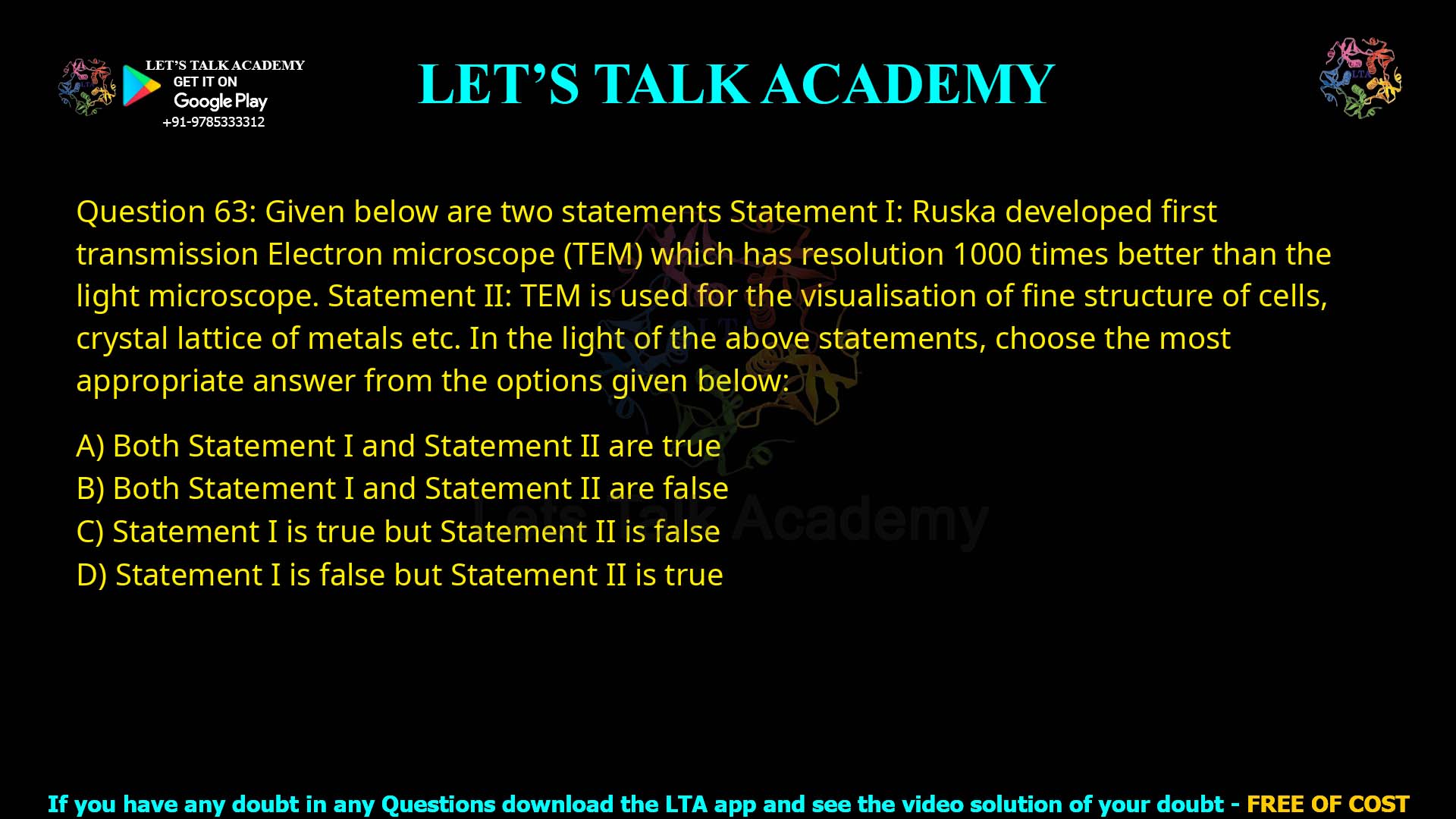
Q.63 Given below are two statements:
Statement I: Ruska developed first transmission Electron microscope (TEM) which has resolution 1000 times
better than the light microscope.
Statement II. Transmission Electron microscope uses very advanced glass in their lenses.
In the light of the above statements. choose the most appropriate answer from the options given below:
1. Both Statement I and Statement II are true
2. Both Statement I and Statement I are false
3. Statement I is true but Statement II is false
4. Statement I is false but Statement II is frue
Ernst Ruska developed the first TEM with ~1000x better resolution than light microscopes, but TEMs use electromagnetic lenses, not glass. Thus, Statement I is true, Statement II is false—correct answer is option 3.
Statement Analysis
Statement I: True
Ernst Ruska and Max Knoll built the first transmission electron microscope (TEM) in 1931. Electrons’ de Broglie wavelength (~0.005 nm vs light’s 500 nm) enables ~0.2 nm resolution vs light microscopy’s ~200 nm limit—exactly 1000x improvement. Ruska’s 1986 Nobel recognized this breakthrough.
Statement II: False
TEMs employ electromagnetic lenses (coils generating magnetic fields) to focus electron beams. Glass lenses refract light via density differences but cannot handle electrons’ mass/charge; glass would shatter under vacuum/high voltage. No “advanced glass” exists in TEM optics.
Option Analysis
Option 1: Both true
Wrong. II’s glass claim fails; TEM = magnetic lenses only.
Option 2: Both false
Wrong. I accurately credits Ruska’s TEM invention/resolution leap.
Option 3: I true, II false (Correct)
Matches facts: Ruska’s TEM revolution (I true), no glass lenses (II false).
Option 4: I false, II true
Wrong on both counts.
Ruska TEM resolution 1000x glass lenses tests microscopy fundamentals in NEET exams. Statement I correctly credits Ernst Ruska’s 1931 TEM invention; Statement II wrongly claims glass lenses—electromagnetic coils focus electrons instead.
TEM Physics
Resolution formula: d=0.61λNA. Electrons: λ≈0.005 nm → d≈0.2 nm. Light: λ=500 nm → d≈200 nm. Exactly 1000x better.
Lens Reality
Light Microscope: Glass lenses (refractive index)

↓

TEM: Electromagnetic lenses (Lorentz force: \(\vec{F} = q(\vec{v} \times \vec{B})\))
Glass fails: electrons need vacuum, magnetic deflection—no refraction possible.
Key distinction: Light → photons/glass; electrons → particles/magnets. Option 3 nails it.


