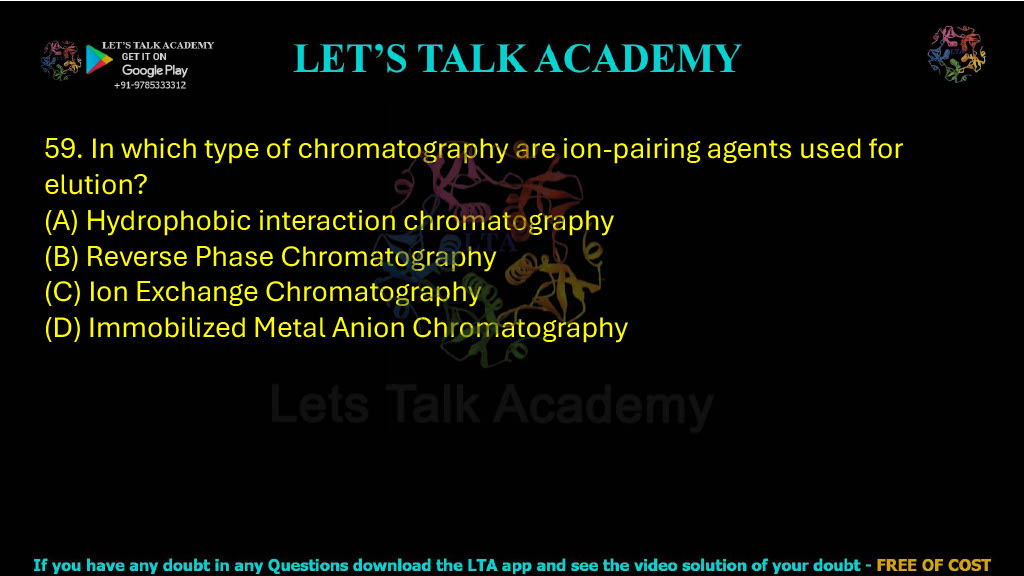
59. In which type of chromatography are ion-pairing agents used for elution?
A. Hydrophobic interaction chromatography
B. Reverse phase chromatography
C. Ion exchange chromatography
D. Immobilized metal anion chromatography
Answer: (B) Reverse phase chromatography
Ion-pairing agents (e.g., TFA, TEA, heptanesulfonate) are used in reverse phase chromatography (RPC) to improve retention and peak shape of charged analytes on hydrophobic C18/C8 columns by forming neutral ion-pairs.
Option Analysis
(A) Hydrophobic Interaction Chromatography
Wrong. HIC uses high salt (ammonium sulfate) for binding to mild hydrophobic ligands; no ion-pairing agents involved.[ prior]
(B) Reverse Phase Chromatography
Correct. Ion-pair reagents in mobile phase (5-20 mM) pair with charged analytes (e.g., peptides, nucleotides), making them more hydrophobic for C18 retention. Gradient elution with organic solvent (acetonitrile).
(C) Ion Exchange Chromatography
Incorrect. Uses charged resins directly; salt gradients elute—no ion-pairing needed or used.
(D) Immobilized Metal Anion Chromatography (IMAC)
Wrong. IMAC uses metal chelates (Ni-NTA) for His-tagged proteins; histidine coordinates metal—no ion-pairing.[ prior]
Reverse phase chromatography ion pairing agents enable separation of charged molecules like peptides and nucleotides on hydrophobic columns, essential for analytical biochemistry.
Ion Pairing Mechanism in RPC
Ion-pairing agents (alkyl sulfonates, quaternary amines) form neutral complexes with charged analytes in aqueous mobile phase: R-SO₃⁻ + R’NH₃⁺ → [R-SO₃⁻…R’NH₃⁺].
This lipophilic ion-pair partitions into C18 stationary phase; gradient (%B acetonitrile) elutes by disrupting pairs.
TFA (0.1%) most common for peptides; heptafluorobutyric acid (HFBA) for maximum retention.
Chromatography Ion Pairing Comparison
| Method | Ion-Pairing Used? | Mobile Phase Additives | Target Analytes |
|---|---|---|---|
| Reverse Phase | Yes | TFA, TEA, alkylsulfonates | Charged peptides |
| HIC | No | High salt (2M) | Hydrophobic proteins |
| Ion Exchange | No | Low salt buffers | All charged proteins |
| IMAC | No | Imidazole | His-tagged proteins |
This clarifies why only reverse phase chromatography requires ion-pairing agents.
GATE Exam Applications
Tests understanding of mobile phase additives; pairs with prior chromatography questions. Remember: ion-pairing = reverse phase only.


2 Comments
Vanshika Sharma
February 4, 2026Reverse phase chromatography
Kanica Sunwalka
June 26, 2026in Reverse phase chr. ion pairing agents r used to improve retention time and peak shape of charged analytes on hydrophobic column