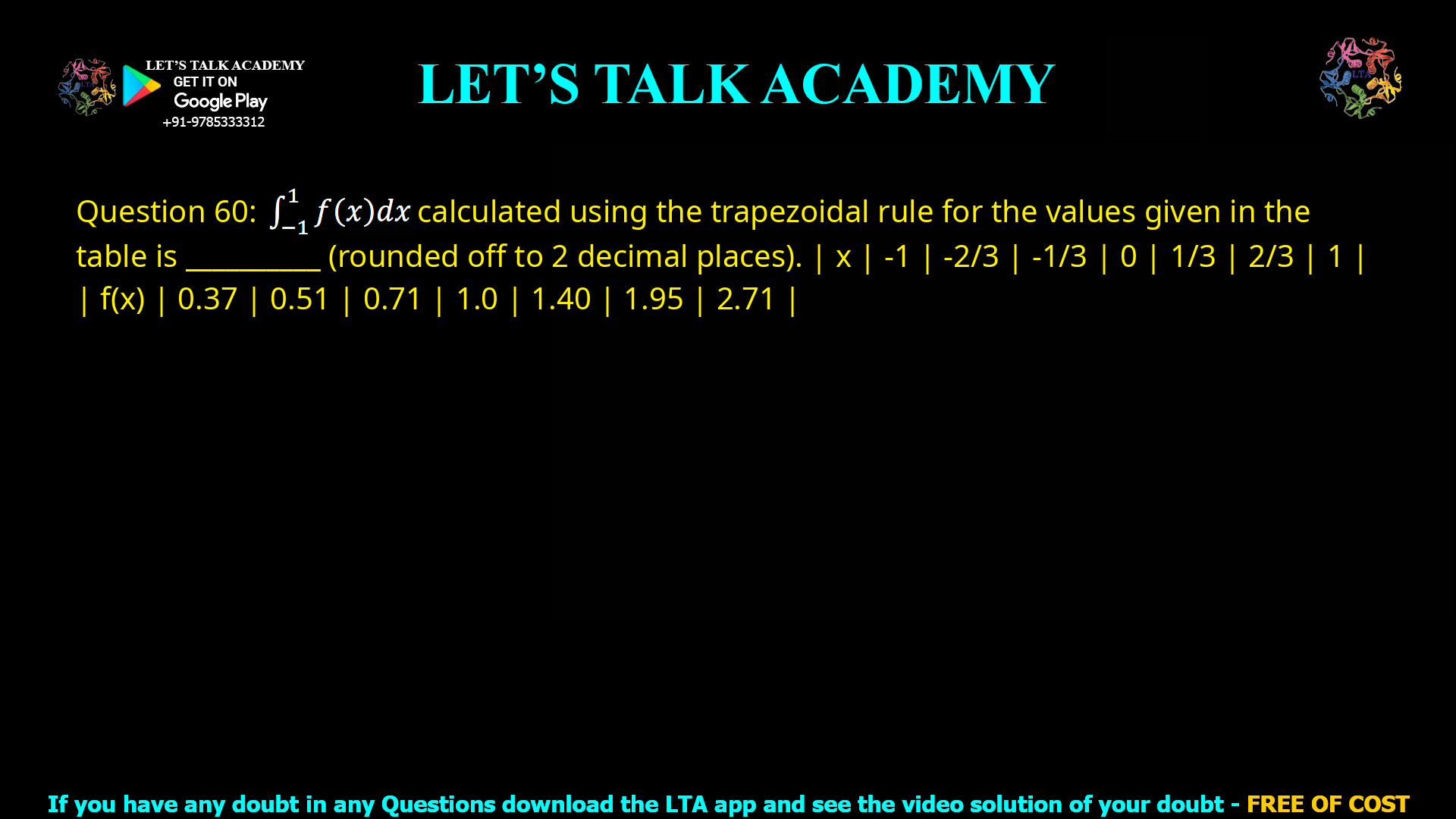
Q.60 ∫-11 f(x) dx calculated using trapezoidal rule for the values given in the table is ________ (rounded off to 2 decimal places).
| x | -1 | -2/3 | -1/3 | 0 | 1/3 | 2/3 | 1 |
|---|---|---|---|---|---|---|---|
| f(x) | 0.37 | 0.51 | 0.71 | 1.0 | 1.40 | 1.95 | 2.71 |
Given Data
| x | -1 | -2/3 | -1/3 | 0 | 1/3 | 2/3 | 1 |
|---|---|---|---|---|---|---|---|
| f(x) | 0.37 | 0.51 | 0.71 | 1.0 | 1.40 | 1.95 | 2.71 |
Step Size
h = (1 – (-1)) / 6 = 2/6 = 1/3
Trapezoidal Rule Formula
∫ab f(x)dx ≈ h × [ (f0 + fn) / 2 + Σ fi ]
Step-by-Step Calculation
1. Average of Endpoints
f(-1) = 0.37, f(1) = 2.71
(f0 + fn) / 2 = (0.37 + 2.71) / 2 = 1.54
2. Sum of Interior Values
0.51 + 0.71 + 1.0 + 1.40 + 1.95 = 5.57
3. Add Terms
Total = 1.54 + 5.57 = 7.11
4. Multiply by h
∫-11 f(x)dx ≈ (1/3) × 7.11 = 2.37
Final Answer
Integral value = 2.37 (rounded to 2 decimal places)
Interpretation
- Because values are tabulated, numerical integration is required
- Equal spacing allows trapezoidal rule application
- Simpson’s rule not applicable due to odd number of segments
Exam Tip
For equally spaced x-values, use trapezoidal rule when Simpson’s rule cannot apply.


