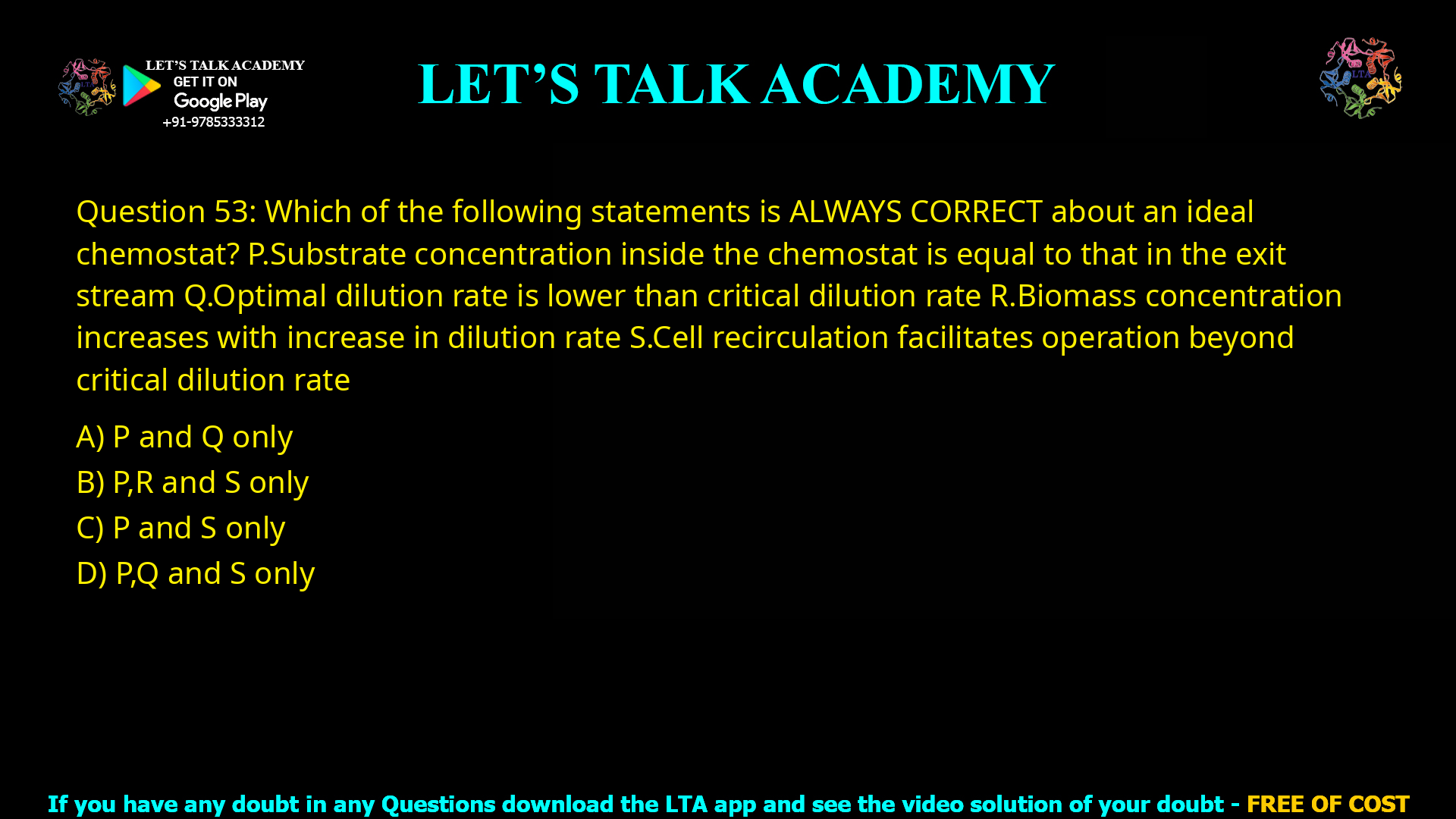
Q.53 Which of the following statements is ALWAYS CORRECT about an ideal chemostat?
P. Substrate concentration inside the chemostat is equal to that in the exit stream
Q. Optimal dilution rate is lower than critical dilution rate
R. Biomass concentration increases with increase in dilution rate
S. Cell recirculation facilitates operation beyond critical dilution rate
(A) P and Q only (B) P, R and S only (C) P and S only (D) P, Q and S only
Ideal Chemostat Characteristics: Which Statements Always Correct?
Correct Answer Summary
P, Q, and S are always correct for an ideal chemostat, making option (D) the right answer. In steady-state operation, the system’s perfect mixing ensures uniform conditions.
Statement Analysis
P: Substrate concentration inside equals exit stream
True always. Perfect mixing in an ideal chemostat means substrate concentration inside the reactor is the same as in the effluent. No concentration gradients exist.
Q: Optimal dilution rate lower than critical
True always. The critical dilution rate is approximately μmax. Operating near this point risks washout, and optimal productivity (D × X) occurs at a slightly lower value.
R: Biomass increases with dilution rate
False. Biomass decreases as dilution rate increases because substrate availability rises and cell concentration drops per Monod kinetics.
S: Recirculation enables beyond critical
True always. Cell recycle retains biomass and prevents washout, allowing operation above μmax.
Chemostat Key Equations
At steady state:
- D = μ
- Biomass: X = Y(S0 – s)
- Substrate: s = KsD / (μmax – D)
Core Ideal Chemostat Principles
An ideal chemostat maintains steady-state conditions where:
- Influent equals effluent
- Perfect mixing ensures uniform substrate concentration
- Growth rate equals dilution rate, controlled externally
Evaluating Each Statement
- P (Correct): Uniform substrate concentration due to mixing.
- Q (Correct): Optimal dilution rate is below critical to avoid washout.
- R (Incorrect): Biomass does not increase; it decreases with higher D.
- S (Correct): Recycling biomass enables operation beyond μmax.
Final Answer
Correct Option: (D) P, Q, S only
Practical Implications
Industrial bioreactors are operated below washout limits. Cell recycle strategies improve productivity and are widely used in enzyme, antibiotic and biofuel production.


