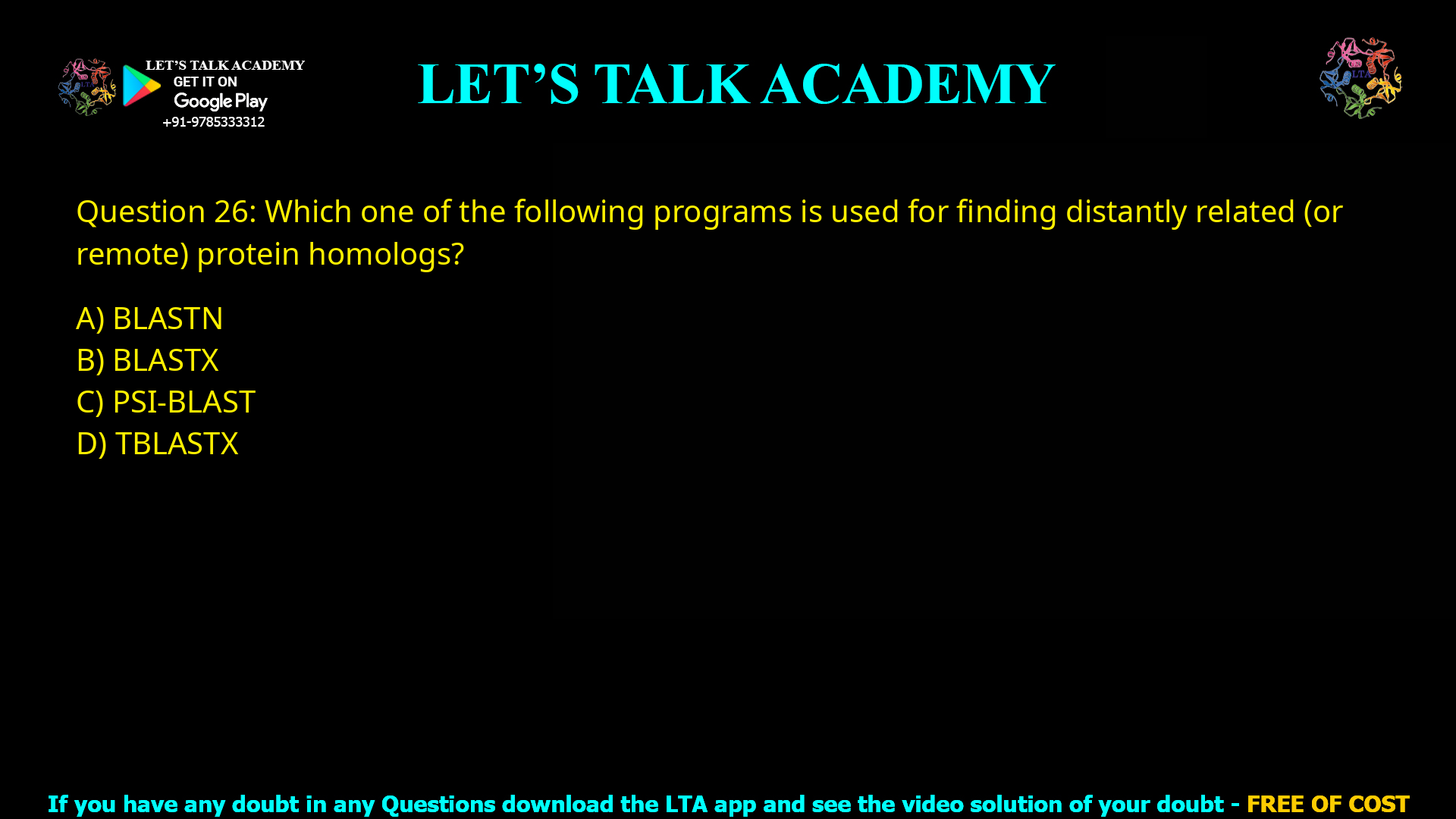
Q.26 Which one of the following programs is used for finding distantly related (or
remote) protein homologs?
(A) BLASTN
(B) BLASTX
(C) PSI–BLAST
(D) TBLASTX
PSI-BLAST is the program used for finding distantly related (or remote) protein homologs. This iterative BLAST variant excels at detecting weak sequence similarities by building position-specific scoring matrices (PSSMs) from multiple rounds of searches. Option (C) is correct, as confirmed in competitive exams like GATE BT.
Option Explanations
BLASTN compares nucleotide sequences against nucleotide databases, ideal for DNA/RNA similarity but ineffective for protein homologs. BLASTX translates a nucleotide query into all six reading frames and searches protein databases, useful for finding protein-coding genes in genomic DNA but not optimized for remote protein-protein matches. PSI-BLAST starts with a protein query like BLASTP, then iteratively refines a PSSM using detected hits to uncover distant homologs with low sequence identity. TBLASTX translates both nucleotide query and database in six frames for protein-level comparison, suited for divergent nucleotide sequences but computationally intensive and not protein-specific.
Finding distantly related protein homologs is essential in bioinformatics for evolutionary studies and function prediction. Among BLAST variants, PSI-BLAST stands out for its sensitivity in detecting remote homologs with low sequence identity, making it a staple in competitive exams like IIT JAM and GATE Biotechnology.
Why PSI-BLAST Excels
PSI-BLAST (Position-Specific Iterated BLAST) performs iterative searches: it begins with a standard BLASTP, constructs a PSSM from significant hits, and repeats to capture evolutionary signals missed by single-pass tools. This boosts sensitivity for homologs sharing 20-30% identity, unlike basic BLAST programs. Users set inclusion thresholds (e.g., E-value < 0.001) to avoid false positives during iterations.
BLAST Program Comparisons
| Program | Query Type | Database Type | Best For | Remote Homolog Detection? |
|---|---|---|---|---|
| BLASTN | Nucleotide | Nucleotide | DNA/RNA similarity | No |
| BLASTX | Nucleotide (translated) | Protein | Gene function in ESTs/genomics | Limited |
| PSI-BLAST | Protein | Protein | Distant homologs | Yes (iterative PSSM) |
| TBLASTX | Nucleotide (both translated) | Nucleotide | Divergent coding regions | No (nucleotide-focused) |
PSI-BLAST outperforms others for protein remote homology due to its profile-based refinement.
Practical Applications
In research, PSI-BLAST identifies novel family members, as in Cryptococcus protein studies. For exam prep, recognize it via questions on “remote protein homologs” – always option C in this format. Avoid over-iteration to prevent PSSM drift from unrelated sequences. Tools like NCBI BLAST+ integrate it seamlessly.


