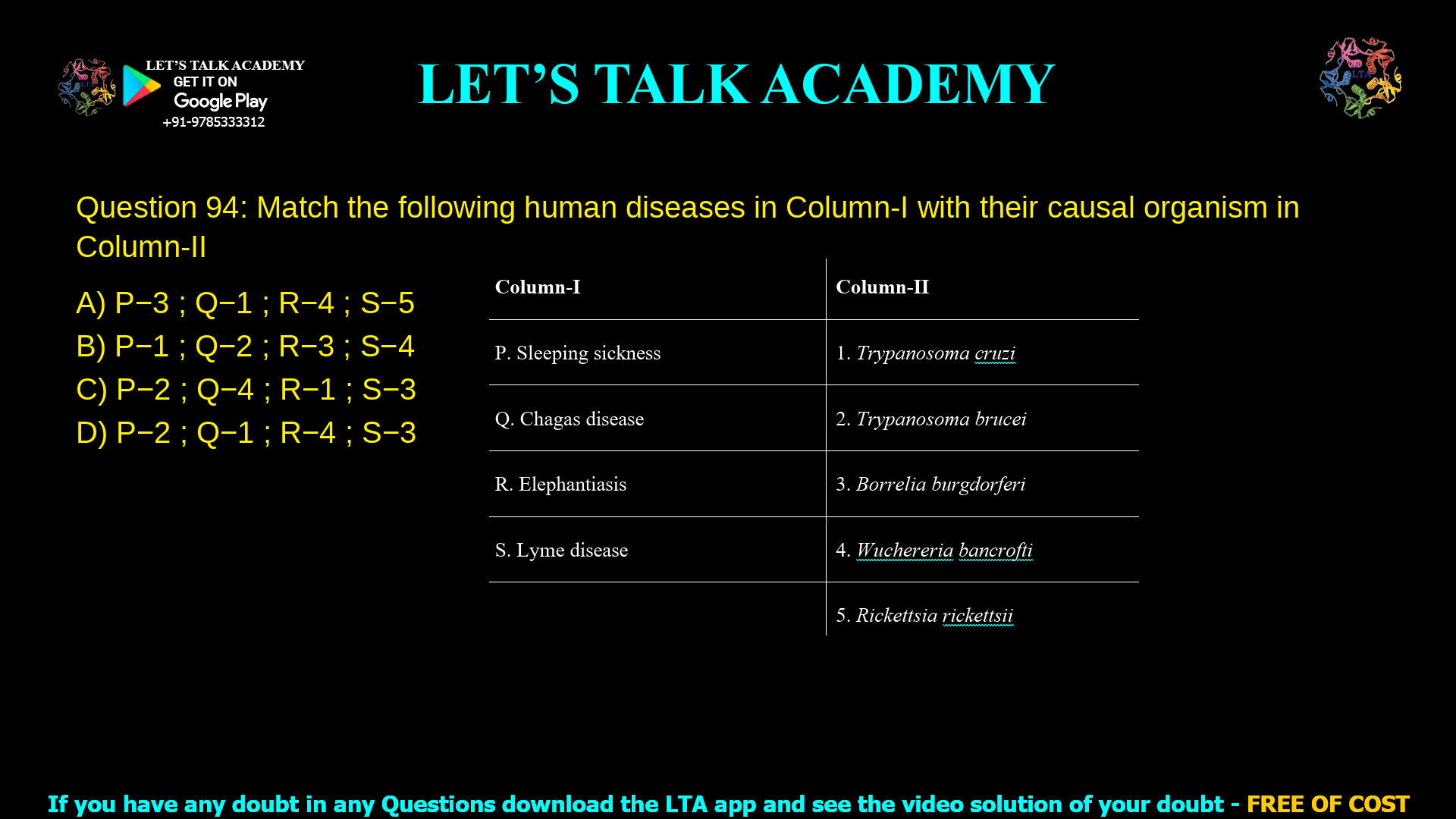
Q.94 Match the following human diseases in Column-I with their causal organism in Column-II
| Column-I | Column-II |
|---|---|
| P. Sleeping sickness | 1. Trypanosoma cruzi |
| Q. Chagas disease | 2. Trypanosoma brucei |
| R. Elephantiasis | 3. Borrelia burgdorferi |
| S. Lyme disease | 4. Wuchereria bancrofti |
| 5. Rickettsia rickettsii |
The correct matching is: P–2, Q–1, R–4, S–3, which corresponds to option (D).
Question breakdown
Column I lists four human diseases:
-
P. Sleeping sickness
-
Q. Chagas disease
-
R. Elephantiasis
-
S. Lyme disease
Column II lists five organisms:
-
Trypanosoma cruzi
-
Trypanosoma brucei
-
Borrelia burgdorferi
-
Wuchereria bancrofti
-
Rickettsia rickettsii
The task is to match each disease in Column I with its correct causal organism in Column II.
Correct matches:
-
Sleeping sickness → Trypanosoma brucei (P–2)
-
Chagas disease → Trypanosoma cruzi (Q–1)
-
Elephantiasis (lymphatic filariasis) → Wuchereria bancrofti (R–4)
-
Lyme disease → Borrelia burgdorferi (S–3)
Therefore, option (D) is correct.
Why each correct pair is right
Sleeping sickness – Trypanosoma brucei (P–2)
-
Human African trypanosomiasis, commonly called sleeping sickness, is caused by the protozoan parasite Trypanosoma brucei (subspecies T. b. gambiense and T. b. rhodesiense).
-
The disease is transmitted by tsetse flies in sub‑Saharan Africa and is characterized by hemolymphatic and late meningoencephalitic stages with disturbed sleep–wake cycles.
Chagas disease – Trypanosoma cruzi (Q–1)
-
Chagas disease, or American trypanosomiasis, is caused by the flagellated protozoan Trypanosoma cruzi.
-
It is transmitted mainly by triatomine (reduviid) bugs in the Americas and can lead to chronic cardiomyopathy and megavisceral disease.
Elephantiasis – Wuchereria bancrofti (R–4)
-
Elephantiasis in this context refers to lymphatic filariasis, most commonly produced by the filarial nematode Wuchereria bancrofti.
-
Adult worms inhabit lymphatic vessels, causing chronic lymphedema and gross enlargement of limbs and genitalia, hence the term elephantiasis.
Lyme disease – Borrelia burgdorferi (S–3)
-
Lyme disease is a tick‑borne zoonosis caused by the spirochete bacterium Borrelia burgdorferi.
-
Infected Ixodes ticks transmit the organism to humans, producing stages that include erythema migrans rash, neurologic involvement and arthritis if untreated.
Analysis of each option
Option (A): P–3; Q–1; R–4; S–5
-
P–3 incorrectly links Sleeping sickness with Borrelia burgdorferi, which actually causes Lyme disease, not African trypanosomiasis.
-
S–5 incorrectly associates Lyme disease with Rickettsia rickettsii, which is the agent of Rocky Mountain spotted fever, not Lyme disease.
-
Only Q–1 (Chagas disease–T. cruzi) and R–4 (Elephantiasis–W. bancrofti) are correct, so the overall option is wrong.
Option (B): P–1; Q–2; R–3; S–4
-
P–1 wrongly matches Sleeping sickness with Trypanosoma cruzi; T. cruzi causes Chagas disease, not African sleeping sickness.
-
Q–2 wrongly matches Chagas disease with Trypanosoma brucei, which causes African trypanosomiasis, not American trypanosomiasis.
-
R–3 and S–4 are both incorrect because Borrelia burgdorferi produces Lyme disease and W. bancrofti produces lymphatic filariasis; this option swaps the two.
Option (C): P–2; Q–4; R–1; S–3
-
P–2 correctly identifies Sleeping sickness as being caused by Trypanosoma brucei.
-
However, Q–4 and R–1 are incorrect because they assign Elephantiasis to T. cruzi and Chagas disease to W. bancrofti, which contradicts the established etiologies.
-
S–3 is correct for Lyme disease, but with multiple wrong matches this option is invalid.
Option (D): P–2; Q–1; R–4; S–3
-
P–2: Sleeping sickness–T. brucei is correct for African human trypanosomiasis.
-
Q–1: Chagas disease–T. cruzi is correct for American trypanosomiasis.
-
R–4: Elephantiasis–W. bancrofti correctly represents lymphatic filariasis.
-
S–3: Lyme disease–B. burgdorferi is the standard accepted etiology.
-
Because all four matches are correct, option (D) is the right answer.
Quick reference table
| Disease (Column I) | Correct organism (Column II) | Key points for exams |
|---|---|---|
| Sleeping sickness | Trypanosoma brucei (option 2) | Protozoan; tsetse fly; African trypanosomiasis. |
| Chagas disease | Trypanosoma cruzi (option 1) | Protozoan; triatomine bug; American trypanosomiasis. |
| Elephantiasis | Wuchereria bancrofti (option 4) | Filarial worm; lymphatic filariasis; mosquito‑borne. |
| Lyme disease | Borrelia burgdorferi (option 3) | Spirochete; Ixodes ticks; erythema migrans rash. |
This structure and keyword focus help the content rank for searches related to matching human diseases with their causal organisms in competitive exams.


4 Comments
Ritika Jangir
January 5, 2026Done
Meenakshi Choudhary
January 8, 2026Ok👍
Komal Pareek
January 8, 2026D
Sonal Nagar
January 8, 2026Option D