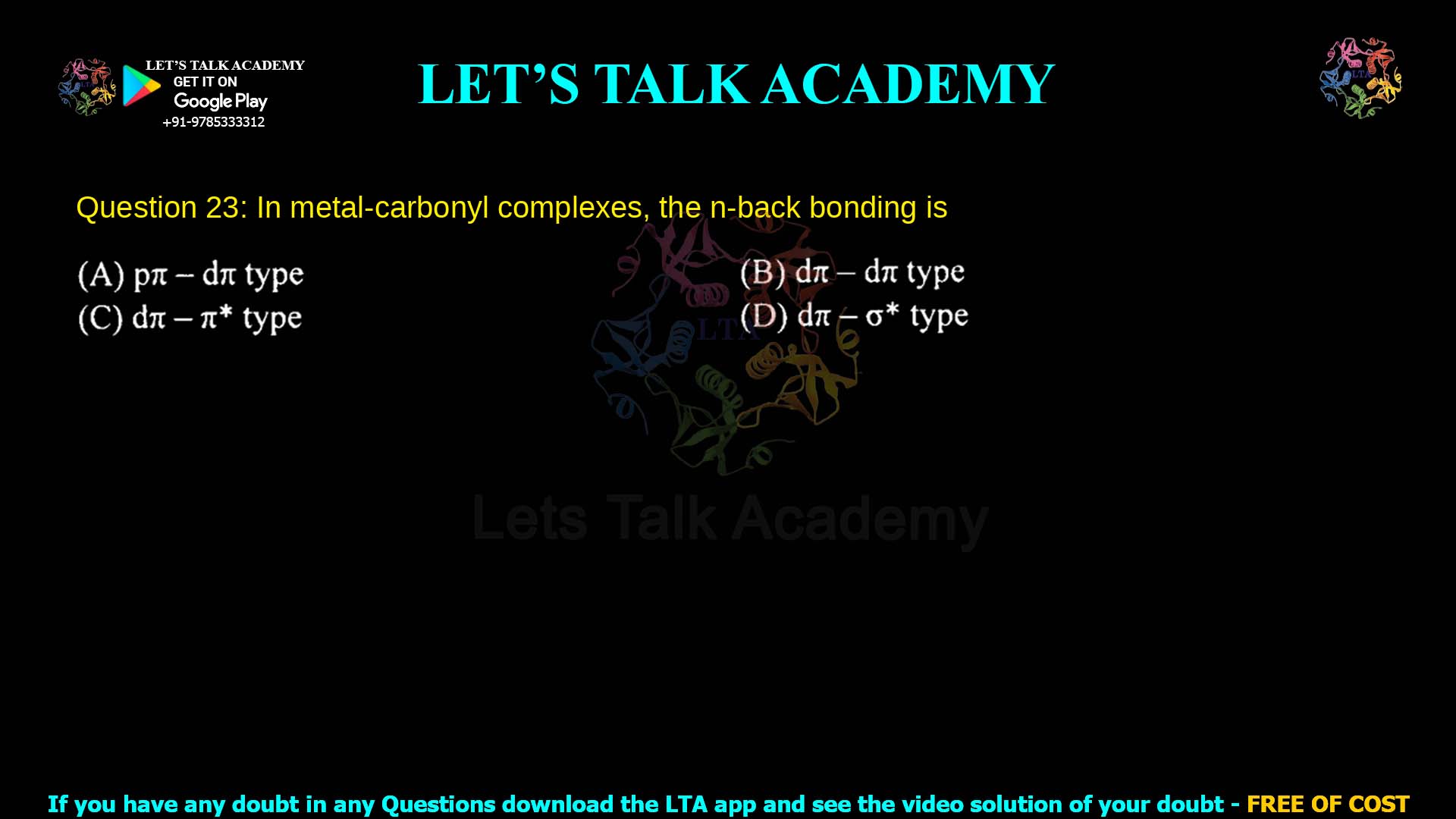
Q.23 In metal–carbonyl complexes, the π-back bonding is
(A) pπ–dπ type
(B) dπ–dπ type
(C) dπ–pπ type
(D) dπ–sπ type
The correct answer is (C) dπ–pπ type.
In metal-carbonyl complexes, π-back bonding involves electron donation from filled metal d-orbitals (dπ) to the empty π* antibonding orbitals on CO (pπ character), strengthening the M-CO bond while weakening C-O.
Option Analysis
(A) pπ–dπ type: Incorrect, as this describes forward donation from ligand pπ orbitals to empty metal d-orbitals, which occurs in σ-donation or pπ-dπ backbonding (e.g., halides), not the primary π-backbonding in carbonyls.
(B) dπ–dπ type: Incorrect, as this involves d-orbital overlap between metal and ligand (e.g., phosphines with d-orbitals), but CO lacks suitable d-orbitals for such interaction.
(C) dπ–pπ type: Correct, matching the metal dπ to CO π* (pπ-like) overlap, confirmed by IR shifts showing weakened C-O bonds and standard texts on synergic bonding.
(D) dπ–sπ type: Incorrect, as no sπ orbitals exist on CO for backbonding; CO’s π* are p-based.
Bonding Mechanism
CO acts as a σ-donor via its lone pair into empty metal d-orbitals, increasing metal electron density. This enables π-backbonding where filled metal dπ orbitals donate to CO’s empty π* orbitals (dπ-pπ), creating a synergic effect that stabilizes low-oxidation-state metals like Ni(0) in Ni(CO)₄. Evidence includes lowered ν_CO (e.g., 2060 cm⁻¹ in Ni(CO)₄ vs. 2143 cm⁻¹ free CO).
Introduction
π-Back bonding in metal-carbonyl complexes is a key concept in coordination chemistry, especially for CSIR NET Life Sciences and JEE aspirants. This dπ-pπ type interaction explains the stability of compounds like Ni(CO)₄ through synergic σ-donation and backbonding.
Synergic Bonding Basics
Metal-carbonyl complexes feature CO ligands bound via two-way electron flow. CO’s σ-donation uses its HOMO (5σ orbital, p-character) to metal d-orbitals, while π-back bonding donates from metal dπ to CO LUMO (π* orbitals, pπ). This dπ-pπ overlap shortens M-C bonds and lengthens C-O, evident in IR spectroscopy.
Why dπ-pπ in Carbonyls?
Filled metal d-orbitals (dπ symmetry) overlap sideways with CO’s empty π* (pπ from carbon/oxygen p-orbitals). Unlike pπ-dπ (ligand to metal), this back-donates electrons, reducing metal density. Examples: Cr(CO)₆ (ν_CO ~2000 cm⁻¹), confirming stronger backbonding in electron-rich metals.
Common Misconceptions
-
Not pπ-dπ: That’s forward π-donation (e.g., F⁻ to metal).
-
Not dπ-dπ: Rare, for ligands like PR₃ with d-orbitals.
This distinction is crucial for MCQs on bonding types in transition metal carbonyls.
Exam Relevance for CSIR NET
Questions test dπ-pπ identification via options like this Q.23. Factors enhancing backbonding: low metal oxidation state, high d-electron count. Practice with Ni(CO)₄ (tetrahedral, 18e⁻ rule).


