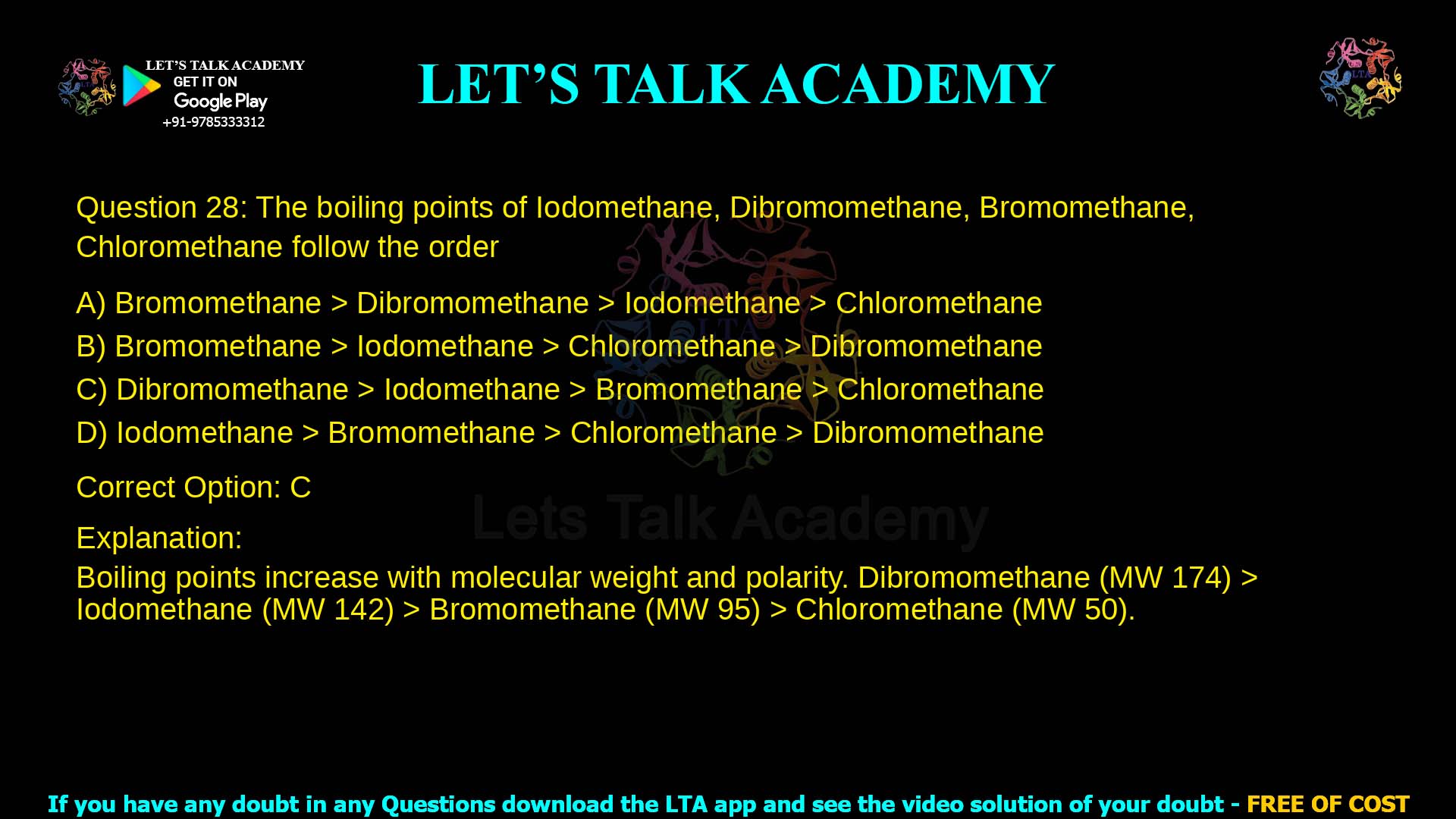
Q.28 The boiling points of Iodomethane, Dibromomethane, Bromomethane,
Chloromethane follow the order
(A) Bromomethane > Dibromomethane > Iodomethane > Chloromethane
(B) Bromomethane > Iodomethane > Chloromethane > Dibromomethane
(C) Dibromomethane > Iodomethane > Bromomethane > Chloromethane
(D) Iodomethane > Bromomethane > Chloromethane > Dibromomethane
Dibromomethane exhibits the highest boiling point among iodomethane, dibromomethane, bromomethane, and chloromethane due to its greatest molecular weight and strongest van der Waals forces. The correct order is Dibromomethane > Iodomethane > Bromomethane > Chloromethane, matching option (C).
Boiling Point Data
Actual boiling points confirm the trend driven by molecular mass (CH3Cl: 50.5 g/mol; CH3Br: 95 g/mol; CH3I: 142 g/mol; CH2Br2: 174 g/mol) and polarizability.
| Compound | Formula | Boiling Point (°C) | Molecular Weight (g/mol) |
|---|---|---|---|
| Chloromethane | CH3Cl | -24 | 50.5 |
| Bromomethane | CH3Br | 3.6-4 | 95 |
| Iodomethane | CH3I | 42 | 142 |
| Dibromomethane | CH2Br2 | 96-98 | 174 |
Higher mass increases surface area for London dispersion forces, outweighing dipole-dipole effects in these non-hydrogen-bonding molecules.
Option Analysis
-
(A) Bromomethane > Dibromomethane > Iodomethane > Chloromethane: Incorrect; dibromomethane (174 g/mol) exceeds bromomethane (95 g/mol), so it boils higher, not lower.
-
(B) Bromomethane > Iodomethane > Chloromethane > Dibromomethane: Wrong; places lowest-mass dibromomethane last despite highest value.
-
(C) Dibromomethane > Iodomethane > Bromomethane > Chloromethane: Correct; follows increasing molecular weight and van der Waals strength: CH3Cl < CH3Br < CH3I < CH2Br2.
-
(D) Iodomethane > Bromomethane > Chloromethane > Dibromomethane: False; iodomethane (42°C) boils far below dibromomethane (96°C) due to dibromomethane’s two heavy Br atoms.
The boiling points of iodomethane, dibromomethane, bromomethane, chloromethane follow a clear trend vital for CSIR NET Life Sciences and chemistry exams. This order—dibromomethane (96-98°C) > iodomethane (42°C) > bromomethane (3.6-4°C) > chloromethane (-24°C)—stems from molecular weights and intermolecular forces.
Boiling points rise with molecular mass in haloalkanes, as heavier atoms boost van der Waals (London dispersion) forces via greater polarizability. Chloromethane’s low mass yields the weakest forces; two bromine atoms in dibromomethane create the strongest despite replacing H.
-
For monohalomethanes (CH3X), order is CH3F < CH3Cl < CH3Br < CH3I due to halogen size/mass.
-
Polyhalomethanes like CH2Br2 surpass CH3I (174 > 142 g/mol).
-
No hydrogen bonding occurs; dipole moments play a secondary role to dispersion forces.
This principle applies across alkyl halides: RI > RBr > RCl > RF for same R, and more halogens raise boiling points. CSIR NET aspirants note this for questions on physical properties.


