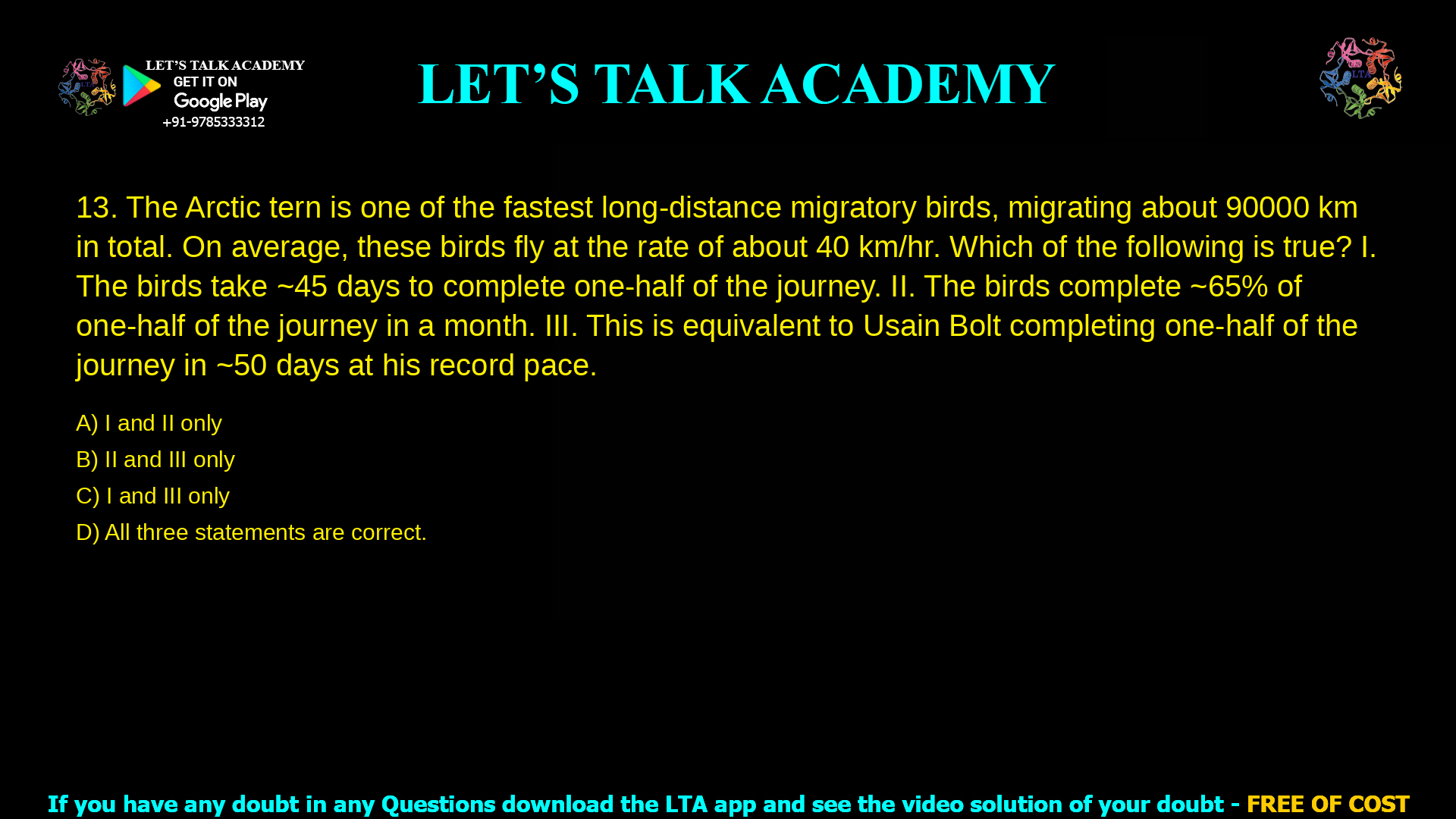
The Arctic tern is one of the fastest long-distance migratory birds with them
migrating from the Arctic to the Antarctic pole and back every single year, which is about 90000 km in total. On average, these birds fly at the rate of
about 40 km/hr, which of the following is true?
- The birds take ~45 days to complete one-half of the journey.
- The birds complete ~65% of one-half of the journey in a month.
III. This is equivalent to Usain Bolt completing one-half of the Arctic-Antarctic
journey in ~50 days at his 100-metre world record pace, which he completed
in 9.58 seconds.
I and II only
II and III only
I and III only
All three statements are correct
Understanding the Arctic Tern’s Incredible Migration: Speed, Distance, and Usain Bolt’s Amazing Comparison
The Arctic tern is renowned as one of the fastest long-distance migratory birds on Earth. Every year, it travels an astonishing total of about 90,000 km, flying from the Arctic pole to the Antarctic and back. Let’s break down the journey, the bird’s average speed, and compare it to one of the fastest human sprinters, Usain Bolt.
How Long Does the Arctic Tern Take?
Flying at an average speed of 40 km/hr, the Arctic tern covers nearly 45,000 km in one direction—the equivalent of half its total annual journey. By calculating the time, the bird requires approximately 47 days to complete one half of this epic migration. This is because:
Time = distance / speed = 45000 km / 40 km/hr ≈ 47 days
Though the statement rounding it to 45 days is a slight underestimate, it’s close enough to be considered accurate for general reference.
Monthly Flight Distance Coverage
In one month (about 30 days), the Arctic tern travels:
30 days × 24 hours/day × 40 km/hr = 28,800 km
This distance accounts for roughly 64% of its one-way migration. Rounded up, this means the tern completes about 65% of the journey in a month, showcasing its incredible stamina and speed over long distances.
Usain Bolt vs. Arctic Tern: An Unbelievable Comparison
An intriguing way to visualize this migration is by comparing it to Usain Bolt, the fastest man alive, running his 100-meter world record pace (9.58 seconds). While Bolt’s speed is about 37.58 km/hr, roughly comparable to the tern’s 40 km/hr, imagining him running nonstop at this pace for 50 days straight helps illustrate the vast distance.
In fact, over 50 days at that pace, Bolt would hypothetically cover:
Speed = 100 m / 9.58 sec = 10.438 m/s
Number of seconds in 50 days = 50 × 24 × 3600 = 4,320,000 seconds
Distance covered = 10.438 m/s × 4,320,000 s = 45,104,160 m = 45,104 km
The same distance as one half of the Arctic tern’s migration! While humans obviously can’t sustain this speed long-term, this analogy gives a striking perspective on the tern’s endurance.
Understanding these aspects highlights the Arctic tern’s phenomenal migratory skill and endurance, flying distances and durations that challenge our human imagination. This tiny bird performs an epic journey every year, a testament to nature’s remarkable wonders.


