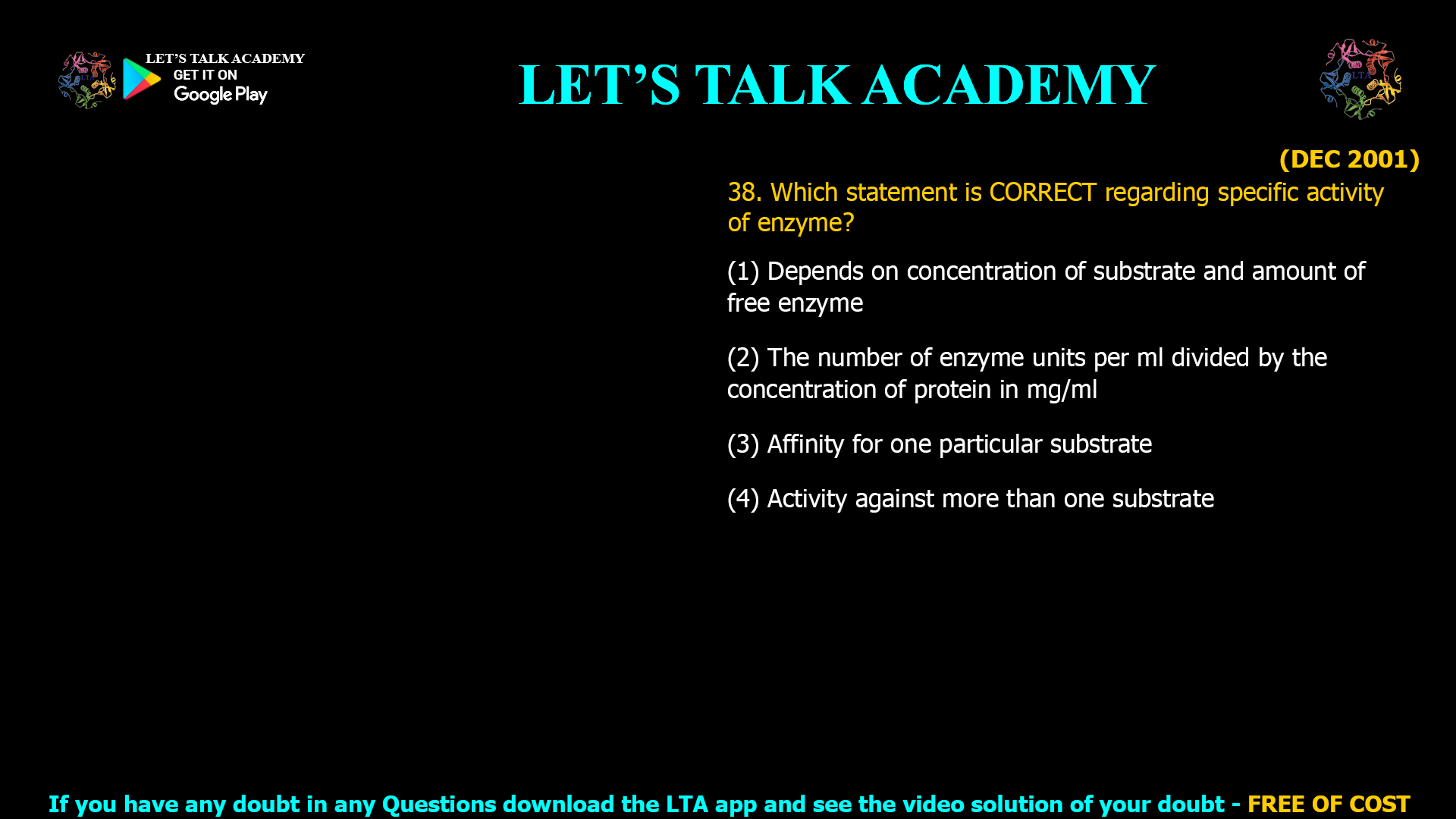
(DEC 2001)
38. Which statement is CORRECT regarding specific activity of enzyme?
(1) Depends on concentration of substrate and amount of free enzyme
(2) The number of enzyme units per ml divided by the concentration of protein in mg/ml
(3) Affinity for one particular substrate
(4) Activity against more than one substrate
The correct answer is (2) The number of enzyme units per ml divided by the concentration of protein in mg/ml.
Introduction
Specific activity is a key parameter in enzyme biochemistry representing the purity and catalytic effectiveness of an enzyme preparation. It quantifies the number of enzymatic units per milligram of protein, providing a normalized measure of enzyme activity relative to protein concentration. This article defines specific activity, explains how it is calculated, and clarifies misconceptions about its dependence on substrate concentration or specificity.
What is Specific Activity?
-
Definition:
The specific activity of an enzyme is the number of enzyme units (units of catalytic activity) per milliliter of enzyme solution, divided by the amount of protein in milligrams per milliliter (mg/ml). It shows how much enzyme activity exists per unit protein mass.
Specific Activity=Enzyme Units/mlProtein mg/ml=units/mg
-
Units: usually expressed as units per mg of protein (U/mg).
Why is Specific Activity Important?
-
Measure of Purity:
As enzyme preparations become purer, specific activity increases because less total protein corresponds to the same or more enzymatic activity. -
Comparison Between Samples:
Allows comparison of enzyme efficiency across batches or treatments, regardless of total protein concentration.
What Specific Activity Does NOT Depend On
-
Substrate Concentration:
Specific activity is intrinsic to the enzyme prep and reflects concentration-normalized catalytic activity; substrate concentration influences raw enzyme activity but is accounted for in units. -
Enzyme Affinity or Specificity for Multiple Substrates:
Specific activity is not an affinity measure nor does it describe substrate spectrum.
Incorrect Options Clarified
-
(1) Depends on concentration of substrate and amount of free enzyme: Incorrect, as specific activity normalizes activity to protein content, independent of substrate concentration or free enzyme amount.
-
(3) Affinity for one particular substrate: Incorrect, affinity is measured by Km or binding constants, not specific activity.
-
(4) Activity against more than one substrate: Incorrect, specific activity is measured for one defined substrate in a given assay.
Calculation Example
If 1 ml enzyme solution has 100 enzyme units and protein concentration is 2 mg/ml, then:
Specific Activity=100 units/ml2 mg/ml=50 U/mg
Summary Table
| Statement | Correct/Incorrect | Explanation |
|---|---|---|
| Depends on substrate and enzyme concentration | Incorrect | Normalized to protein concentration |
| Number of units per ml / mg protein | Correct | True definition of specific activity |
| Measures substrate affinity | Incorrect | Affinity is Km, not specific activity |
| Activity on multiple substrates | Incorrect | Specific activity measures activity for one substrate |
Conclusion
Specific activity, defined as the number of enzyme units per ml divided by protein concentration in mg/ml, is a fundamental measure of enzyme purity and activity. It normalizes enzymatic activity to protein content, ensuring consistent comparison across samples and experimental conditions. It is distinct from substrate affinity or substrate specificity.
This detailed explanation enables students and researchers to accurately calculate and interpret specific activity, driving better understanding of enzymatic preparations and experimental results.


39 Comments
Varsha Tatla
September 13, 2025Enz specific activity always depends upon substrate concentration nd free Enz amount
Khushi Vaishnav
September 13, 2025The number of enzyme units per ml divided by the concentration of protein in mg/ml.
Aakansha sharma Sharma
September 13, 2025The correct answer is (2) The number of enzyme units per ml divided by the concentration of protein in mg/ml.
Kajal
September 14, 2025Option 2 is correct answer as specific activities of enzyme’s depends upon no. of enzyme unit per ml /concentration of protein in mg /ml
Sakshi yadav
September 14, 2025The number of enzyme units per ml divided by the concentration of protein in mg/ml.
Pratibha Jain
September 14, 2025correct answer is option (2)
The number of enzyme units per ml divided by the concentration of protein in mg/ml.
Mohd juber Ali
September 14, 2025Option 2
Kavita Choudhary
September 14, 2025The number of enzyme units per ml divided by the concentration of protein in mg/ml.
Pooja
September 14, 2025Option b is correct
The number of enzyme units per ml divided by the concentration of protein in mg/ml
Kanica Sunwalka
September 14, 2025option 2 is correct
Soniya Shekhawat
September 14, 2025Specific activity of enzyme is Number of enzyme units per ml / mg protein.
Kirti Agarwal
September 14, 2025Opt 2
Santosh Saini
September 14, 2025The number of enzyme units per ml divided by the concentration of protein in mg/ml
Shivani
September 14, 2025The number of enzyme units per ml divided by the concentration of protein in mg/ml
Rishita
September 14, 2025Option 2 is correct answer as specific activities of enzyme’s depends upon no. of enzyme unit per ml /concentration of protein in mg /ml
Khushi Agarwal
September 14, 2025The correct answer is 2
The number of enzyme units per ml divided by the concentration of protein in mg/ml
Neha Yadav
September 14, 2025The number of enzyme units per ml divided by the concentration of protein in mg/ml.
Vanshika Sharma
September 14, 2025The no. Of enzymes units per ml divided by conc of protiens in mg per ml
Aartii sharma
September 14, 2025The no. Of enzymes units per ml dividedby conc of proteins in mg per ml
Tanvi Panwar
September 14, 2025the specific activity of enzymes is no. of enzymes unit per ml divided by protein conc. in mg per ml.
Muskan singodiya
September 14, 2025Option 2
Priya dhakad
September 14, 2025The number of enzyme units per ml divided by the concentration of protein in mg/ml.
Heena Mahlawat
September 14, 2025Specific activities of enzyme is defined as number of enzyme units per ml divided by concentration of protein in mg/ml that shows how much enzyme activity exists per unit protein mass.
Anurag Giri
September 15, 2025The correct answer is (2) The number of enzyme units per ml divided by the concentration of protein
yashika
September 15, 2025The number of enzyme units per ml divided by concentration
Asha Gurzzar
September 15, 2025No.of enzyme units per ml division by concentration
Pallavi Ghangas
September 15, 2025The number of enzyme units per ml divided by the concentration of protein in mg/ml.
Bhavana kankhedia
September 15, 2025(2) The number of enzyme units per ml divided by the concentration of protein in mg/ml
Anjana sharma
September 16, 2025The number of enzyme units per ml divided by the concentration of protein in mg/ml.
Sonal nagar
September 16, 2025Option 2
The number of enzyme units per ml divided by the concentration of protein in mg/ml.
Avni
September 16, 2025The correct answer is (2) The number of enzyme units per ml divided by the concentration of protein in mg/ml.
Palak Sharma
September 16, 2025The number of enzyme units per ml divided by the concentration of protein in mg/ml.
Simran Saini
September 16, 2025The number of enzyme units per ml divided by the concentration of protein in mg/ml.
Muskan Yadav
September 17, 2025The number of enzyme units per ml divided by the concentration of protein in mg/ml.
Sonal nagar
September 17, 2025Option 2
Ruchika
September 17, 2025Number of enzymes unit per of ml divided by tha conc of protein in mg/ml
Payal Solanki
September 18, 2025Option 2 is correct the number of enzyme units per divided by the concentration of protein in mg/ml
Minal Sethi
September 18, 2025the no. of enzyme units per ml divided by the concentration of protein in mg/ml
Deepika sheoran
September 18, 2025Option 2
Number of enzyme units per ml divided by the concentration of protein in mg/ml.