
27. Given below are graphs depicting two possible dynamics of gene duplication events over a period of time during genome evolution.
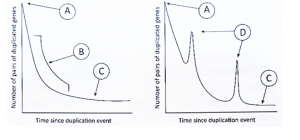
Based on the above figures, which one of the following options correctly represents the identity of A, B, C and D?
(1) A-Gene duplication event, B-random loss of duplicated genes, C-remaining pairs of
duplicated genes, D-additional gene duplication events
(2) A-remaining pairs of duplicated genes, B-gene duplication event, C-random loss of duplicated genes, D-additional gene duplication events
(3) A-additional gene duplication events, B-random loss of duplicated genes, C- remaining pairs of duplicated genes, D-Gene duplication event
(4) A-Random loss of duplicated genes, B-additional gene duplication events, C- gene
duplication event, D-remaining pairs of duplicated genes
Gene Duplication Dynamics: Understanding the Fate of Duplicated Genes in Genome Evolution
Gene duplication is one of the most powerful forces in genome evolution, providing raw material for genetic innovation and complexity. However, the fate of duplicated genes is not straightforward. After duplication, some gene copies are retained, while others are lost or diverge in function. To visualize these processes, scientists often use graphs that depict the number and fate of duplicated genes over time during genome evolution. Understanding these graphs is essential for interpreting how genomes expand and diversify.
The Stages of Gene Duplication and Loss
Gene duplication events can occur through various mechanisms such as unequal crossing-over, replication slippage, or whole-genome duplication. After a duplication event, the following stages typically occur:
-
Immediate Increase: The number of gene pairs rises sharply due to the duplication event.
-
Random Loss: Many duplicated genes are lost over time through genetic drift, deletion, or pseudogenization.
-
Retention and Divergence: Some gene pairs are retained and may acquire new functions or become specialized.
-
Additional Duplication Events: Further duplication events can occur, adding more gene pairs to the genome.
Interpreting Gene Duplication Graphs
In the context of the question, the graphs illustrate two possible dynamics:
-
A sudden spike in gene pairs (indicating a duplication event).
-
A gradual or rapid decline (representing random loss of duplicated genes).
-
A plateau or steady state (remaining pairs of duplicated genes).
-
Occasional additional spikes (additional duplication events).
Correct Identification of Graph Labels
Given the options and the typical progression of gene duplication dynamics, the correct identification is:
-
A: Gene duplication event (sharp increase in gene pairs)
-
B: Random loss of duplicated genes (decline after the spike)
-
C: Remaining pairs of duplicated genes (plateau or steady state)
-
D: Additional gene duplication events (subsequent spikes)
This matches Option (1):
A-Gene duplication event, B-random loss of duplicated genes, C-remaining pairs of duplicated genes, D-additional gene duplication events
Why This Pattern Occurs
-
Gene duplication events provide a sudden increase in gene copy number.
-
Random loss is common because many duplicates are non-essential and can be lost without affecting fitness.
-
Remaining pairs are those that either provide a selective advantage or have acquired new functions.
-
Additional duplication events can occur, further shaping the genome.
The Evolutionary Impact
Gene duplication and loss are central to the evolution of gene families and biological complexity. While many duplicated genes are lost, those that are retained can drive innovation, adaptation, and the emergence of new traits.
Conclusion
Understanding the dynamics of gene duplication and loss is crucial for interpreting genome evolution. The most accurate representation of these dynamics in gene duplication graphs is:
A: Gene duplication event, B: random loss of duplicated genes, C: remaining pairs of duplicated genes, D: additional gene duplication events.
This pattern highlights the balance between innovation and redundancy in the evolutionary history of genomes.


