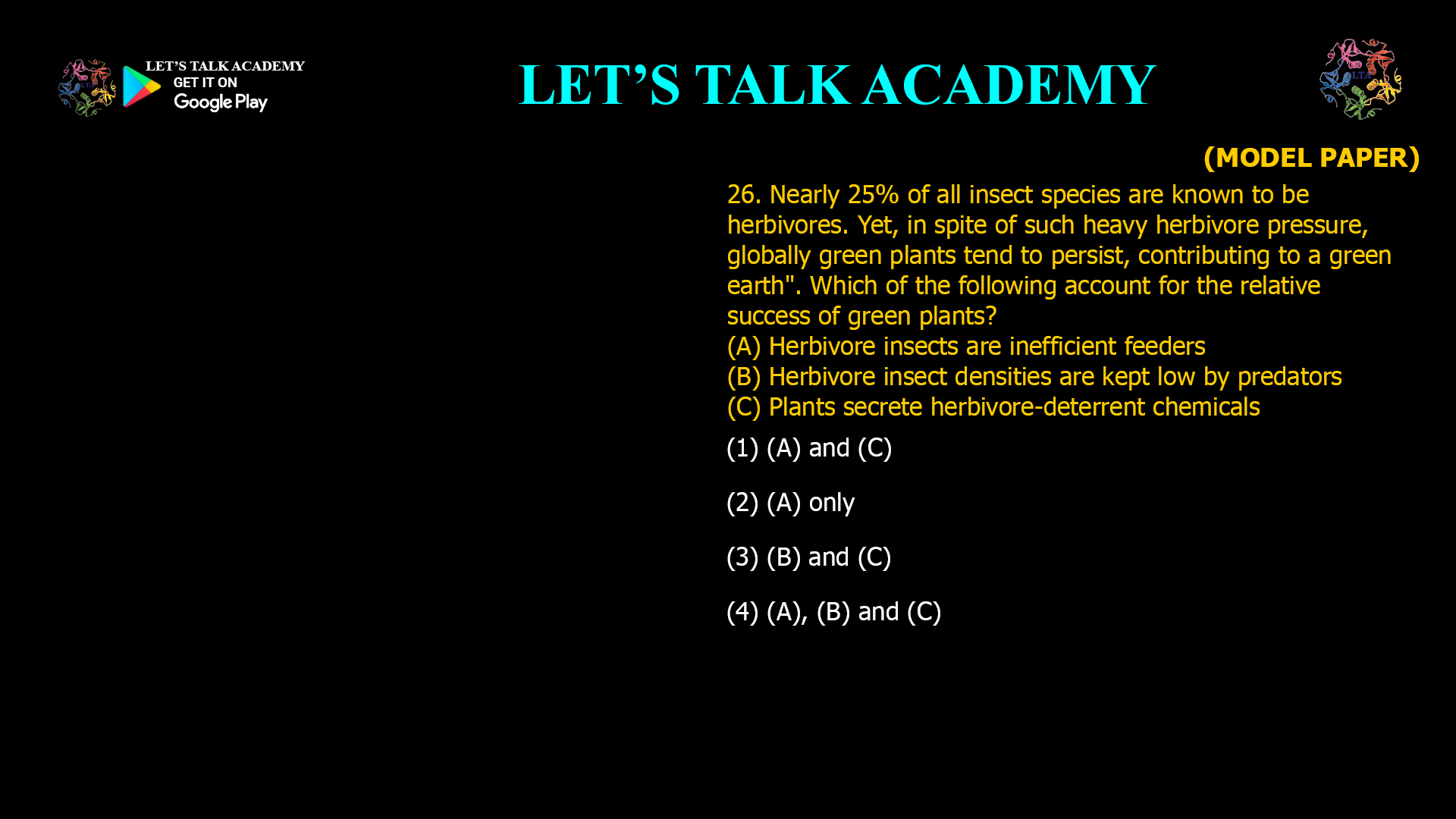
- Nearly 25% of all insect species are known to be herbivores. Yet, in spite of such heavy herbivore pressure, globally green plants tend to persist, contributing to a green earth”. Which of the following account for the relative success of green plants?
(A) Herbivore insects are inefficient feeders
(B) Herbivore insect densities are kept low by predators
(C) Plants secrete herbivore-deterrent chemicals
(1) (A) and (C) (2) (A) only
(3) (B) and (C) (4) (A), (B) and (C)Key Reasons for the Success of Green Plants
1. Herbivore Insects Are Inefficient Feeders
Herbivorous insects, while abundant, are not always efficient at consuming plant material. Many factors contribute to this inefficiency:
-
Digestive limitations: Insects often struggle to fully digest tough plant tissues or break down complex plant compounds.
-
Plant defenses: Physical barriers like waxy cuticles, thorns, and tough leaves reduce the amount of plant material that herbivores can access or process136.
-
Behavioral constraints: Some insects are selective feeders, targeting only certain plant parts or species, leaving much of the vegetation untouched.
2. Herbivore Insect Densities Are Kept Low by Predators
Natural enemies play a crucial role in regulating herbivore populations:
-
Predators and parasitoids: Birds, spiders, wasps, and other predators feed on herbivorous insects, keeping their numbers in check4.
-
Indirect plant defenses: Some plants attract or shelter predators (such as ants) that defend them from herbivores, further reducing herbivore pressure4.
-
Ecological balance: The presence of these natural enemies ensures that herbivore outbreaks are usually short-lived and localized, preventing widespread plant destruction.
3. Plants Secrete Herbivore-Deterrent Chemicals
Plants have evolved a sophisticated arsenal of chemical defenses to deter or harm herbivores:
-
Secondary metabolites: Compounds like alkaloids, glycosides, tannins, and volatile oils make plants unpalatable, toxic, or even lethal to many insects123568.
-
Induced responses: When attacked, some plants ramp up the production of these chemicals or release volatile compounds that attract predators of the herbivores138.
-
Constitutive defenses: Many plants maintain a baseline level of chemical defenses at all times, while others produce them only in response to herbivore damage.
Synthesis: The Green World Hypothesis
The persistence of green plants globally is explained by the combined effects of herbivore inefficiency, effective natural enemies, and plant chemical defenses. These mechanisms act together to prevent herbivores from ever consuming the majority of plant biomass, maintaining the balance of terrestrial ecosystems.
Correct Answer
Given the options:
-
(A) Herbivore insects are inefficient feeders
-
(B) Herbivore insect densities are kept low by predators
-
(C) Plants secrete herbivore-deterrent chemicals
The most comprehensive and accurate explanation is:
(4) (A), (B) and (C)
Conclusion
Green plants persist and thrive despite the immense pressure from herbivorous insects because of a combination of herbivore inefficiency, the regulatory effect of predators, and the production of powerful chemical defenses. This synergy ensures the continued dominance of green vegetation on Earth, supporting the stability and productivity of ecosystems worldwide.
-


3 Comments
Manisha choudhary
November 8, 2025A,B and C all statement are correct
Kajal
November 9, 2025All
Sakshi Kanwar
November 27, 2025A B and C