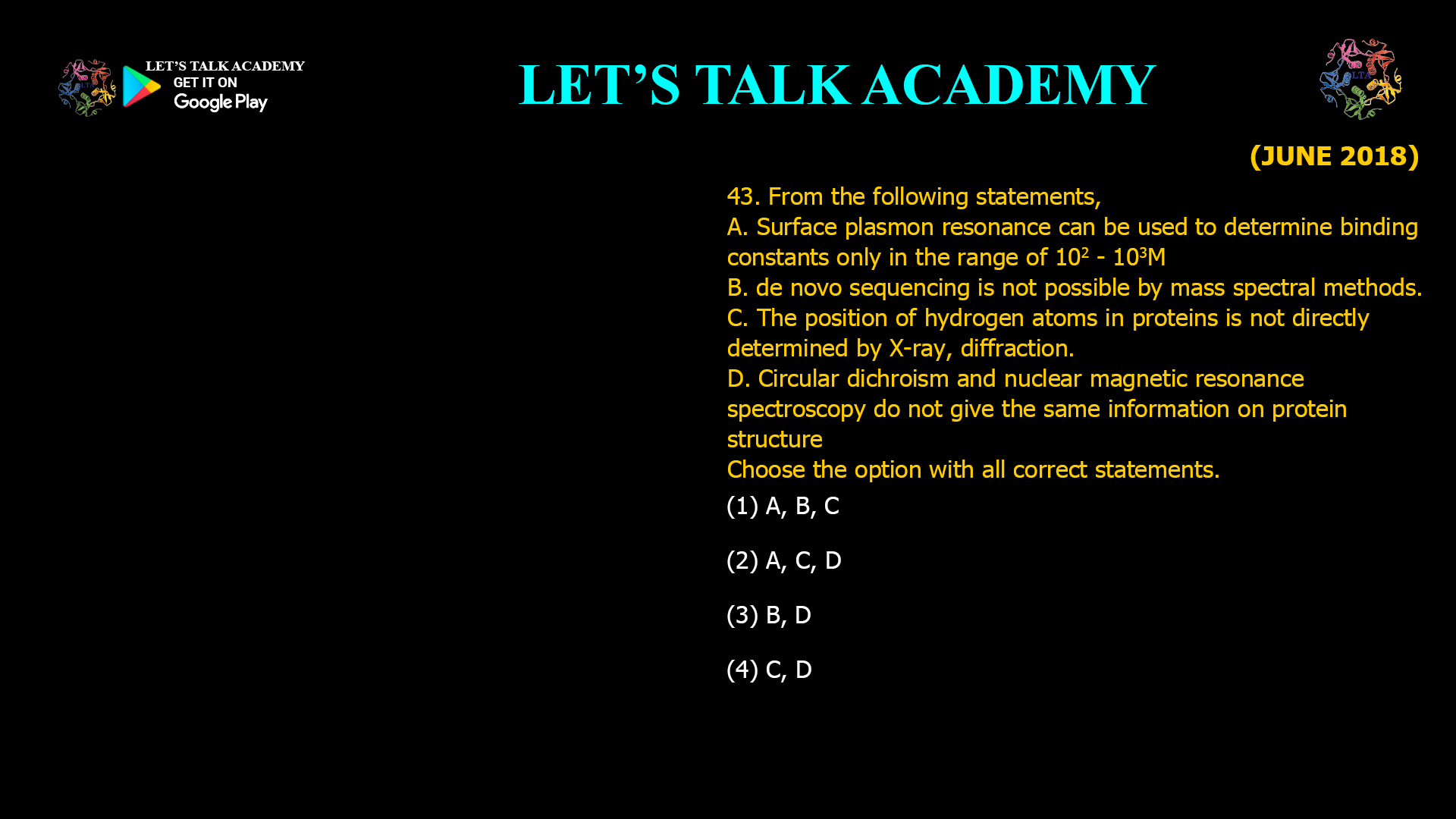
43. From the following statements,
A. Surface plasmon resonance can be used to determine binding constants only in the range of 10²–10³ M.
B. De novo sequencing is not possible by mass spectral methods.
C. The position of hydrogen atoms in proteins is not directly determined by X-ray diffraction.
D. Circular dichroism and nuclear magnetic resonance spectroscopy do not give the same information on protein structure.
Choose the option with all correct statements.
(A) A, B, C
(B) A, C, D
(C) B, D
(D) C, D
Evaluating Statements on Protein Structure Analysis Techniques
Correct Answer
Option (4): C, D
Explanation
This question evaluates the principles and applications of several important techniques used in structural biology and biophysical chemistry. Each method provides different types of information about proteins, ranging from molecular interactions to three-dimensional structure and amino acid sequence. The validity of each statement must therefore be examined individually.
Analysis of Statement A
Statement A is incorrect.
Surface Plasmon Resonance (SPR) is a highly sensitive technique used to study biomolecular interactions in real time without the need for molecular labeling. One of its major applications is the determination of kinetic rate constants and equilibrium binding constants. SPR is capable of measuring interactions over a very broad affinity range, extending from weak millimolar interactions to extremely tight picomolar interactions, depending on the experimental design and instrument sensitivity.
The statement incorrectly claims that SPR can determine binding constants only in the range of 102–103 M. In reality, SPR is routinely used to measure equilibrium dissociation constants spanning several orders of magnitude. Therefore, restricting its applicability to such a narrow range is scientifically incorrect.
Analysis of Statement B
Statement B is incorrect.
Modern tandem mass spectrometry (MS/MS) is capable of determining the amino acid sequence of peptides directly from fragmentation patterns. This process, known as de novo sequencing, does not require prior knowledge of the protein sequence or comparison with a sequence database. By analyzing fragment ions generated during peptide fragmentation, the amino acid sequence can be reconstructed with high accuracy.
Although de novo sequencing becomes increasingly challenging for long peptides or proteins containing multiple modifications, it is nevertheless a well-established application of mass spectrometry. Therefore, the statement claiming that de novo sequencing is not possible is incorrect.
Analysis of Statement C
Statement C is correct.
X-ray diffraction detects the distribution of electrons surrounding atoms rather than the atomic nuclei themselves. Hydrogen atoms possess only a single electron and therefore scatter X-rays extremely weakly compared with heavier atoms such as carbon, nitrogen, oxygen, and sulfur. As a result, hydrogen atoms are generally not directly visualized in conventional protein X-ray diffraction experiments. Instead, their positions are usually inferred from standard chemical geometry, hydrogen-bonding patterns, and computational refinement. Only exceptionally high-resolution X-ray structures may reveal a limited number of hydrogen atoms directly.
Analysis of Statement D
Statement D is correct.
Circular Dichroism (CD) spectroscopy and Nuclear Magnetic Resonance (NMR) spectroscopy provide fundamentally different structural information. CD spectroscopy primarily estimates the secondary structural content of proteins by measuring the differential absorption of circularly polarized light. It provides information about the relative proportions of α-helices, β-sheets, turns, and random coils but does not determine the complete three-dimensional structure.
NMR spectroscopy, in contrast, provides atomic-level structural information in solution. It can determine three-dimensional protein structures, identify interatomic distances, investigate molecular dynamics, monitor conformational changes, and study intermolecular interactions. Since the two techniques measure different physical properties and provide different structural information, they cannot be considered equivalent.
Why Option (1) is Incorrect
This option includes Statements A and B, both of which are incorrect. SPR is not limited to a narrow binding constant range, and de novo peptide sequencing is routinely performed using tandem mass spectrometry. Although Statement C is correct, the presence of incorrect statements makes this option invalid.
Why Option (2) is Incorrect
While Statements C and D are correct, Statement A is incorrect because SPR measures molecular interactions over a wide range of binding affinities rather than only within the narrow range specified. Therefore, this combination cannot be accepted.
Why Option (3) is Incorrect
Statement D is correct, but Statement B is incorrect because tandem mass spectrometry is capable of determining peptide sequences directly through de novo sequencing strategies. Consequently, this option contains an incorrect statement.
Why Option (4) is Correct
Statement C correctly describes the limitation of conventional X-ray diffraction in directly locating hydrogen atoms, while Statement D accurately distinguishes the structural information provided by Circular Dichroism and Nuclear Magnetic Resonance spectroscopy. Since Statements A and B are incorrect, the correct combination consists only of Statements C and D.
Comparison of the Techniques
Surface Plasmon Resonance is primarily used to investigate biomolecular interactions and determine kinetic and equilibrium binding parameters. Mass spectrometry identifies proteins, detects post-translational modifications, and enables peptide sequencing through fragmentation analysis. X-ray diffraction provides high-resolution three-dimensional structures by analyzing electron density within crystals. Circular Dichroism estimates secondary structural content and monitors structural transitions, whereas Nuclear Magnetic Resonance determines protein structures and molecular dynamics in solution at atomic resolution.
Conclusion
Among the four statements, only Statements C and D are scientifically correct. Surface Plasmon Resonance is not restricted to the narrow binding range stated, and de novo peptide sequencing is an established application of tandem mass spectrometry. Therefore, the correct answer is Option (4): C, D.


