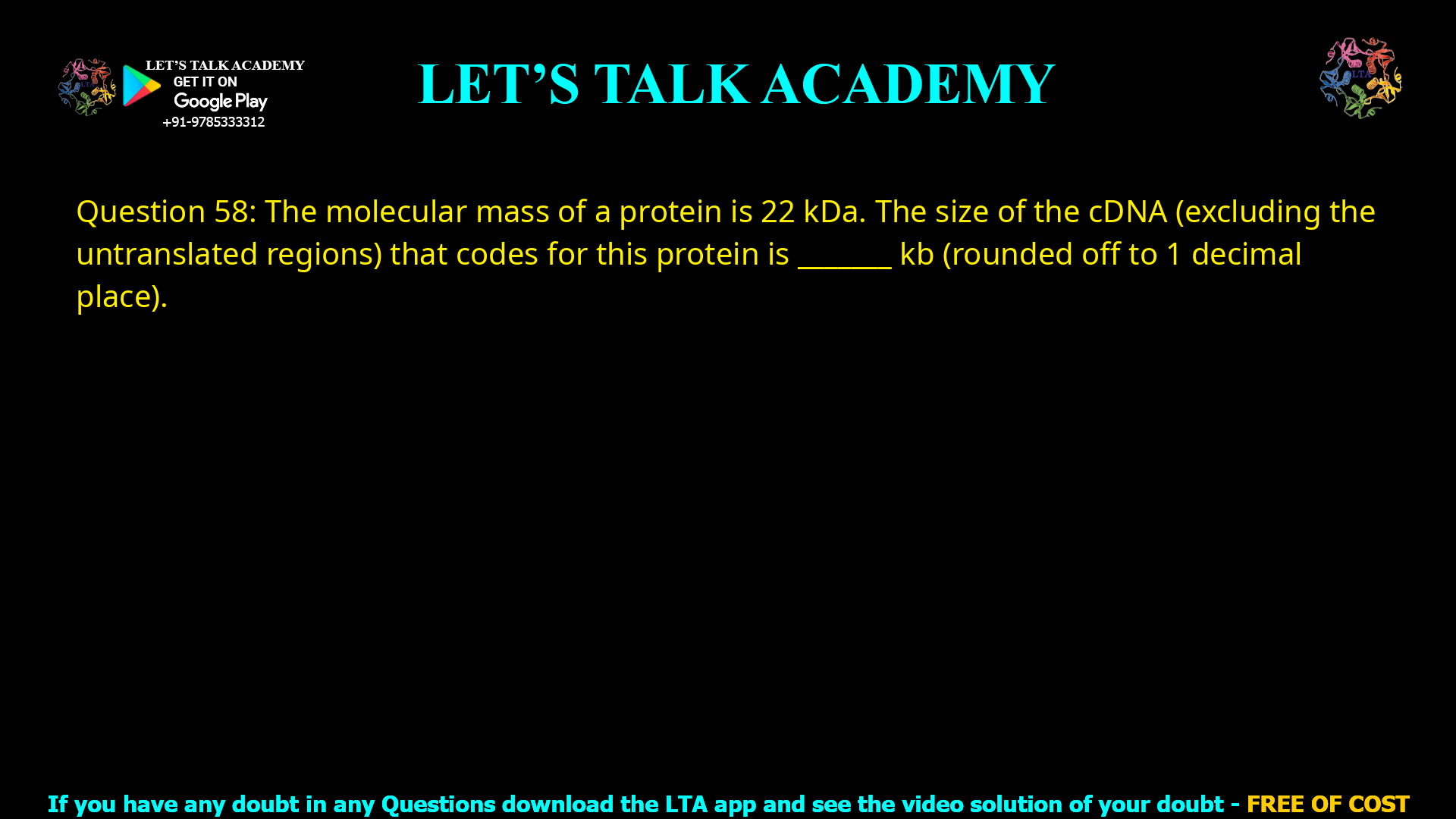
Q.58 The molecular mass of a protein is 22 kDa.
The size of the cDNA (excluding the untranslated regions) that codes for this protein is _______ kb (rounded off to 1 decimal place).
Final Answer
0.6 kb
Calculation Steps
A protein with a molecular mass of 22 kDa equals 22,000 Daltons.
- Average residue mass = 110 Da
- Number of amino acids:
n = 22000 / 110 = 200 residues
Each amino acid requires a codon of 3 nucleotides:
200 × 3 = 600 bases = 0.6 kb
This excludes untranslated regions (UTRs) or leader sequences.
Options Explained
No explicit options appear in the text, but common incorrect values include:
- 2.2 kb or 4.4 kb — incorrectly include UTRs or regulatory regions
- ~0.7 kb — uses free amino acid mass (~128 Da) instead of residue mass
- 0.5 kb — rounding errors
Correct method uses 110 Da per residue and only coding DNA.
Key Formula
Protein mass (Da) ÷ 110 Da/residue = amino acids
amino acids × 3 bases/codon = bp ≈ bp ÷ 1000 = kb
22,000 Da / 110 Da = 200 aa
200 aa × 3 bases = 600 bp = 0.6 kb
Common Errors
- Using free amino acid mass (128 Da) → underestimates needed bases
- Including 5’ & 3’ UTRs → inflates kb size incorrectly
- Ignoring residue mass vs. molecular weight → 10–20% error
Applications
- Predict insert size for cloning vectors
- Estimate PCR product length
- Useful for biotech exam questions on gene–protein relationships
This protein-to-cDNA kb method is essential in genetic engineering, expression analysis, and bioinformatics workflows.


