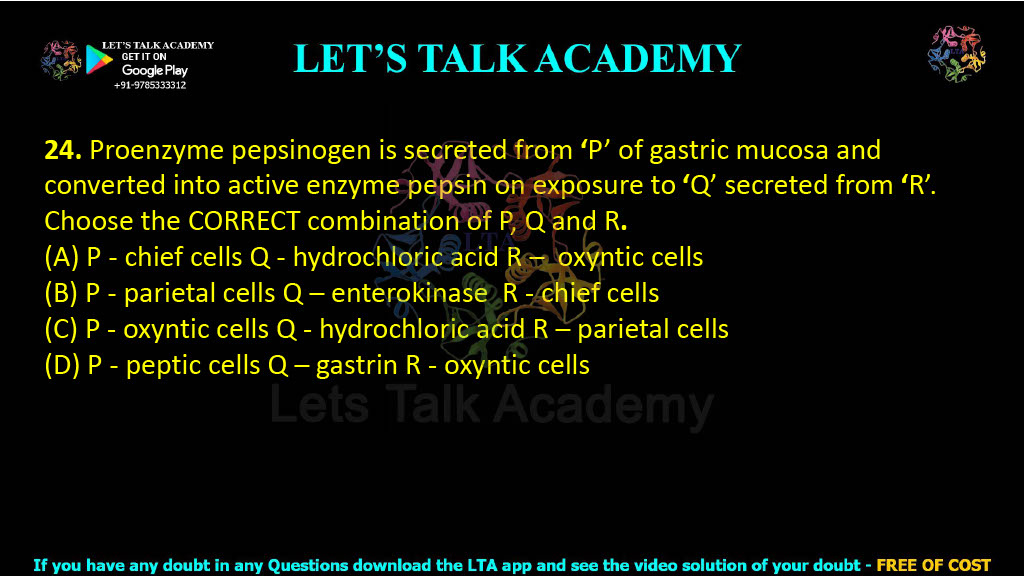
24. Proenzyme pepsinogen is secreted from ‘P’ of gastric mucosa and converted into active enzyme pepsin on exposure to ‘Q’ secreted from ‘R’. Choose the CORRECT combination of P, Q and R.
(A) P – chief cells Q – hydrochloric acid R – oxyntic cells
(B) P – parietal cells Q – enterokinase R – chief cells
(C) P – oxyntic cells Q – hydrochloric acid R – parietal cells
(D) P – peptic cells Q – gastrin R – oxyntic cells
Pepsinogen Activation in the Stomach
Introduction
The stomach is one of the most important organs of the digestive system and plays a major role in the digestion of proteins. Gastric glands present in the stomach lining contain specialized secretory cells that produce digestive enzymes, hydrochloric acid, mucus, and regulatory hormones. These secretions work together to initiate protein digestion, protect the stomach lining, and create an acidic environment that prevents microbial growth.
One of the major digestive enzymes produced in the stomach is pepsin, which digests proteins into smaller peptides. However, pepsin is not secreted in its active form because it could digest the proteins of the cells producing it. Instead, the enzyme is synthesized as an inactive precursor called pepsinogen. Pepsinogen is converted into active pepsin only after exposure to hydrochloric acid secreted by parietal (oxyntic) cells. This mechanism protects gastric cells from self-digestion while ensuring efficient protein digestion after food enters the stomach.
Correct Answer
Correct Option: (A) P – Chief cells, Q – Hydrochloric acid, R – Oxyntic cells
Detailed Explanation
Protein digestion begins in the stomach through the action of the enzyme pepsin. To prevent damage to the cells that produce it, pepsin is synthesized and stored as the inactive zymogen pepsinogen. Pepsinogen is secreted by the chief cells, also known as peptic cells or zymogenic cells, located in the gastric glands of the stomach.
Once pepsinogen is released into the stomach lumen, it encounters the highly acidic gastric juice. The acidity is produced by parietal cells, also called oxyntic cells, which secrete hydrochloric acid (HCl). Hydrochloric acid lowers the gastric pH to approximately 1.5–2.0. This acidic environment converts inactive pepsinogen into active pepsin by removing an inhibitory peptide segment from the zymogen molecule.
After a small amount of pepsin is formed, it can activate additional pepsinogen molecules through an autocatalytic process, thereby accelerating protein digestion. Thus, pepsinogen secretion by chief cells and hydrochloric acid secretion by oxyntic (parietal) cells together ensure efficient digestion while protecting gastric tissues from autodigestion.
Explanation of Each Option
Option (A): Chief Cells – Hydrochloric Acid – Oxyntic Cells
This statement is correct. Chief cells secrete pepsinogen, while oxyntic (parietal) cells secrete hydrochloric acid. Hydrochloric acid activates pepsinogen into pepsin, making this the correct combination.
Option (B): Parietal Cells – Enterokinase – Chief Cells
This statement is incorrect. Parietal cells do not secrete pepsinogen. Furthermore, enterokinase (enteropeptidase) is produced by the duodenal mucosa and activates trypsinogen, not pepsinogen.
Option (C): Oxyntic Cells – Hydrochloric Acid – Parietal Cells
This statement is incorrect. Although oxyntic cells and parietal cells are the same cell type that secretes hydrochloric acid, pepsinogen is not produced by these cells. Pepsinogen is secreted by chief cells.
Option (D): Peptic Cells – Gastrin – Oxyntic Cells
This statement is incorrect. Peptic cells indeed secrete pepsinogen, but gastrin is a hormone secreted by G cells of the stomach. Gastrin stimulates gastric acid secretion but does not directly convert pepsinogen into pepsin.
Why Option (A) is Correct
Chief cells produce inactive pepsinogen, whereas oxyntic (parietal) cells produce hydrochloric acid. Hydrochloric acid provides the acidic environment necessary to convert pepsinogen into active pepsin. Therefore, the correct sequence is Chief cells → Pepsinogen → Hydrochloric acid from oxyntic cells → Pepsin.
Why the Other Options are Incorrect
Why Option (B) is Incorrect
Enterokinase activates trypsinogen in the small intestine and has no role in pepsinogen activation.
Why Option (C) is Incorrect
Oxyntic cells secrete hydrochloric acid but do not synthesize pepsinogen.
Why Option (D) is Incorrect
Gastrin stimulates acid secretion but is not the activating molecule for pepsinogen.
Comparison of All Options
| Option | P | Q | R | Correct or Incorrect |
|---|---|---|---|---|
| A | Chief Cells | Hydrochloric Acid | Oxyntic Cells | Correct |
| B | Parietal Cells | Enterokinase | Chief Cells | Incorrect |
| C | Oxyntic Cells | Hydrochloric Acid | Parietal Cells | Incorrect |
| D | Peptic Cells | Gastrin | Oxyntic Cells | Incorrect |
Major Cells of Gastric Glands
| Cell Type | Secretion | Major Function |
|---|---|---|
| Chief (Peptic) Cells | Pepsinogen | Protein digestion |
| Parietal (Oxyntic) Cells | Hydrochloric acid and Intrinsic factor | Acid secretion and Vitamin B12 absorption |
| Mucous Cells | Mucus and bicarbonate | Protection of gastric mucosa |
| G Cells | Gastrin | Stimulates gastric acid secretion |
| Enterochromaffin-like Cells | Histamine | Stimulates parietal cells |
Activation of Digestive Enzymes
| Inactive Enzyme | Activated By | Active Enzyme |
|---|---|---|
| Pepsinogen | Hydrochloric acid and Pepsin | Pepsin |
| Trypsinogen | Enterokinase (Enteropeptidase) | Trypsin |
| Chymotrypsinogen | Trypsin | Chymotrypsin |
| Procarboxypeptidase | Trypsin | Carboxypeptidase |
Functions of Hydrochloric Acid in the Stomach
| Function | Importance |
|---|---|
| Activates Pepsinogen | Initiates protein digestion |
| Maintains Low Gastric pH | Provides optimum environment for pepsin |
| Denatures Proteins | Facilitates enzymatic digestion |
| Destroys Microorganisms | Protects against ingested pathogens |
| Enhances Mineral Absorption | Improves iron and calcium availability |
Biological Significance of Pepsinogen Activation
Secretion of digestive enzymes as inactive zymogens is a protective strategy that prevents self-digestion of secretory cells. Only after pepsinogen reaches the acidic lumen of the stomach does it become enzymatically active. This mechanism ensures that protein digestion occurs exclusively within the stomach while preserving the integrity of gastric tissues. Similar protective activation mechanisms are also observed in pancreatic digestive enzymes.
Final Answer
Correct Option: (A) P – Chief cells, Q – Hydrochloric acid, R – Oxyntic cells
Pepsinogen is secreted by chief (peptic) cells of the gastric glands. It is activated into pepsin by hydrochloric acid, which is secreted by parietal (oxyntic) cells. Therefore, Option (A) is the correct answer.


