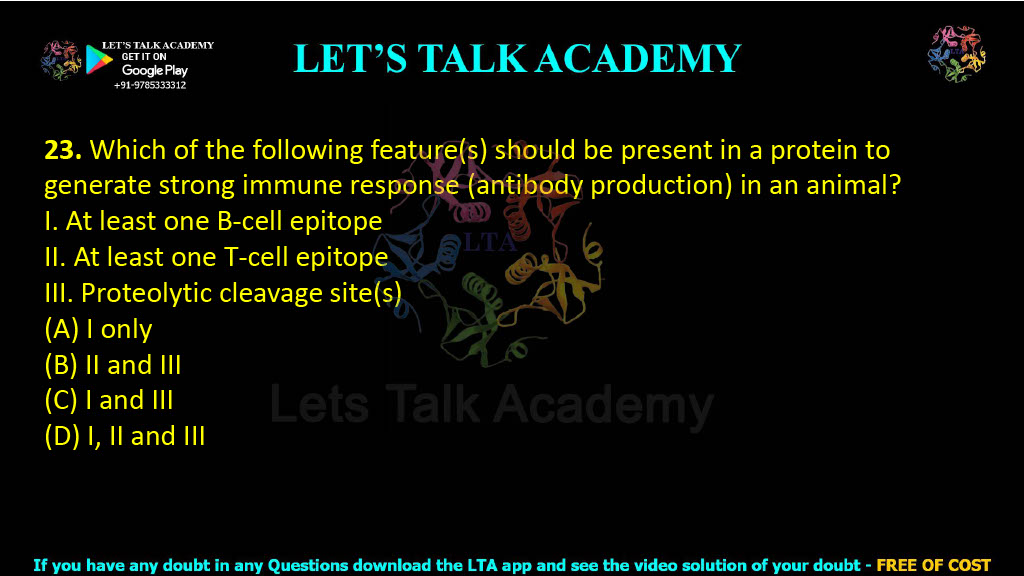
23. Which of the following feature(s) should be present in a protein to generate strong immune response (antibody production) in an animal?
I. At least one B-cell epitope
II. At least one T-cell epitope
III. Proteolytic cleavage site(s)
(A) I only
(B) II and III
(C) I and III
(D) I, II and III
Protein Features Required for Strong Antibody Production
Introduction
The adaptive immune system protects the body by recognizing foreign antigens and producing highly specific antibodies against them. However, not every protein is capable of inducing a strong immune response. The ability of a protein to stimulate antibody production depends on its immunogenicity, which is influenced by several structural and functional characteristics. Proteins that efficiently activate both B lymphocytes and helper T lymphocytes generate a much stronger and long-lasting immune response than proteins that stimulate only one arm of the immune system.
For a protein antigen to induce robust antibody production, it must contain recognizable B-cell epitopes, suitable T-cell epitopes, and regions that can be processed by antigen-presenting cells through proteolytic cleavage. These features allow efficient antigen uptake, processing, presentation on Major Histocompatibility Complex (MHC) molecules, helper T-cell activation, and subsequent activation of B cells. Understanding these concepts is fundamental in immunology, vaccine development, monoclonal antibody production, and antigen design.
Correct Answer
Correct Option: (D) I, II and III
Detailed Explanation
A strong antibody response requires coordinated activation of both the innate and adaptive immune systems. The first requirement is the presence of a B-cell epitope, which is the region of an antigen directly recognized by the B-cell receptor (BCR) or by antibodies. Without a B-cell epitope, B lymphocytes cannot specifically recognize the antigen and initiate antibody production.
Recognition by B cells alone, however, is usually insufficient to generate a robust antibody response. Most protein antigens are T-dependent antigens, meaning that activated B cells require assistance from CD4+ helper T cells. For this reason, the protein must also contain at least one T-cell epitope. After antigen uptake, antigen-presenting cells or B cells digest the protein into smaller peptides and present these peptides on MHC class II molecules. Helper T cells recognize these peptide-MHC complexes through their T-cell receptors and provide cytokines and co-stimulatory signals that stimulate B-cell proliferation, class switching, affinity maturation, and memory cell formation.
Efficient antigen processing further requires the presence of proteolytic cleavage sites. These sites allow intracellular proteases to digest the antigen into peptide fragments that can be loaded onto MHC molecules. Without appropriate cleavage sites, antigen presentation becomes inefficient, reducing helper T-cell activation and weakening antibody production.
Therefore, a highly immunogenic protein should contain all three essential features: a B-cell epitope, a T-cell epitope, and proteolytic cleavage sites.
Explanation of Each Statement
Statement I: At Least One B-cell Epitope
This statement is correct. B-cell epitopes are directly recognized by B-cell receptors or antibodies. They initiate antigen-specific B-cell activation and are indispensable for antibody production.
Statement II: At Least One T-cell Epitope
This statement is correct. Helper T-cell activation requires presentation of antigen-derived peptides on MHC class II molecules. T-cell help is essential for strong, high-affinity, long-lasting antibody responses against protein antigens.
Statement III: Proteolytic Cleavage Site(s)
This statement is correct. Antigen-processing enzymes require proteolytic cleavage sites to generate peptide fragments suitable for MHC presentation. Efficient processing enhances T-cell activation and ultimately strengthens antibody production.
Why Option (D) is Correct
A protein capable of generating a strong immune response must be recognized by B cells, processed efficiently into peptide fragments, and presented to helper T cells. Therefore, the simultaneous presence of B-cell epitopes, T-cell epitopes, and proteolytic cleavage sites is essential for maximum immunogenicity.
Why the Other Options are Incorrect
Why Option (A) is Incorrect
A B-cell epitope alone cannot generate a strong T-dependent antibody response because helper T-cell activation is absent.
Why Option (B) is Incorrect
T-cell epitopes and proteolytic cleavage sites are important, but without a B-cell epitope the antigen cannot be efficiently recognized by B lymphocytes.
Why Option (C) is Incorrect
Although B-cell epitopes and proteolytic cleavage sites are required, helper T-cell activation cannot occur without a T-cell epitope, resulting in a weaker antibody response.
Comparison of All Options
| Option | Features Included | Correct or Incorrect |
|---|---|---|
| A | I only | Incorrect |
| B | II and III | Incorrect |
| C | I and III | Incorrect |
| D | I, II and III | Correct |
Role of Each Feature in Antibody Production
| Feature | Function |
|---|---|
| B-cell Epitope | Recognized directly by B-cell receptors and antibodies |
| T-cell Epitope | Presented by MHC molecules to helper T cells |
| Proteolytic Cleavage Sites | Allow antigen processing into peptides for MHC presentation |
Steps in Protein Antigen-Induced Antibody Response
| Step | Event |
|---|---|
| 1 | B-cell receptor recognizes the antigen |
| 2 | Protein antigen is internalized by the B cell or antigen-presenting cell |
| 3 | Proteolytic enzymes digest the protein into peptides |
| 4 | Peptides are presented on MHC class II molecules |
| 5 | CD4+ helper T cells become activated |
| 6 | Activated helper T cells stimulate B-cell proliferation and antibody production |
| 7 | Formation of plasma cells and memory B cells |
Comparison Between B-cell and T-cell Epitopes
| Characteristic | B-cell Epitope | T-cell Epitope |
|---|---|---|
| Recognition | B-cell receptor or antibody | T-cell receptor |
| Structure | Native antigen | Processed peptide |
| MHC Requirement | No | Yes |
| Main Function | Initiates antibody recognition | Provides helper T-cell activation |
Biological Significance of These Features
The presence of B-cell epitopes, T-cell epitopes, and proteolytic cleavage sites ensures efficient communication between antigen-presenting cells, helper T lymphocytes, and B lymphocytes. This coordinated interaction results in high-affinity antibody production, immunological memory, class switching, and long-term protective immunity. These principles form the scientific basis for the design of modern recombinant protein vaccines and peptide-based vaccines.
Final Answer
Correct Option: (D) I, II and III
A protein capable of inducing a strong antibody response should contain at least one B-cell epitope for antigen recognition, at least one T-cell epitope for helper T-cell activation, and proteolytic cleavage sites for efficient antigen processing and presentation. Together, these three features generate a robust and long-lasting adaptive immune response.


