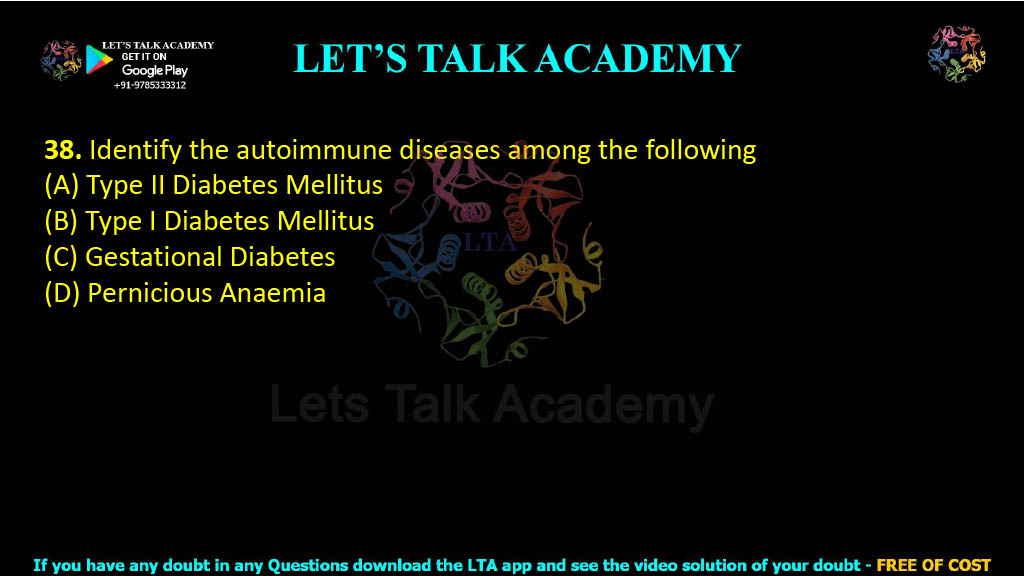
38. Identify the autoimmune diseases among the following
(A) Type II Diabetes Mellitus
(B) Type I Diabetes Mellitus
(C) Gestational Diabetes
(D) Pernicious Anaemia
Autoimmune Diseases – Type I Diabetes Mellitus and Pernicious Anaemia
Introduction
The immune system is designed to recognize and eliminate pathogens while protecting the body’s own tissues. Normally, immune cells develop a state known as self-tolerance, which prevents them from attacking normal body cells. However, when this tolerance fails, the immune system mistakenly recognizes self-antigens as foreign and mounts an immune response against them. Such conditions are known as autoimmune diseases.
Autoimmune diseases can affect almost every organ system, including the endocrine, nervous, hematopoietic, gastrointestinal, and musculoskeletal systems. Some autoimmune disorders are organ-specific, whereas others involve multiple organs. Among the diseases listed in this question, Type I Diabetes Mellitus and Pernicious Anaemia are classic examples of autoimmune diseases. In contrast, Type II Diabetes Mellitus is primarily caused by insulin resistance, while Gestational Diabetes develops during pregnancy because of hormonal changes rather than autoimmune destruction.
Correct Answer
Correct Options: (B) Type I Diabetes Mellitus and (D) Pernicious Anaemia
Detailed Explanation
Autoimmune diseases arise when the immune system produces autoreactive T lymphocytes or autoantibodies that attack normal tissues. Genetic susceptibility, environmental factors, infections, and immune dysregulation all contribute to the development of these disorders.
Type I Diabetes Mellitus is an organ-specific autoimmune disease in which autoreactive T cells progressively destroy the insulin-producing β-cells of the pancreatic islets of Langerhans. As β-cell destruction continues, insulin production decreases dramatically, resulting in persistent hyperglycemia. Patients require lifelong insulin therapy because the pancreas can no longer produce sufficient insulin.
Pernicious Anaemia is another classic autoimmune disorder. In this condition, the immune system produces antibodies against intrinsic factor or gastric parietal cells. Intrinsic factor is essential for the absorption of vitamin B12 in the ileum. Destruction of intrinsic factor or parietal cells leads to vitamin B12 deficiency, impaired DNA synthesis, and megaloblastic anemia.
Type II Diabetes Mellitus differs fundamentally from Type I diabetes. It develops mainly because of insulin resistance combined with progressive β-cell dysfunction. Although chronic inflammation contributes to its pathogenesis, it is not considered a classical autoimmune disease.
Gestational Diabetes occurs during pregnancy due to increased secretion of placental hormones such as human placental lactogen, estrogen, progesterone, and cortisol, which reduce insulin sensitivity. This condition usually resolves after delivery and is not autoimmune in origin.
Explanation of Each Option
Option (A): Type II Diabetes Mellitus
This statement is incorrect. Type II diabetes is primarily caused by insulin resistance and reduced insulin responsiveness rather than autoimmune destruction of pancreatic β-cells.
Option (B): Type I Diabetes Mellitus
This statement is correct. Type I diabetes is an autoimmune disease in which T lymphocytes destroy insulin-producing pancreatic β-cells, leading to absolute insulin deficiency.
Option (C): Gestational Diabetes
This statement is incorrect. Gestational diabetes develops because pregnancy hormones increase insulin resistance. It is not caused by an autoimmune response.
Option (D): Pernicious Anaemia
This statement is correct. Autoantibodies against intrinsic factor or gastric parietal cells prevent vitamin B12 absorption, producing megaloblastic anemia.
Why Options (B) and (D) are Correct
Both diseases result directly from an abnormal immune response against the body’s own tissues. In Type I diabetes, pancreatic β-cells are destroyed by autoreactive immune cells, whereas in pernicious anaemia, antibodies target intrinsic factor or parietal cells, preventing vitamin B12 absorption. Therefore, both are true autoimmune diseases.
Why the Other Options are Incorrect
Why Option (A) is Incorrect
Type II diabetes is a metabolic disorder characterized mainly by insulin resistance and relative insulin deficiency rather than autoimmunity.
Why Option (C) is Incorrect
Gestational diabetes is caused by pregnancy-induced hormonal changes that decrease insulin sensitivity. It is not mediated by autoimmune mechanisms.
Comparison of All Options
| Option | Disease | Autoimmune? | Correct or Incorrect |
|---|---|---|---|
| A | Type II Diabetes Mellitus | No | Incorrect |
| B | Type I Diabetes Mellitus | Yes | Correct |
| C | Gestational Diabetes | No | Incorrect |
| D | Pernicious Anaemia | Yes | Correct |
Common Autoimmune Diseases
| Autoimmune Disease | Target Tissue | Major Autoimmune Mechanism |
|---|---|---|
| Type I Diabetes Mellitus | Pancreatic β-cells | T-cell mediated destruction |
| Pernicious Anaemia | Intrinsic factor and gastric parietal cells | Autoantibody mediated |
| Hashimoto Thyroiditis | Thyroid gland | Autoantibodies and T-cell destruction |
| Graves Disease | TSH receptor | Stimulating autoantibodies |
| Myasthenia Gravis | Acetylcholine receptor | Blocking autoantibodies |
| Systemic Lupus Erythematosus | Multiple organs | Immune complex deposition |
| Rheumatoid Arthritis | Synovial joints | Autoantibodies and inflammation |
Differences Between Type I and Type II Diabetes Mellitus
| Feature | Type I Diabetes | Type II Diabetes |
|---|---|---|
| Cause | Autoimmune β-cell destruction | Insulin resistance |
| Insulin Production | Very Low or Absent | Initially Normal or High |
| Age of Onset | Usually Childhood | Usually Adults |
| Treatment | Insulin Therapy | Lifestyle modification and oral drugs |
| Autoimmune Nature | Yes | No |
Biological Significance of Autoimmune Diseases
Autoimmune diseases demonstrate the importance of immune tolerance in maintaining normal physiology. Failure of self-tolerance allows immune cells to attack healthy tissues, leading to chronic inflammation and progressive organ damage. Early diagnosis and immunomodulatory therapies can reduce tissue destruction, improve quality of life, and prevent severe complications. Understanding autoimmune mechanisms has also contributed to the development of targeted biological therapies that specifically regulate abnormal immune responses.
Final Answer
Correct Options: (B) Type I Diabetes Mellitus and (D) Pernicious Anaemia
Among the given diseases, Type I Diabetes Mellitus and Pernicious Anaemia are autoimmune disorders because they result from immune-mediated destruction of the body’s own tissues. Therefore, the correct answer is Options (B) and (D).


