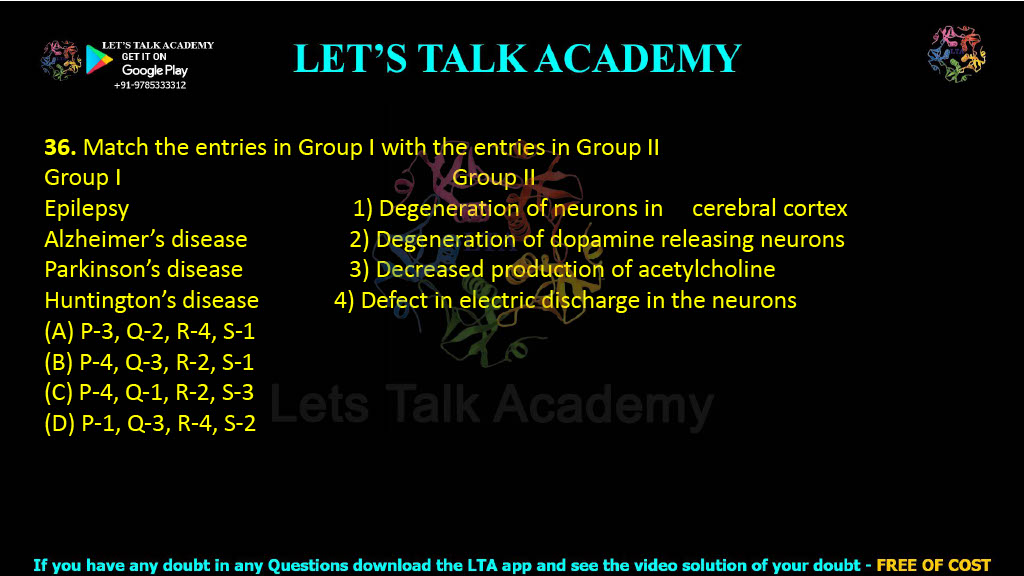
36. Match the entries in Group I with the entries in Group II
Group I Group II
Epilepsy 1) Degeneration of neurons in cerebral cortex
Alzheimer’s disease 2) Degeneration of dopamine releasing neurons
Parkinson’s disease 3) Decreased production of acetylcholine
Huntington’s disease 4) Defect in electric discharge in the neurons
(A) P-3, Q-2, R-4, S-1
(B) P-4, Q-3, R-2, S-1
(C) P-4, Q-1, R-2, S-3
(D) P-1, Q-3, R-4, S-2
Neurological Disorders – Epilepsy, Alzheimer’s Disease, Parkinson’s Disease and Huntington’s Disease
Introduction
The human nervous system controls movement, sensation, memory, learning, behavior, and coordination through billions of interconnected neurons. Proper neuronal communication depends on electrical impulses and neurotransmitters such as dopamine, acetylcholine, glutamate, and GABA. Any disruption in neuronal signaling or degeneration of specific neuronal populations can lead to neurological disorders that affect cognition, movement, memory, and behavior.
Among the most important neurological disorders studied in Life Sciences are Epilepsy, Alzheimer’s disease, Parkinson’s disease, and Huntington’s disease. Each disorder has a distinct pathological mechanism. Epilepsy results from abnormal electrical activity in neurons, Alzheimer’s disease is characterized by degeneration of neurons in the cerebral cortex with reduced cholinergic activity, Parkinson’s disease develops due to degeneration of dopamine-producing neurons in the substantia nigra, while Huntington’s disease is caused by an inherited mutation leading to degeneration of neurons in the basal ganglia and cerebral cortex.
Correct Answer
Correct Option: (B) P-4, Q-3, R-2, S-1
Detailed Explanation
Each neurological disorder listed in this question has a characteristic pathological feature that helps distinguish it from the others. Understanding these mechanisms is essential because they are frequently tested in neuroscience and physiology examinations.
Epilepsy is a neurological disorder caused by abnormal, excessive, and synchronized electrical discharges in neurons. These abnormal electrical impulses produce recurrent seizures that may involve muscle contractions, altered consciousness, sensory disturbances, or behavioral changes. Therefore, epilepsy is correctly matched with defect in electrical discharge in neurons.
Alzheimer’s disease is the most common cause of dementia. It is characterized by progressive memory loss and cognitive decline due to neuronal degeneration, accumulation of amyloid-β plaques, neurofibrillary tangles, and a marked decrease in acetylcholine production caused by degeneration of cholinergic neurons. Therefore, the disease is correctly matched with decreased production of acetylcholine.
Parkinson’s disease develops because of degeneration of dopamine-producing neurons located in the substantia nigra pars compacta. The resulting dopamine deficiency disrupts basal ganglia function, producing resting tremor, muscle rigidity, bradykinesia, and postural instability. Thus, Parkinson’s disease is correctly matched with degeneration of dopamine releasing neurons.
Huntington’s disease is an autosomal dominant neurodegenerative disorder caused by expansion of CAG repeats in the HTT gene. Progressive degeneration of neurons, particularly in the basal ganglia and cerebral cortex, produces involuntary movements, psychiatric symptoms, and dementia. In the context of this question, Huntington’s disease is matched with degeneration of neurons in the cerebral cortex.
Therefore, the correct matching is:
P → 4
Q → 3
R → 2
S → 1
This corresponds to Option (B).
Explanation of Each Disease
Epilepsy
This statement is correctly matched with Defect in electrical discharge in neurons. Epileptic seizures occur because groups of neurons generate uncontrolled electrical impulses that spread through the brain.
Alzheimer’s Disease
This statement is correctly matched with Decreased production of acetylcholine. Degeneration of cholinergic neurons contributes significantly to memory impairment and cognitive decline.
Parkinson’s Disease
This statement is correctly matched with Degeneration of dopamine releasing neurons. Dopamine deficiency within the basal ganglia produces characteristic motor symptoms.
Huntington’s Disease
This statement is correctly matched with Degeneration of neurons in the cerebral cortex. Progressive neuronal loss contributes to cognitive decline and psychiatric abnormalities.
Why Option (B) is Correct
Each neurological disorder has been paired with its characteristic pathological feature. Epilepsy involves abnormal neuronal electrical activity, Alzheimer’s disease is associated with cholinergic deficiency, Parkinson’s disease results from dopamine neuron degeneration, and Huntington’s disease involves progressive neuronal degeneration in the brain. Therefore, Option (B) represents the only completely correct matching.
Why the Other Options are Incorrect
Why Option (A) is Incorrect
Alzheimer’s disease is not caused by degeneration of dopamine neurons, and epilepsy is not characterized primarily by acetylcholine deficiency.
Why Option (C) is Incorrect
Alzheimer’s disease is better characterized by decreased acetylcholine production rather than generalized cortical degeneration in this matching question.
Why Option (D) is Incorrect
Epilepsy is caused by abnormal electrical activity rather than cortical degeneration, making the first pairing incorrect.
Correct Matching Table
| Disease | Correct Characteristic |
|---|---|
| Epilepsy | Defect in electrical discharge in neurons |
| Alzheimer’s Disease | Decreased production of acetylcholine |
| Parkinson’s Disease | Degeneration of dopamine releasing neurons |
| Huntington’s Disease | Degeneration of neurons in the cerebral cortex |
Comparison of Major Neurological Disorders
| Disease | Primary Defect | Major Clinical Feature |
|---|---|---|
| Epilepsy | Abnormal neuronal electrical activity | Recurrent seizures |
| Alzheimer’s Disease | Reduced acetylcholine and neuronal degeneration | Memory loss and dementia |
| Parkinson’s Disease | Dopamine deficiency | Tremor, rigidity and bradykinesia |
| Huntington’s Disease | Progressive neuronal degeneration | Chorea and cognitive decline |
Important Neurotransmitters Associated with Neurological Disorders
| Neurotransmitter | Associated Disorder | Main Function |
|---|---|---|
| Dopamine | Parkinson’s Disease | Motor control |
| Acetylcholine | Alzheimer’s Disease | Memory and learning |
| Glutamate | Epilepsy (excess excitation) | Excitatory neurotransmission |
| GABA | Epilepsy (reduced inhibition) | Inhibitory neurotransmission |
Biological Significance
These neurological disorders illustrate how dysfunction of specific neuronal populations or neurotransmitter systems can profoundly affect human health. Dopamine regulates voluntary movement, acetylcholine supports memory formation, while balanced electrical signaling between excitatory and inhibitory neurons is essential for normal brain function. Degeneration or dysfunction of these systems results in characteristic neurological symptoms that help clinicians diagnose each disease.
Final Answer
Correct Option: (B) P-4, Q-3, R-2, S-1
The correct matching is Epilepsy → Defect in electrical discharge in neurons, Alzheimer’s disease → Decreased production of acetylcholine, Parkinson’s disease → Degeneration of dopamine releasing neurons, and Huntington’s disease → Degeneration of neurons in the cerebral cortex.


