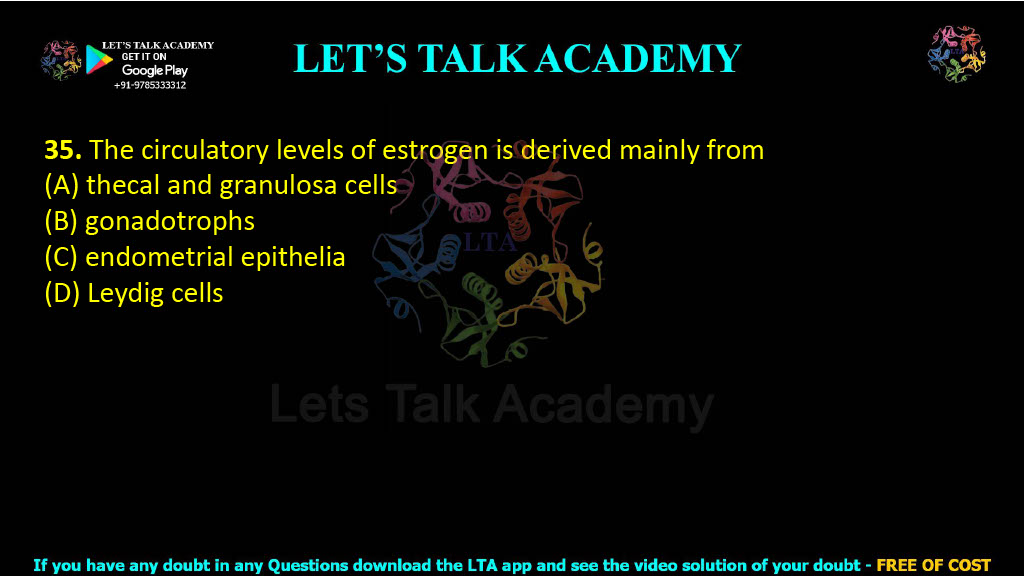
35. The circulatory levels of estrogen is derived mainly from
(A) thecal and granulosa cells
(B) gonadotrophs
(C) endometrial epithelia
(D) Leydig cells
Source of Circulating Estrogen
Introduction
Estrogen is one of the most important steroid hormones in the female reproductive system. It regulates follicular development, maturation of reproductive organs, proliferation of the endometrium, development of secondary sexual characteristics, maintenance of bone density, and regulation of the menstrual cycle. Although several tissues can produce small amounts of estrogen, the ovaries are the principal source of circulating estrogen during the reproductive years.
The synthesis of estrogen is a cooperative process involving two specialized ovarian cell types: the theca cells and the granulosa cells. This mechanism is known as the Two-Cell Two-Gonadotropin Theory. According to this model, luteinizing hormone (LH) stimulates theca cells to synthesize androgens from cholesterol, while follicle-stimulating hormone (FSH) stimulates granulosa cells to convert these androgens into estrogens using the enzyme aromatase.
Correct Answer
Correct Option: (A) Thecal and Granulosa Cells
Detailed Explanation
During the ovarian follicular phase, estrogen synthesis occurs through the coordinated activities of theca interna cells and granulosa cells. Neither cell type alone can produce large amounts of estrogen. Instead, they function together in a highly integrated endocrine pathway.
The theca cells possess receptors for luteinizing hormone (LH). LH stimulates these cells to convert cholesterol into androgenic steroids such as androstenedione and testosterone. However, theca cells lack the enzyme aromatase, which is necessary for estrogen synthesis.
The androgen molecules produced by theca cells diffuse into the adjacent granulosa cells. Granulosa cells possess receptors for follicle-stimulating hormone (FSH). Under the influence of FSH, granulosa cells express the enzyme aromatase, which converts androstenedione and testosterone into estrogens, primarily estradiol (E2), the most potent circulating estrogen.
This cooperative interaction between theca cells and granulosa cells is known as the Two-Cell Two-Gonadotropin Theory. Since both cell types are essential for estrogen biosynthesis, the majority of circulating estrogen is derived from these ovarian follicular cells.
Explanation of Each Option
Option (A): Thecal and Granulosa Cells
This statement is correct. Theca cells synthesize androgen precursors under LH stimulation, while granulosa cells convert these androgens into estrogen through aromatization under the influence of FSH.
Option (B): Gonadotrophs
This statement is incorrect. Gonadotrophs are endocrine cells of the anterior pituitary gland that secrete FSH and LH. They regulate ovarian function but do not synthesize estrogen.
Option (C): Endometrial Epithelia
This statement is incorrect. Endometrial epithelial cells respond to circulating estrogen by proliferating during the menstrual cycle, but they are not the primary source of estrogen production.
Option (D): Leydig Cells
This statement is incorrect. Leydig cells are located in the testes and synthesize testosterone in response to LH. They are not responsible for producing circulating estrogen in females.
Why Option (A) is Correct
Estrogen synthesis requires both theca and granulosa cells. Theca cells provide androgen precursors, and granulosa cells convert these precursors into estradiol through aromatase activity. This coordinated pathway accounts for nearly all ovarian estrogen production during the reproductive years.
Why the Other Options are Incorrect
Why Option (B) is Incorrect
Gonadotrophs regulate ovarian hormone production by secreting FSH and LH but do not produce steroid hormones themselves.
Why Option (C) is Incorrect
The endometrium is a target tissue for estrogen rather than its major site of synthesis.
Why Option (D) is Incorrect
Leydig cells synthesize testosterone in males and are not involved in ovarian estrogen production.
Comparison of All Options
| Option | Cell Type | Primary Function | Correct or Incorrect |
|---|---|---|---|
| A | Theca and Granulosa Cells | Cooperative estrogen synthesis | Correct |
| B | Gonadotrophs | Secretion of FSH and LH | Incorrect |
| C | Endometrial Epithelium | Responds to estrogen | Incorrect |
| D | Leydig Cells | Testosterone synthesis | Incorrect |
Two-Cell Two-Gonadotropin Theory
| Cell Type | Hormone Acting | Major Product |
|---|---|---|
| Theca Cells | LH | Androgens (Androstenedione, Testosterone) |
| Granulosa Cells | FSH | Estradiol (Estrogen) via Aromatase |
Major Functions of Estrogen
| Function | Physiological Role |
|---|---|
| Follicular Growth | Promotes ovarian follicle maturation |
| Endometrial Proliferation | Prepares uterus for implantation |
| Secondary Sexual Characteristics | Breast development and female body contour |
| Bone Metabolism | Maintains bone density |
| LH Surge | Positive feedback leading to ovulation |
Hormonal Regulation of Estrogen Synthesis
| Hormone | Target Cell | Major Action |
|---|---|---|
| GnRH | Anterior Pituitary | Stimulates FSH and LH secretion |
| LH | Theca Cells | Stimulates androgen production |
| FSH | Granulosa Cells | Stimulates aromatase expression and estrogen synthesis |
| Estradiol | Hypothalamus and Pituitary | Feedback regulation of reproductive hormones |
Biological Significance of Estrogen Production
The coordinated interaction between theca and granulosa cells ensures efficient estrogen synthesis during the reproductive cycle. Estradiol regulates follicular maturation, induces proliferation of the endometrium, supports ovulation through positive feedback on LH secretion, and maintains reproductive health. Defects in aromatase activity, granulosa cell function, or gonadotropin signaling can impair estrogen production, resulting in infertility, menstrual irregularities, and endocrine disorders.
Final Answer
Correct Option: (A) Thecal and Granulosa Cells
The majority of circulating estrogen is produced through the coordinated action of theca cells and granulosa cells. Theca cells synthesize androgen precursors under the influence of LH, while granulosa cells convert these androgens into estradiol using the enzyme aromatase under FSH stimulation.


