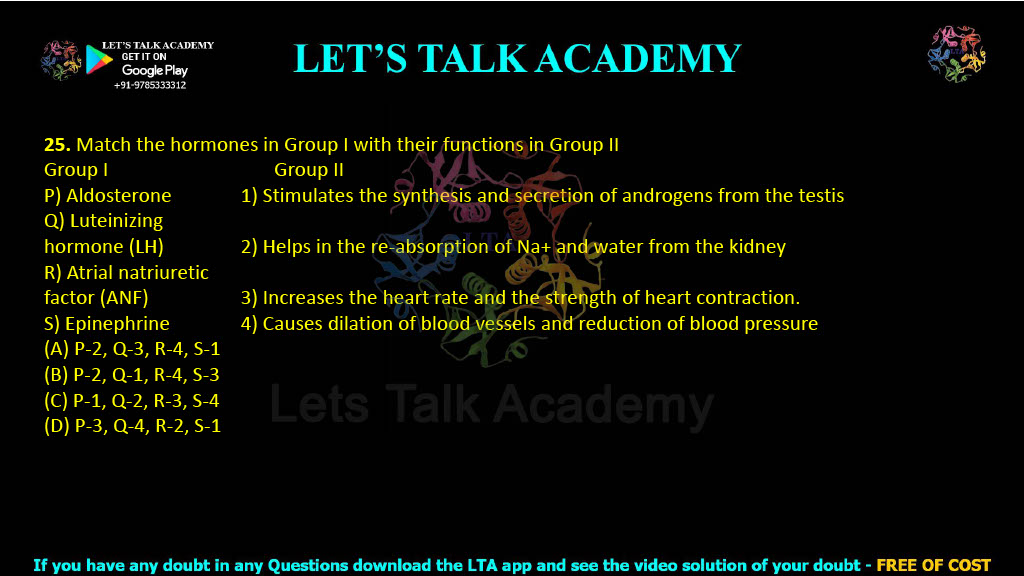
25. Match the hormones in Group I with their functions in Group II
Group I Group II
P) Aldosterone 1) Stimulates the synthesis and secretion of androgens from the testis
Q) Luteinizing 2) Helps in the re-absorption of Na+ and water from the kidney
hormone (LH)
R) Atrial natriuretic 3) Increases the heart rate and the strength of heart contraction.
factor (ANF)
S) Epinephrine 4) Causes dilation of blood vessels and reduction of blood pressure
(A) P-2, Q-3, R-4, S-1
(B) P-2, Q-1, R-4, S-3
(C) P-1, Q-2, R-3, S-4
(D) P-3, Q-4, R-2, S-1
Hormones and Their Functions
Introduction
The endocrine system regulates almost every physiological process in the human body through the secretion of hormones. Hormones are chemical messengers released by specialized endocrine glands into the bloodstream, where they travel to distant target organs and regulate metabolism, growth, reproduction, electrolyte balance, blood pressure, and stress responses. Since each hormone has a unique physiological role, understanding their functions is essential for interpreting normal body functions as well as endocrine disorders.
Among the important hormones tested in competitive examinations are aldosterone, luteinizing hormone (LH), atrial natriuretic factor (ANF), and epinephrine. Aldosterone regulates sodium and water balance, LH stimulates testosterone production in males and ovulation in females, ANF reduces blood pressure by promoting sodium excretion, and epinephrine prepares the body for the fight-or-flight response by increasing heart rate and cardiac output.
Correct Answer
Correct Option: (B) P-2, Q-1, R-4, S-3
Detailed Explanation
The four hormones listed in this question regulate different physiological systems. Aldosterone is a mineralocorticoid hormone secreted by the zona glomerulosa of the adrenal cortex. Its primary function is to increase sodium reabsorption and potassium excretion in the distal convoluted tubules and collecting ducts of the kidney. Since water follows sodium by osmosis, aldosterone also promotes water reabsorption, thereby increasing blood volume and blood pressure.
Luteinizing hormone (LH) is secreted by the anterior pituitary gland. In males, LH acts on Leydig cells of the testes to stimulate the synthesis and secretion of testosterone, the principal androgen. In females, LH triggers ovulation and promotes corpus luteum formation. Therefore, the function listed in this question corresponds to stimulation of androgen synthesis in the testis.
Atrial natriuretic factor (ANF), also called atrial natriuretic peptide (ANP), is secreted by atrial muscle cells of the heart when blood volume and atrial pressure increase. ANF promotes sodium excretion (natriuresis), increases urine formation, relaxes blood vessels, inhibits aldosterone secretion, and ultimately lowers blood pressure.
Epinephrine, secreted by the adrenal medulla, is the major hormone of the fight-or-flight response. It increases heart rate, enhances the force of cardiac contraction, dilates bronchioles, increases blood glucose concentration, and improves blood flow to skeletal muscles during stress.
Thus, the correct matching is:
P → 2
Q → 1
R → 4
S → 3
Therefore, Option (B) is the correct answer.
Explanation of Each Hormone
Option P: Aldosterone
This statement is correctly matched with Function 2. Aldosterone promotes sodium and water reabsorption in the kidney while increasing potassium excretion. This helps maintain extracellular fluid volume and blood pressure.
Option Q: Luteinizing Hormone (LH)
This statement is correctly matched with Function 1. In males, LH stimulates Leydig cells of the testes to synthesize and secrete testosterone. In females, it induces ovulation and corpus luteum formation.
Option R: Atrial Natriuretic Factor (ANF)
This statement is correctly matched with Function 4. ANF relaxes blood vessels, promotes sodium excretion, reduces blood volume, and lowers arterial blood pressure.
Option S: Epinephrine
This statement is correctly matched with Function 3. Epinephrine increases heart rate, cardiac contractility, and cardiac output during stress or emergency situations.
Why Option (B) is Correct
Each hormone has been matched with its well-established physiological function. Aldosterone regulates sodium balance, LH stimulates androgen production, ANF lowers blood pressure through natriuresis and vasodilation, and epinephrine increases cardiac activity. Therefore, Option (B) represents the only completely correct combination.
Why the Other Options are Incorrect
Why Option (A) is Incorrect
Luteinizing hormone does not increase heart rate, and epinephrine does not stimulate androgen synthesis.
Why Option (C) is Incorrect
Aldosterone does not stimulate androgen synthesis, while LH does not regulate sodium reabsorption.
Why Option (D) is Incorrect
All hormone-function pairings are incorrectly matched.
Correct Matching Table
| Hormone | Correct Function |
|---|---|
| Aldosterone | Helps in reabsorption of Na+ and water from the kidney |
| Luteinizing Hormone (LH) | Stimulates synthesis and secretion of androgens from the testis |
| Atrial Natriuretic Factor (ANF) | Causes vasodilation and reduces blood pressure |
| Epinephrine | Increases heart rate and force of heart contraction |
Major Endocrine Hormones and Their Functions
| Hormone | Source | Major Function |
|---|---|---|
| Aldosterone | Adrenal Cortex | Na+ and water reabsorption, K+ excretion |
| LH | Anterior Pituitary | Stimulates testosterone secretion and ovulation |
| ANF | Atrial Muscle Cells | Natriuresis, vasodilation, reduced blood pressure |
| Epinephrine | Adrenal Medulla | Fight-or-flight response |
Comparison of the Four Hormones
| Hormone | Target Organ | Physiological Effect |
|---|---|---|
| Aldosterone | Kidney | Increases sodium and water retention |
| LH | Testis/Ovary | Stimulates sex hormone production |
| ANF | Kidney and Blood Vessels | Promotes sodium excretion and lowers blood pressure |
| Epinephrine | Heart, Blood Vessels, Liver, Muscles | Increases cardiac output and energy availability |
Biological Significance of These Hormones
These four hormones collectively maintain cardiovascular stability, electrolyte balance, reproduction, and stress adaptation. Aldosterone conserves sodium and water during dehydration, LH regulates reproductive function and fertility, ANF protects the body against excessive blood pressure by promoting sodium loss, and epinephrine enables rapid physiological responses during emergencies. Together, they maintain internal homeostasis under both normal and stressful conditions.
Final Answer
Correct Option: (B) P-2, Q-1, R-4, S-3
The correct matching is Aldosterone → Sodium and water reabsorption, Luteinizing Hormone → Androgen synthesis in the testis, Atrial Natriuretic Factor → Vasodilation and reduction of blood pressure, and Epinephrine → Increased heart rate and force of cardiac contraction.


