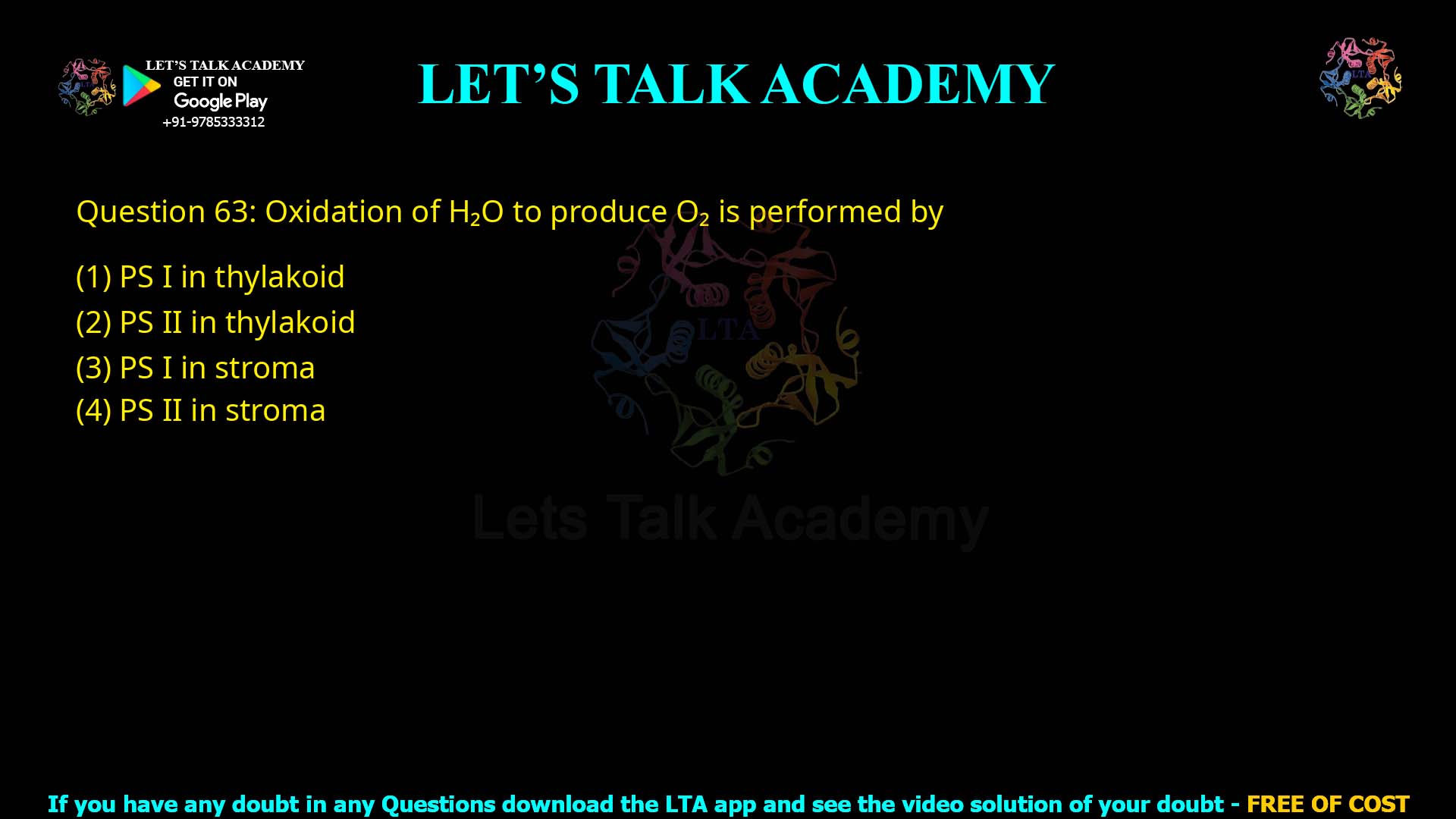
Q.63 Oxidation of H2O to produce O2 is performed by:
Oxidation of H₂O to produce O₂ occurs in PS II in thylakoid (option 2).
Option Breakdown
Photosystems I and II are pigment-protein complexes in chloroplasts driving photosynthesis; PS II specifically handles water splitting via its oxygen-evolving complex (OEC).
-
(1) PS I in thylakoid: PS I (P700) in thylakoid membrane reduces NADP⁺ to NADPH using electrons from PS II; no water oxidation role.
-
(2) PS II in thylakoid: Correct; PS II (P680) in thylakoid lumen side oxidizes H₂O at Mn₄CaO₅ OEC through S-states (S₀-S₄), releasing O₂, 4H⁺, 4e⁻.
-
(3) PS I in stroma: PS I is embedded in thylakoid, not stroma; stroma hosts Calvin cycle enzymes, no photosystems.
-
(4) PS II in stroma: PS II resides in thylakoid membrane (stroma lamellae/grana); stroma-facing side receives plastoquinone but oxidation is lumenal.
Oxidation of H₂O to produce O₂ is a cornerstone of photosynthesis, executed by PS II in thylakoid to supply electrons for the electron transport chain. This light-driven process at the oxygen-evolving complex sustains oxygenic life, vital for competitive exams like GATE Life Sciences.
Photosystem Locations and Roles
Both photosystems embed in thylakoid membranes: PS II in grana, PS I in stroma lamellae.
-
PS II in thylakoid: Catalyzes 2H₂O → O₂ + 4H⁺ + 4e⁻ via OEC; P680⁺ oxidizes water through Kok cycle (S₀ to S₄).
-
PS I in thylakoid: Cyclic/non-cyclic electron flow to ferredoxin/NADPH; no O₂ evolution.
-
Stroma locations: Incorrect; stroma is aqueous phase for ATP/NADPH utilization in dark reactions.
Light excites PS II first (longer wavelength), transferring electrons to plastoquinone while splitting water.
Water Oxidation Mechanism
Oxidation of H₂O to produce O₂ advances in four flashes:
-
S₁ → S₂: Mn oxidation.
-
S₂ → S₃: Further oxidation, water binding.
-
S₃ → S₄: O-O bond forms.
-
S₄ → S₀: O₂ release.
Proton release couples with O₂ evolution, creating lumen proton gradient for ATP synthesis.
Exam Tips for Photosynthesis MCQs
Target PS II in thylakoid for water-splitting queries; distinguish from PS I (NADPH producer) and stroma (Calvin cycle).


