Q.57
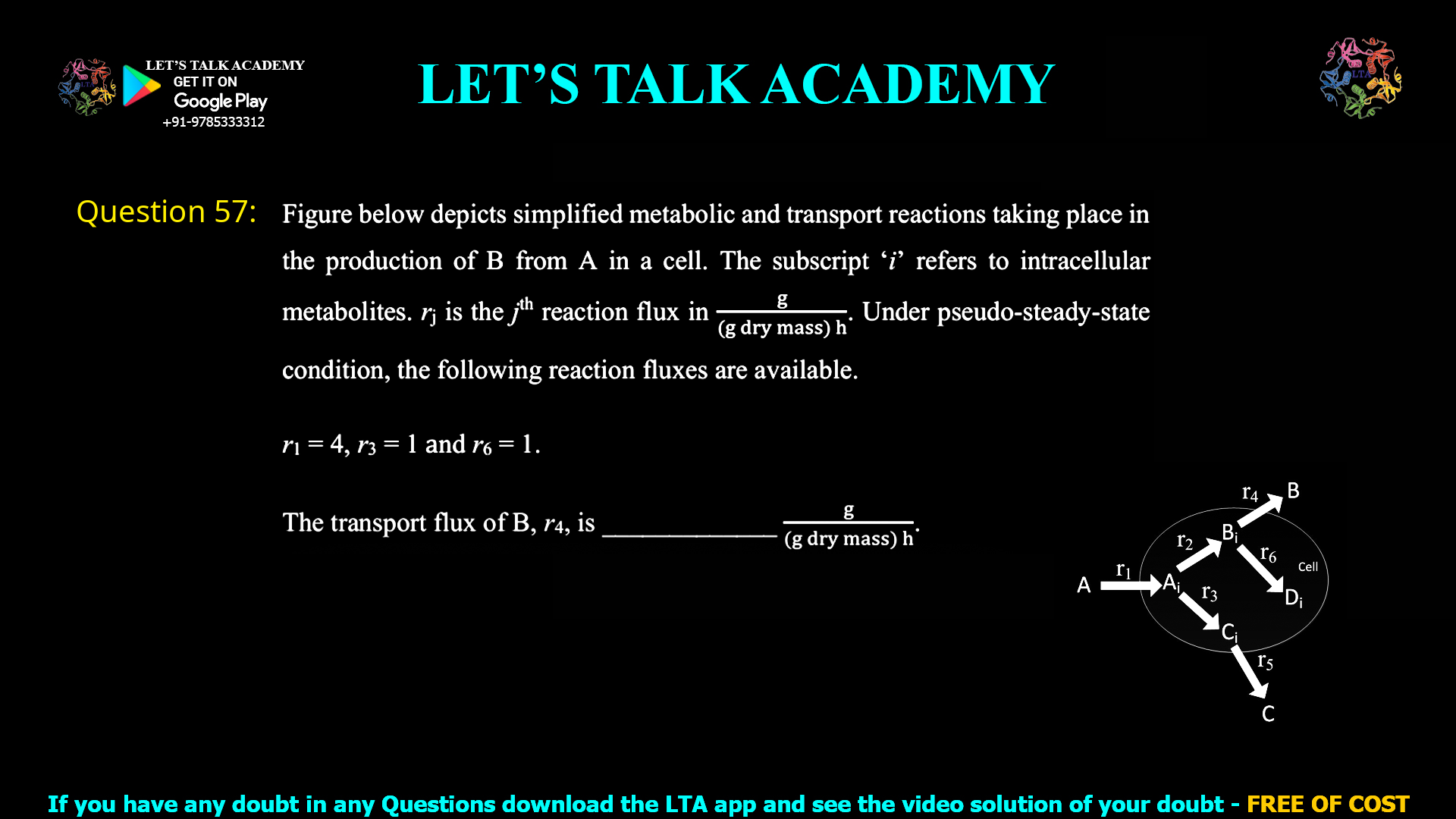
Figure below depicts simplified metabolic and transport reactions taking place in the production of B from A in a cell.
The subscript ‘i’ refers to intracellular metabolites.
rj is the jth reaction flux in
g / (g dry mass · h).
Under pseudo-steady-state condition, the following reaction fluxes are available.
r1 = 4,
r3 = 1
and r6 = 1.
The transport flux of B, r4, is __________________
g / (g dry mass · h).
Compute Transport Flux r₄ Under Pseudo-Steady-State
Problem Overview
In this metabolic network, intracellular reactions convert substrate A to product B through intermediate metabolites.
Under pseudo-steady-state, metabolite accumulation is zero.
Given:
- r1 = 4
- r3 = 1
- r6 = 1
The goal is to compute the transport flux of B, r4.
Step-By-Step Solution
1. Mass Balance on Metabolite Ai
From the reaction diagram, r1 produces intracellular A,
while r2 and r3 consume it.
Steady-state equation:
r1 = r2 + r3
4 = r2 + 1 → r2 = 3
2. Mass Balance on Metabolite Bi
B is formed from A at rate r2 and leaves by
r4 (transport) + r6 (to metabolite D).
r2 = r4 + r6
3 = r4 + 1 → r4 = 2
Final Answer
r4 = 2 g/(g dry mass·h)
Flux Role Summary
| Flux | Meaning | Value | Role |
|---|---|---|---|
| r₁ | Uptake of A | 4 | Supplies intracellular pool |
| r₃ | A → C pathway | 1 | Diverts flux |
| r₂ | A → B pathway | 3 (derived) | Main formation route |
| r₆ | B → D | 1 | Consumes B |
| r₄ | B → Transported out | 2 | Product output |
Conclusion
Applying pseudo-steady-state balances on intracellular intermediates yields
r4 = 2 g/(g dry mass·h),
ensuring no metabolite buildup in the cell.


