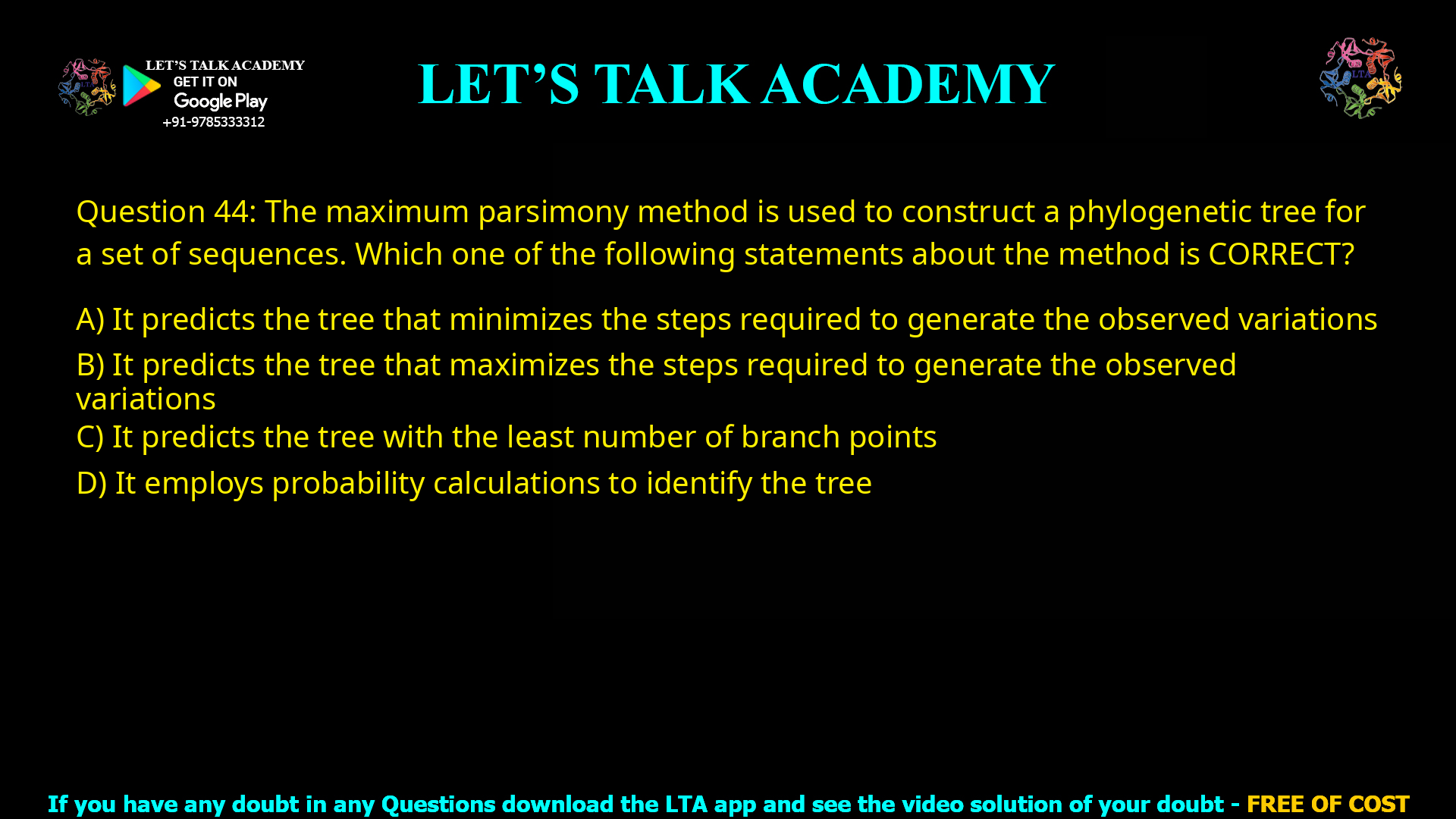
Q.44 The maximum parsimony method is used to construct a phylogenetic tree for a
set of sequences. Which one of the following statements about the method is
CORRECT?
(A) It predicts the tree that minimizes the steps required to generate the observed
variations
(B) It predicts the tree that maximizes the steps required to generate the observed
variations
(C) It predicts the tree with the least number of branch points
(D) It employs probability calculations to identify the tree
Understanding Maximum Parsimony in Phylogenetic Tree Construction
The maximum parsimony method constructs phylogenetic trees by selecting the simplest evolutionary explanation for sequence data. The correct answer to the query is option (A).
Correct Answer
Option (A) It predicts the tree that minimizes the steps required to generate the observed variations.
Maximum parsimony seeks the tree requiring the fewest evolutionary changes, such as nucleotide substitutions, to explain observed differences across aligned sequences. This approach assumes the simplest hypothesis best reflects evolutionary history, evaluating all possible trees to identify the one with minimal steps.
Why Other Options Are Incorrect
Option (B) Maximizes Steps
This option reverses the core principle, as maximum parsimony minimizes rather than maximizes evolutionary steps to avoid unnecessary complexity.
Option (C) Least Branch Points
Branch points represent speciation events, but parsimony optimizes changes along branches, not their number; trees can have identical branch points but differ in total steps.
Option (D) Probability Calculations
Probability-based methods like maximum likelihood use statistical models, whereas parsimony relies on a non-probabilistic optimality criterion focused on step minimization.
Key Applications
-
Ideal for closely related sequences with limited data.
-
Implemented in tools like PAUP and PHYLIP for exhaustive tree searches.


