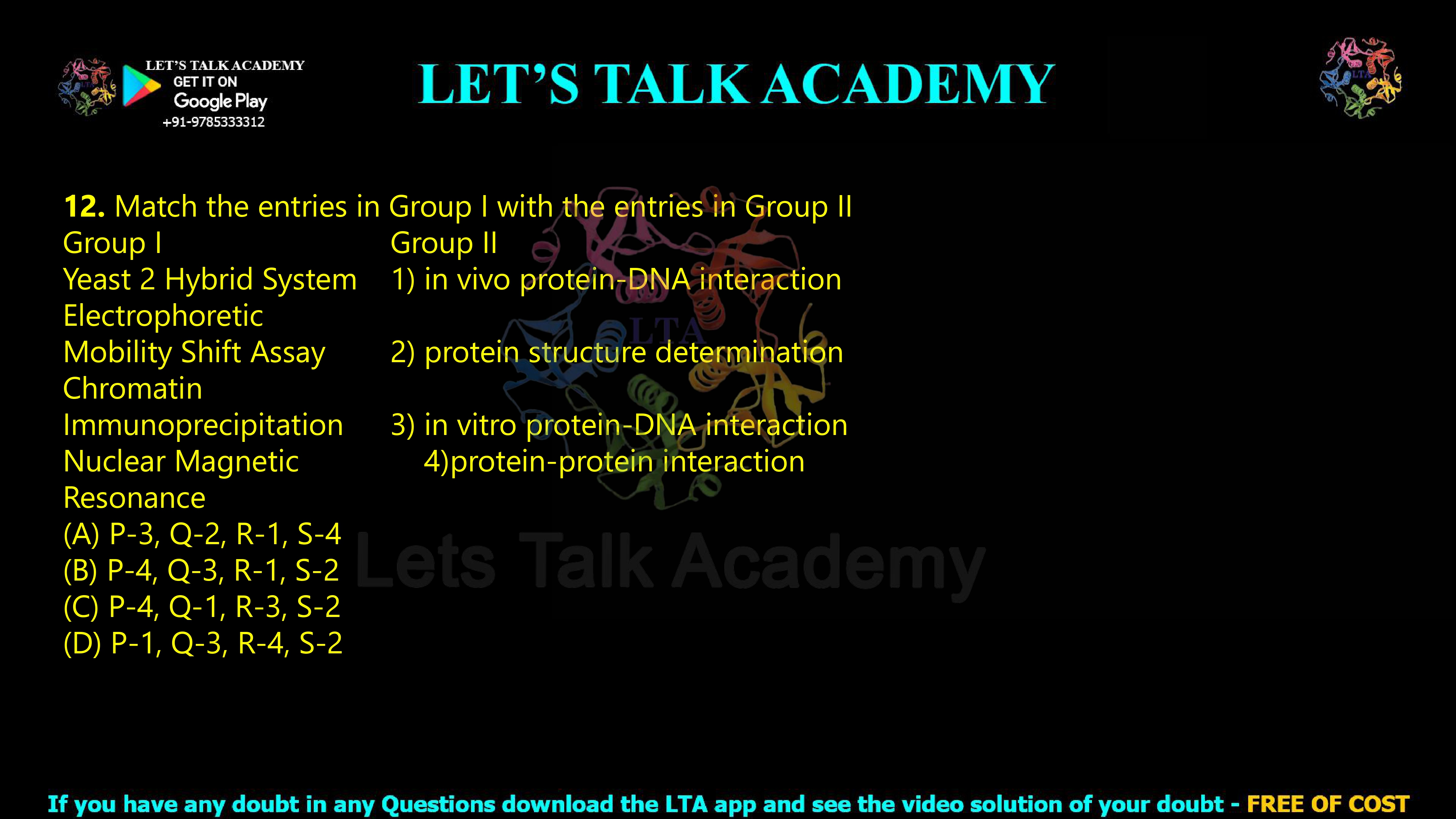
12. Match the entries in Group I with the entries in Group II
Group I Group II
Yeast 2 Hybrid System 1) in vivo protein-DNA interaction
Electrophoretic
Mobility Shift Assay 2) protein structure determination
Chromatin
Immunoprecipitation 3) in vitro protein-DNA interaction
Nuclear Magnetic 4)protein-protein interaction
Resonance
(A) P-3, Q-2, R-1, S-4
(B) P-4, Q-3, R-1, S-2
(C) P-4, Q-1, R-3, S-2
(D) P-1, Q-3, R-4, S-2
Match the Molecular Biology Techniques with Their Correct Applications: Yeast Two-Hybrid, EMSA, ChIP and NMR
Correct Answer
Correct Option: (B) P-4, Q-3, R-1, S-2
The correct matching is straightforward when the fundamental purpose of each molecular biology technique is understood. The Yeast Two-Hybrid System is primarily used to study protein-protein interactions. The Electrophoretic Mobility Shift Assay (EMSA) detects protein-DNA interactions under in vitro conditions. Chromatin Immunoprecipitation (ChIP) identifies protein-DNA interactions occurring inside living cells, making it an in vivo technique. Finally, Nuclear Magnetic Resonance (NMR) spectroscopy is widely used for protein structure determination.
Therefore, the correct combination is:
P → 4, Q → 3, R → 1, S → 2
Hence, Option (B) is the correct answer.
Detailed Explanation of the Correct Matching
P. Yeast Two-Hybrid System → 4. Protein-Protein Interaction
The Yeast Two-Hybrid System, commonly abbreviated as Y2H, is a powerful molecular biology technique used to detect physical interactions between two proteins. It is especially useful for determining whether a protein of interest can directly or indirectly associate with another protein inside a yeast cell.
The principle of the Yeast Two-Hybrid System is based on the modular organization of a transcription factor. A typical transcription factor contains two functionally distinct parts: a DNA-binding domain and a transcriptional activation domain. These two domains can function separately, but transcription occurs only when they are brought together.
In this technique, one protein is fused to the DNA-binding domain of a transcription factor. This protein is called the bait protein. A second protein is fused to the transcriptional activation domain and is called the prey protein. If the bait and prey proteins interact with each other, the DNA-binding domain and activation domain are brought close together. This reconstructs a functional transcription factor and activates the expression of a reporter gene.
Reporter genes may produce a detectable signal, such as cell growth on a selective medium or a measurable color change. Therefore, activation of the reporter gene provides evidence that the two proteins interact.
The important point is that the Yeast Two-Hybrid System is designed primarily to investigate protein-protein interactions. Therefore:
P → 4
Q. Electrophoretic Mobility Shift Assay → 3. In Vitro Protein-DNA Interaction
The Electrophoretic Mobility Shift Assay, abbreviated as EMSA, is used to study interactions between proteins and nucleic acids, particularly protein-DNA interactions under in vitro conditions. It is also commonly known as a gel shift assay or band shift assay.
The basic principle of EMSA is based on the difference in electrophoretic mobility between free DNA and DNA bound to a protein. A short DNA fragment containing a suspected protein-binding sequence is incubated with a purified protein or protein-containing cell extract in a test tube.
If the protein does not bind to the DNA, the free DNA fragment migrates relatively rapidly through a non-denaturing polyacrylamide gel. However, if the protein binds to the DNA, a larger protein-DNA complex is formed. Because this complex is larger and moves more slowly through the gel, it produces a shifted band.
This slower migration is called a mobility shift. The appearance of a shifted band indicates the formation of a protein-DNA complex.
EMSA is classified as an in vitro technique because the protein and DNA are allowed to interact outside the living cell under experimentally controlled laboratory conditions. The interaction takes place in a reaction tube before the sample is loaded onto the gel.
Therefore:
Q → 3
R. Chromatin Immunoprecipitation → 1. In Vivo Protein-DNA Interaction
Chromatin Immunoprecipitation, commonly abbreviated as ChIP, is used to determine whether a particular protein is associated with a specific DNA sequence inside living cells. It is therefore a major technique for studying in vivo protein-DNA interactions.
ChIP is especially important for investigating transcription factors, histones, chromatin-associated proteins and epigenetic modifications. It allows researchers to identify the genomic regions associated with a particular DNA-binding protein.
In a typical ChIP experiment, living cells are first treated with a cross-linking agent, commonly formaldehyde. This treatment stabilizes protein-DNA interactions that are occurring naturally inside the cell. The chromatin is then isolated and fragmented into smaller pieces.
An antibody specific to the protein of interest is added. The antibody binds to the target protein and allows the entire protein-DNA complex to be isolated by immunoprecipitation. The cross-links are subsequently reversed, and the associated DNA is purified and analyzed.
The recovered DNA may be examined by PCR, quantitative PCR or high-throughput sequencing. When ChIP is combined with sequencing, the technique is known as ChIP-seq.
The defining feature of ChIP is that it captures interactions that existed within the cellular chromatin environment. For this reason, it is used to investigate in vivo protein-DNA interactions.
Therefore:
R → 1
S. Nuclear Magnetic Resonance → 2. Protein Structure Determination
Nuclear Magnetic Resonance, abbreviated as NMR, is a sophisticated analytical technique used to study the three-dimensional structures and dynamic properties of biological molecules. It is widely applied to protein structure determination, particularly for proteins and other biomolecules in solution.
NMR spectroscopy is based on the magnetic properties of certain atomic nuclei. When molecules are placed in a strong magnetic field and exposed to radiofrequency energy, specific nuclei absorb and release energy in ways that depend on their surrounding chemical environment.
The resulting NMR signals provide information about the positions and relationships of atoms within the molecule. By analyzing these signals, researchers can determine distances between atoms and reconstruct the three-dimensional structure of a protein.
One major advantage of NMR is that it can examine proteins in solution, allowing researchers to study not only static structures but also molecular flexibility, conformational changes and interactions with other molecules.
NMR is therefore fundamentally associated with the structural analysis of proteins and other biomolecules.
Therefore:
S → 2
Complete Matching at a Glance
| Technique | Correct Application | Match |
|---|---|---|
| Yeast Two-Hybrid System | Protein-protein interaction | P → 4 |
| Electrophoretic Mobility Shift Assay | In vitro protein-DNA interaction | Q → 3 |
| Chromatin Immunoprecipitation | In vivo protein-DNA interaction | R → 1 |
| Nuclear Magnetic Resonance | Protein structure determination | S → 2 |
Thus, the complete matching is:
P-4, Q-3, R-1, S-2
Therefore, Option (B) is correct.
Understanding the Difference Between EMSA and ChIP
EMSA Studies Protein-DNA Interaction Outside the Cell
The most important distinction between EMSA and ChIP is the experimental environment in which the protein-DNA interaction is studied. In EMSA, the DNA and protein are mixed under controlled laboratory conditions outside the living cell. The formation of a protein-DNA complex is detected by observing slower migration through a non-denaturing gel.
For this reason, EMSA is an in vitro protein-DNA interaction technique.
ChIP Studies Protein-DNA Interaction Inside the Cell
In ChIP, the protein-DNA interactions are captured from chromatin within cells. The interaction is preserved by cross-linking, and an antibody is then used to isolate the protein together with its associated DNA.
For this reason, ChIP is an in vivo protein-DNA interaction technique.
This distinction is central to solving the question correctly. Both EMSA and ChIP study protein-DNA interactions, but they differ in whether the interaction is analyzed outside or within the cellular environment.
Explanation of Every Option
Option (A): P-3, Q-2, R-1, S-4
Option (A) is incorrect. The matching of Chromatin Immunoprecipitation with in vivo protein-DNA interaction is correct because ChIP identifies protein-DNA associations occurring in cells. However, the other major matches are incorrect.
The Yeast Two-Hybrid System does not primarily detect in vitro protein-DNA interactions; it is used for protein-protein interaction analysis. EMSA is not a protein structure determination method; it detects protein-DNA binding in vitro. NMR is also not primarily a protein-protein interaction assay; its major role in this question is protein structure determination.
Therefore, Option (A) cannot be correct.
Option (B): P-4, Q-3, R-1, S-2
Option (B) is correct. Every technique is matched with its standard molecular biology application.
The Yeast Two-Hybrid System detects protein-protein interactions. EMSA detects protein-DNA interactions under in vitro conditions. Chromatin Immunoprecipitation identifies protein-DNA interactions occurring in vivo. NMR is used for protein structure determination.
Therefore:
P-4, Q-3, R-1, S-2
This makes Option (B) the correct answer.
Option (C): P-4, Q-1, R-3, S-2
Option (C) is incorrect. The matching of the Yeast Two-Hybrid System with protein-protein interaction is correct, and the matching of NMR with protein structure determination is also correct. However, EMSA and ChIP have been interchanged.
EMSA studies protein-DNA interactions in vitro, not in vivo. In contrast, ChIP detects protein-DNA interactions occurring in the cellular chromatin environment and is therefore associated with in vivo analysis.
The correct assignments should be Q-3 and R-1, not Q-1 and R-3.
Therefore, Option (C) is incorrect.
Option (D): P-1, Q-3, R-4, S-2
Option (D) is incorrect. EMSA is correctly matched with in vitro protein-DNA interaction, and NMR is correctly matched with protein structure determination. However, the assignments for the Yeast Two-Hybrid System and Chromatin Immunoprecipitation are incorrect.
The Yeast Two-Hybrid System is used to investigate protein-protein interactions, so it should match with 4. Chromatin Immunoprecipitation studies in vivo protein-DNA interactions, so it should match with 1.
The correct matching is therefore P-4 and R-1, not P-1 and R-4.
Hence, Option (D) is incorrect.
Comparison of the Four Molecular Biology Techniques
| Feature | Yeast Two-Hybrid | EMSA | ChIP | NMR |
|---|---|---|---|---|
| Main purpose | Protein-protein interaction | Protein-DNA interaction | Protein-DNA interaction | Protein structure determination |
| Experimental context | Cellular assay | In vitro | In vivo | Structural analysis |
| Main detection principle | Reporter gene activation | Mobility shift in gel | Antibody-based chromatin isolation | Magnetic properties of atomic nuclei |
| Major target | Interacting proteins | DNA-binding proteins | Chromatin-associated proteins | Protein structure and dynamics |
Final Answer
The correct matching is:
P. Yeast Two-Hybrid System → 4. Protein-protein interaction
Q. Electrophoretic Mobility Shift Assay → 3. In vitro protein-DNA interaction
R. Chromatin Immunoprecipitation → 1. In vivo protein-DNA interaction
S. Nuclear Magnetic Resonance → 2. Protein structure determination
Therefore:
P-4, Q-3, R-1, S-2
Correct Option: (B)


