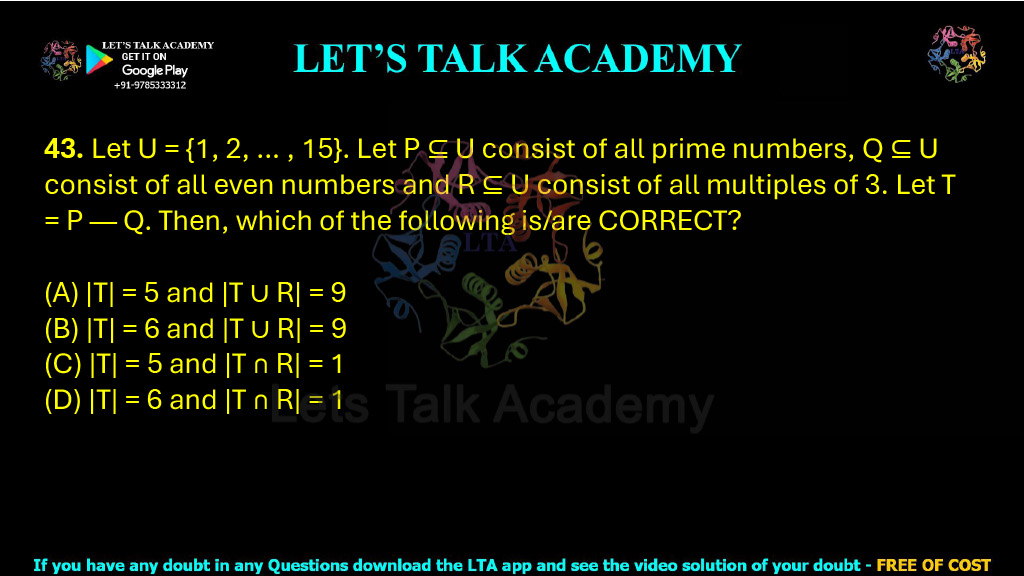
43. Let U = {1, 2, … , 15}. Let P ⊆ U consist of all prime numbers, Q ⊆ U consist of all even numbers and R ⊆ U consist of all multiples of 3. Let T = P — Q. Then, which of the following is/are CORRECT?
(A) |T| = 5 and |T ∪ R| = 9
(B) |T| = 6 and |T ∪ R| = 9
(C) |T| = 5 and |T ∩ R| = 1
(D) |T| = 6 and |T ∩ R| = 1
Find |T|, |T ∪ R| and |T ∩ R| for Prime, Even and Multiple of 3 Sets
Understanding the Given Set Theory Problem
This question is based on the fundamental concepts of sets, subsets, set difference, union, intersection, and cardinality. We are given a universal set U containing the natural numbers from 1 to 15. Three subsets are then defined according to different mathematical properties.
The universal set is:
U = {1, 2, 3, 4, 5, 6, 7, 8, 9, 10, 11, 12, 13, 14, 15}
The set P contains all prime numbers in U, the set Q contains all even numbers in U, and the set R contains all multiples of 3 in U. We first need to construct these sets correctly and then determine the set T = P − Q.
After finding T, we must calculate three important quantities:
|T|
|T ∪ R|
|T ∩ R|
These values will allow us to identify all the correct options.
Writing the Set P of All Prime Numbers
A prime number is a natural number greater than 1 that has exactly two positive factors: 1 and the number itself.
The prime numbers between 1 and 15 are:
2, 3, 5, 7, 11, and 13
Therefore:
P = {2, 3, 5, 7, 11, 13}
The number 1 is not included because 1 is not a prime number. It has only one positive factor, whereas a prime number must have exactly two positive factors.
Thus, the cardinality of P is:
|P| = 6
Writing the Set Q of All Even Numbers
An even number is an integer that is exactly divisible by 2. The even numbers contained in the universal set U are:
2, 4, 6, 8, 10, 12, and 14
Therefore:
Q = {2, 4, 6, 8, 10, 12, 14}
Among all the prime numbers in P, only the number 2 is even. In fact, 2 is the only even prime number.
Writing the Set R of All Multiples of 3
A multiple of 3 is obtained by multiplying 3 by a positive integer. The multiples of 3 contained in U are:
3, 6, 9, 12, and 15
Therefore:
R = {3, 6, 9, 12, 15}
Hence, the number of elements in R is:
|R| = 5
Finding the Set T = P − Q
The set difference P − Q consists of all elements that belong to P but do not belong to Q. Therefore, we begin with the elements of P and remove every element that is also present in Q.
We have:
P = {2, 3, 5, 7, 11, 13}
and:
Q = {2, 4, 6, 8, 10, 12, 14}
The only common element of P and Q is:
2
Therefore, when the even numbers are removed from the set of prime numbers, the number 2 is removed.
Hence:
T = P − Q
T = {3, 5, 7, 11, 13}
Finding the Cardinality |T|
The notation |T| represents the cardinality of the set T, which means the total number of distinct elements present in the set.
We have:
T = {3, 5, 7, 11, 13}
Counting the elements gives:
|T| = 5
This immediately eliminates options (B) and (D) because both of these options incorrectly state that |T| = 6.
Finding the Union T ∪ R
The union of two sets contains every element that belongs to either of the sets, without repeating any element. We need to find:
T ∪ R
The two sets are:
T = {3, 5, 7, 11, 13}
and:
R = {3, 6, 9, 12, 15}
Combining all distinct elements from both sets gives:
T ∪ R = {3, 5, 6, 7, 9, 11, 12, 13, 15}
Now, counting the elements:
|T ∪ R| = 9
Therefore:
|T| = 5 and |T ∪ R| = 9
This confirms that Option (A) is correct.
Finding the Intersection T ∩ R
The intersection of two sets contains only those elements that are common to both sets. We need to determine:
T ∩ R
Again, the two sets are:
T = {3, 5, 7, 11, 13}
and:
R = {3, 6, 9, 12, 15}
The only element common to both sets is:
3
Therefore:
T ∩ R = {3}
Hence:
|T ∩ R| = 1
Since we have already calculated that |T| = 5, we get:
|T| = 5 and |T ∩ R| = 1
Therefore, Option (C) is also correct.
Verifying the Union Using the Cardinality Formula
The value of |T ∪ R| can also be verified using the standard formula for the cardinality of the union of two sets:
|T ∪ R| = |T| + |R| − |T ∩ R|
We have already found:
|T| = 5
|R| = 5
|T ∩ R| = 1
Substituting these values into the formula:
|T ∪ R| = 5 + 5 − 1
Therefore:
|T ∪ R| = 9
The common element 3 is subtracted once because it is counted in both |T| and |R| when the two cardinalities are added.
Analysis of All the Given Options
Option (A): |T| = 5 and |T ∪ R| = 9
This option is correct. The set T = P − Q is {3, 5, 7, 11, 13}, so |T| = 5. Also, T ∪ R = {3, 5, 6, 7, 9, 11, 12, 13, 15}, which contains 9 elements. Therefore, both statements in Option (A) are correct.
Option (B): |T| = 6 and |T ∪ R| = 9
This option is incorrect. Although |T ∪ R| = 9 is correct, the statement |T| = 6 is incorrect. The prime number 2 must be removed from P because it is also an even number and belongs to Q. Therefore, |T| = 5, not 6.
Option (C): |T| = 5 and |T ∩ R| = 1
This option is correct. The set T contains 5 elements, and the only common element between T and R is 3. Therefore, |T| = 5 and |T ∩ R| = 1.
Option (D): |T| = 6 and |T ∩ R| = 1
This option is incorrect. The statement |T ∩ R| = 1 is correct, but |T| = 6 is incorrect. Since 2 is both prime and even, it is removed when forming T = P − Q. Hence, the correct value is |T| = 5.
Final Answer
The required sets are:
P = {2, 3, 5, 7, 11, 13}
Q = {2, 4, 6, 8, 10, 12, 14}
R = {3, 6, 9, 12, 15}
Therefore:
T = P − Q = {3, 5, 7, 11, 13}
Hence:
|T| = 5
|T ∪ R| = 9
|T ∩ R| = 1
Correct Options: (A) and (C)


