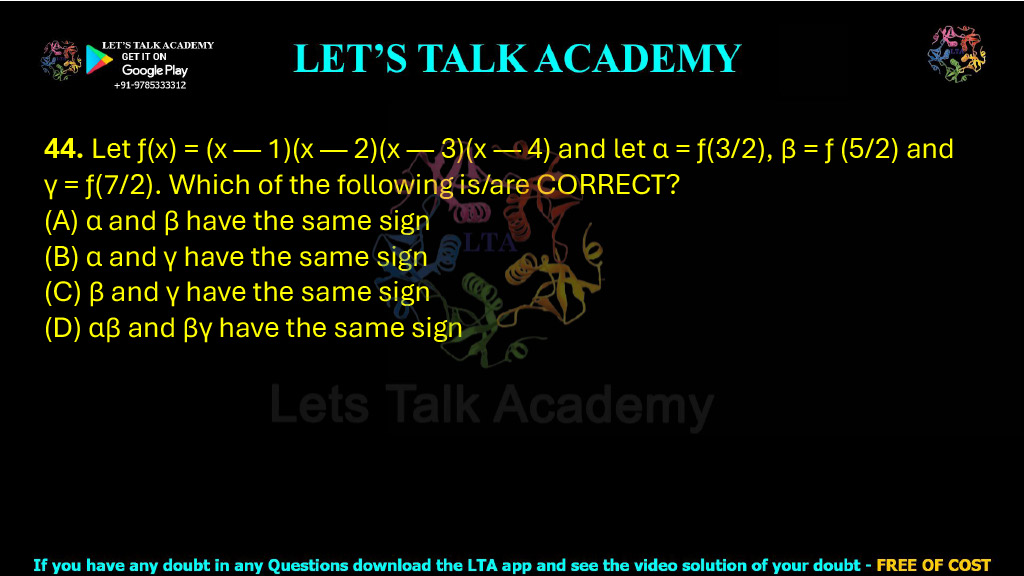
44. Let ƒ(x) = (x — 1)(x — 2)(x — 3)(x — 4) and let α = ƒ(3/2), β = ƒ (5/2) and γ = ƒ(7/2). Which of the following is/are CORRECT?
(A) α and β have the same sign
(B) α and γ have the same sign
(C) β and γ have the same sign
(D) αβ and βγ have the same sign
Determine the Signs of α, β and γ for f(x) = (x − 1)(x − 2)(x − 3)(x − 4)
Understanding the Given Polynomial Function
This question is based on the sign analysis of a polynomial function. We are given a polynomial expressed as the product of four linear factors:
f(x) = (x − 1)(x − 2)(x − 3)(x − 4)
Three values of the function are defined as:
α = f(3/2)
β = f(5/2)
γ = f(7/2)
The question does not directly ask us to calculate the exact numerical values of α, β, and γ. Instead, it asks us to compare their signs. Therefore, we mainly need to determine whether each value is positive or negative.
After finding the signs of α, β, and γ, we can examine each option and identify all the correct statements.
Finding the Zeros of the Polynomial
The polynomial is:
f(x) = (x − 1)(x − 2)(x − 3)(x − 4)
The value of the polynomial becomes zero whenever any one of its factors is zero. Therefore, its zeros are:
x = 1, 2, 3, and 4
These four zeros divide the real number line into the following intervals:
x < 1
1 < x < 2
2 < x < 3
3 < x < 4
x > 4
The three values given in the question lie in three consecutive intervals:
3/2 = 1.5 lies between 1 and 2
5/2 = 2.5 lies between 2 and 3
7/2 = 3.5 lies between 3 and 4
We now determine the sign of the polynomial in each of these intervals.
Finding the Sign of α = f(3/2)
Substituting x = 3/2 into the polynomial:
α = f(3/2)
α = (3/2 − 1)(3/2 − 2)(3/2 − 3)(3/2 − 4)
Simplifying each factor:
α = (1/2)(−1/2)(−3/2)(−5/2)
Now observe the signs of the four factors:
(+) × (−) × (−) × (−)
There are three negative factors. The product of an odd number of negative factors is negative.
Therefore:
α < 0
Hence, α is negative.
Exact Value of α
Although only the sign is required, we can calculate the exact value for complete verification:
α = (1/2)(−1/2)(−3/2)(−5/2)
The product of the numerators is:
1 × (−1) × (−3) × (−5) = −15
The product of the denominators is:
2 × 2 × 2 × 2 = 16
Therefore:
α = −15/16
This confirms that α is negative.
Finding the Sign of β = f(5/2)
Now substitute x = 5/2 into the polynomial:
β = f(5/2)
β = (5/2 − 1)(5/2 − 2)(5/2 − 3)(5/2 − 4)
Simplifying each factor:
β = (3/2)(1/2)(−1/2)(−3/2)
The signs of the four factors are:
(+) × (+) × (−) × (−)
There are two negative factors. The product of an even number of negative factors is positive.
Therefore:
β > 0
Hence, β is positive.
Exact Value of β
For complete verification:
β = (3/2)(1/2)(−1/2)(−3/2)
The product of the numerators is:
3 × 1 × (−1) × (−3) = 9
The product of the denominators is:
2 × 2 × 2 × 2 = 16
Therefore:
β = 9/16
This confirms that β is positive.
Finding the Sign of γ = f(7/2)
Now substitute x = 7/2 into the polynomial:
γ = f(7/2)
γ = (7/2 − 1)(7/2 − 2)(7/2 − 3)(7/2 − 4)
Simplifying each factor:
γ = (5/2)(3/2)(1/2)(−1/2)
The signs of the four factors are:
(+) × (+) × (+) × (−)
There is only one negative factor. Therefore, the complete product is negative.
Hence:
γ < 0
Therefore, γ is negative.
Exact Value of γ
For complete verification:
γ = (5/2)(3/2)(1/2)(−1/2)
The product of the numerators is:
5 × 3 × 1 × (−1) = −15
The product of the denominators is:
2 × 2 × 2 × 2 = 16
Therefore:
γ = −15/16
This confirms that γ is negative.
Comparing the Signs of α, β and γ
From the calculations above, we have:
α = −15/16 < 0
β = 9/16 > 0
γ = −15/16 < 0
Therefore, the sign pattern is:
α: Negative
β: Positive
γ: Negative
We can now use this sign pattern to analyse all the given options.
Analysis of All the Given Options
Option (A): α and β Have the Same Sign
This option is incorrect. We have found that α is negative, whereas β is positive. Since one value is negative and the other is positive, they do not have the same sign.
Therefore:
Sign of α ≠ Sign of β
Option (B): α and γ Have the Same Sign
This option is correct. Both α and γ are negative.
We have:
α = −15/16
and:
γ = −15/16
Therefore, α and γ have the same sign. In fact, for this particular polynomial, they also have the same numerical value.
Option (C): β and γ Have the Same Sign
This option is incorrect. The value of β is positive, whereas the value of γ is negative.
Therefore:
Sign of β ≠ Sign of γ
Hence, β and γ do not have the same sign.
Option (D): αβ and βγ Have the Same Sign
To analyse this statement, we use the signs already obtained:
α is negative
β is positive
γ is negative
Therefore, the sign of αβ is:
(−) × (+) = (−)
Thus:
αβ < 0
Similarly, the sign of βγ is:
(+) × (−) = (−)
Thus:
βγ < 0
Both αβ and βγ are negative. Therefore, they have the same sign.
Hence, Option (D) is correct.
Alternative Solution Using the Sign of the Polynomial Between Its Roots
The polynomial:
f(x) = (x − 1)(x − 2)(x − 3)(x − 4)
has four distinct roots:
1, 2, 3, and 4
Each root has multiplicity 1, which is odd. Therefore, the sign of the polynomial changes whenever x crosses any one of these roots.
For x > 4, all four factors are positive, so:
f(x) > 0
Moving from right to left across each simple root, the sign changes. Therefore, the sign pattern is:
x > 4: Positive
3 < x < 4: Negative
2 < x < 3: Positive
1 < x < 2: Negative
Since:
3/2 ∈ (1, 2)
5/2 ∈ (2, 3)
7/2 ∈ (3, 4)
we immediately obtain:
α < 0, β > 0, γ < 0
This gives the same conclusion without calculating the exact values of the function.
Final Answer
The signs of the three values are:
α < 0
β > 0
γ < 0
Therefore, α and γ have the same sign. Also, both αβ and βγ are negative and hence have the same sign.
Correct Options: (B) and (D)


