
1. Introduction to Fidelity of Replication
Fidelity of replication refers to the remarkable accuracy with which DNA is copied during cell division. Since DNA contains the genetic information required for the structure, function, development, and survival of an organism, maintaining the correct nucleotide sequence during replication is essential.
DNA replication is not simply a process of producing another DNA molecule. It is a highly regulated and accurate molecular process in which the newly synthesized DNA strand must closely match the template strand. The fidelity of replication ensures that genetic information is transmitted from one generation of cells to the next with minimal errors.
Despite this high accuracy, DNA replication is not completely error-free. DNA polymerases can occasionally insert an incorrect nucleotide, resulting in a mismatch. Cells therefore use several layers of accuracy-control mechanisms, including correct nucleotide selection, proofreading by DNA polymerases, and post-replication DNA repair pathways.
The combined action of these mechanisms makes DNA replication one of the most accurate biochemical processes known.
2. Meaning of Fidelity of Replication
Fidelity of replication is the ability of the DNA replication machinery to accurately copy the nucleotide sequence of a template DNA molecule.
In simple terms:
Fidelity of replication = Accuracy with which DNA is replicated and genetic information is preserved.
During DNA replication, an incoming nucleotide is selected according to complementary base pairing:
- Adenine (A) pairs with Thymine (T).
- Guanine (G) pairs with Cytosine (C).
Thus, if the template contains adenine, thymine should normally be incorporated into the newly synthesized strand. Similarly, guanine directs the incorporation of cytosine.
The replication machinery must distinguish between correct and incorrect nucleotides and remove errors whenever they occur.
3. Importance of High Fidelity in DNA Replication
High fidelity is essential because DNA stores the information required for cellular activities. Even a small number of replication errors can alter genes and potentially affect protein structure or cellular function.
Accurate replication is particularly important for:
3.1 Maintenance of Genetic Information
The primary function of replication is to transmit genetic information accurately to daughter cells. High fidelity minimizes changes in the DNA sequence during this process.
3.2 Prevention of Harmful Mutations
Replication errors can produce mutations. Although some mutations are neutral or occasionally beneficial, many can interfere with normal cellular functions.
3.3 Genome Stability
Cells must maintain a stable genome for normal growth and development. Replication fidelity works together with DNA repair pathways to prevent the accumulation of mutations.
3.4 Proper Cell Division
Before a cell divides, its DNA must be accurately duplicated. Errors that escape correction can be inherited by daughter cells.
3.5 Prevention of Disease
Defects in replication fidelity and DNA repair can increase genomic instability. Persistent genomic instability is associated with several diseases, including cancer.
4. Basic Principles Responsible for Replication Fidelity
Replication fidelity is achieved through multiple molecular mechanisms rather than through a single proofreading system.
The major mechanisms include:
- Accurate template-directed nucleotide selection
- Proper base pairing
- Structural discrimination by DNA polymerases
- Polymerase proofreading
- Mismatch repair
- Additional DNA damage surveillance and repair pathways
These mechanisms operate sequentially and collectively.
5. Complementary Base Pairing

The first level of replication fidelity arises from complementary base pairing.
DNA contains four nitrogenous bases:
- Adenine
- Thymine
- Guanine
- Cytosine
Adenine forms hydrogen bonds with thymine, whereas guanine forms hydrogen bonds with cytosine.
During replication, the template strand determines the sequence of the newly synthesized strand.
For example:
Template: 5′-A G C T-3′
New strand: 3′-T C G A-5′
This complementary relationship provides the fundamental basis for accurate DNA copying.
However, hydrogen bonding alone cannot explain the extremely high fidelity of replication because incorrect base pairs can occasionally form. Additional mechanisms are therefore necessary.
6. Role of DNA Polymerases in Replication Fidelity
DNA polymerases are the enzymes responsible for synthesizing new DNA strands.
They add nucleotides to the 3′-OH group of the growing DNA strand. Therefore, DNA synthesis occurs in the 5′ to 3′ direction.
DNA polymerases contribute to fidelity in two major ways:
- They preferentially select the correct nucleotide.
- Many DNA polymerases possess proofreading activity that removes incorrectly incorporated nucleotides.
The active site of a DNA polymerase has a highly specific three-dimensional structure. A correctly paired incoming nucleotide fits efficiently into this active site and supports further DNA synthesis.
An incorrect nucleotide generally causes structural distortions and is less efficiently incorporated.
7. Nucleotide Selection and Kinetic Discrimination

DNA polymerases do not simply recognize nucleotides based on hydrogen bonding. They also use structural and kinetic mechanisms to distinguish correct from incorrect nucleotides.
When the correct nucleotide enters the polymerase active site, the enzyme undergoes conformational changes that create a favorable environment for catalysis.
This is sometimes described as an induced-fit mechanism.
The correct nucleotide promotes proper alignment of:
- Template DNA
- Primer terminus
- Incoming nucleotide
- Catalytic residues
- Metal ions required for phosphodiester bond formation
An incorrect nucleotide usually fails to produce the same optimal alignment.
Consequently, incorrect nucleotides are incorporated much less frequently than correct ones.
8. Proofreading Mechanism
Proofreading is one of the most important mechanisms responsible for replication fidelity.
Many replicative DNA polymerases possess 3′→5′ exonuclease activity. This activity allows the polymerase to remove an incorrectly incorporated nucleotide from the growing DNA strand.
The process can be summarized as:
Nucleotide incorporation → Error detection → Removal of incorrect nucleotide → Resumption of DNA synthesis
9. 3′→5′ Exonuclease Activity

The term exonuclease refers to an enzyme that removes nucleotides from the end of a nucleic acid strand.
During proofreading, the incorrect nucleotide is removed from the 3′ end of the newly synthesized strand.
This is possible because DNA polymerase synthesizes DNA in the 5′→3′ direction but proofreading proceeds in the opposite direction.
Thus:
DNA synthesis: 5′ → 3′
Proofreading: 3′ → 5′
This distinction is extremely important for understanding replication fidelity.
10. How Proofreading Works
The proofreading process occurs through several steps.
10.1 Incorrect Nucleotide Incorporation
Occasionally, DNA polymerase inserts a nucleotide that does not correctly match the template base.
10.2 Detection of the Mismatch
The incorrect base pair produces an abnormal structure at the growing end of the DNA molecule.
DNA polymerase senses the distorted geometry of the newly formed DNA terminus.
10.3 Transfer to the Proofreading Site
The newly synthesized DNA end is transferred from the polymerase active site to a separate exonuclease site within the enzyme.
10.4 Removal of the Incorrect Nucleotide
The 3′→5′ exonuclease activity removes the incorrect nucleotide.
10.5 Return to the Polymerization Site
The corrected DNA terminus returns to the polymerase active site.
10.6 Continuation of DNA Synthesis
The polymerase then incorporates the correct nucleotide and continues DNA synthesis.
This proofreading mechanism dramatically increases the accuracy of DNA replication.
11. Polymerase and Exonuclease Activities
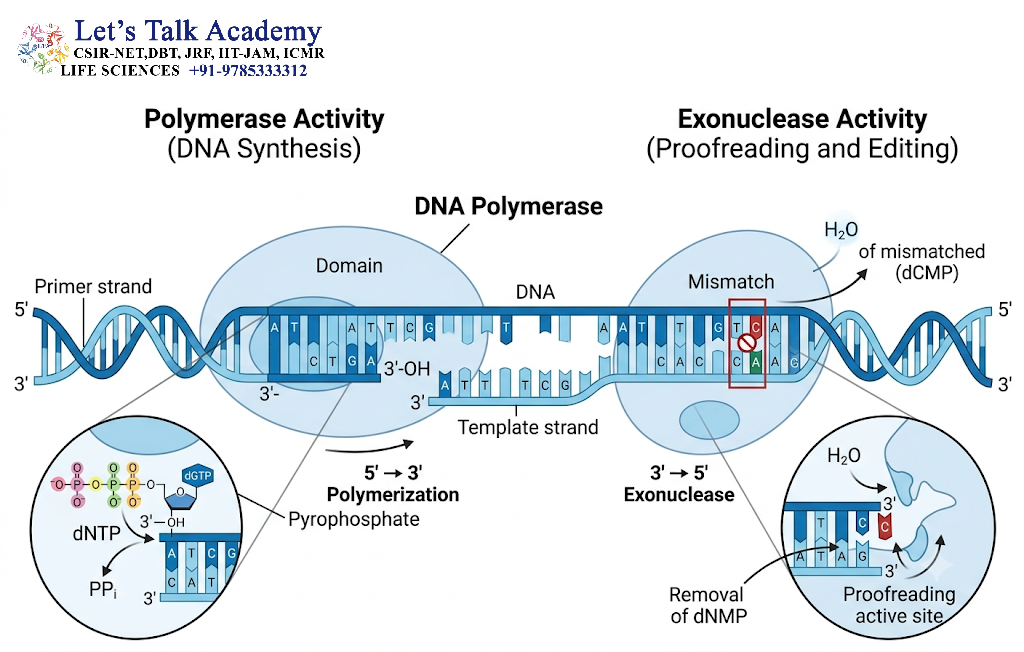
Replicative DNA polymerases can therefore have two functionally distinct activities.
11.1 Polymerase Activity
The polymerase activity adds nucleotides to the growing DNA strand.
Direction: 5′→3′
11.2 Exonuclease Activity
The proofreading exonuclease removes incorrectly incorporated nucleotides.
Direction: 3′→5′
The coordination between these activities allows DNA synthesis to proceed rapidly while maintaining high accuracy.
12. Fidelity Beyond Proofreading
Proofreading alone does not produce the final level of DNA replication accuracy.
Some mismatches escape polymerase proofreading. These errors are corrected after replication by mismatch repair.
Therefore, replication fidelity can be viewed as a multilayered process:
Correct nucleotide selection → Proofreading → Mismatch repair
Each layer further reduces the probability that an error will become a permanent mutation.
13. Mismatch Repair
Mismatch repair is a post-replicative DNA repair mechanism that identifies and corrects incorrectly paired bases that remain after DNA replication.
For example, a normal base pair may be:
G–C
But a replication error may produce:
G–T
Such mismatches can be recognized by mismatch repair proteins.
The repair pathway removes the incorrectly synthesized portion of DNA and replaces it with the correct sequence.
14. Major Steps in Mismatch Repair
Mismatch repair generally involves:
- Recognition of the mismatch
- Identification of the newly synthesized DNA strand
- Excision of the error-containing region
- Resynthesis using the correct template strand
- Sealing of the remaining nick
This pathway provides an additional opportunity to correct replication errors before they become permanent mutations.
15. Fidelity in Bacteria

In bacteria such as Escherichia coli, DNA replication is primarily performed by DNA polymerase III, which is the major replicative polymerase.
DNA polymerase III possesses proofreading activity through its associated 3′→5′ exonuclease function.
DNA polymerase I also contributes to DNA replication and repair and possesses both polymerase and exonuclease activities.
Mismatch repair proteins, including MutS, MutL, and MutH in the classical bacterial system, further improve replication fidelity.
15.1 MutS
MutS recognizes mismatched bases in newly replicated DNA.
15.2 MutL
MutL acts as an intermediary and coordinates several steps of the repair process.
15.3 MutH
In organisms possessing the MutH-dependent pathway, MutH helps identify the newly synthesized DNA strand through the methylation status of DNA.
This system allows the repair machinery to distinguish the newly synthesized strand from the parental strand.
16. Fidelity in Eukaryotes
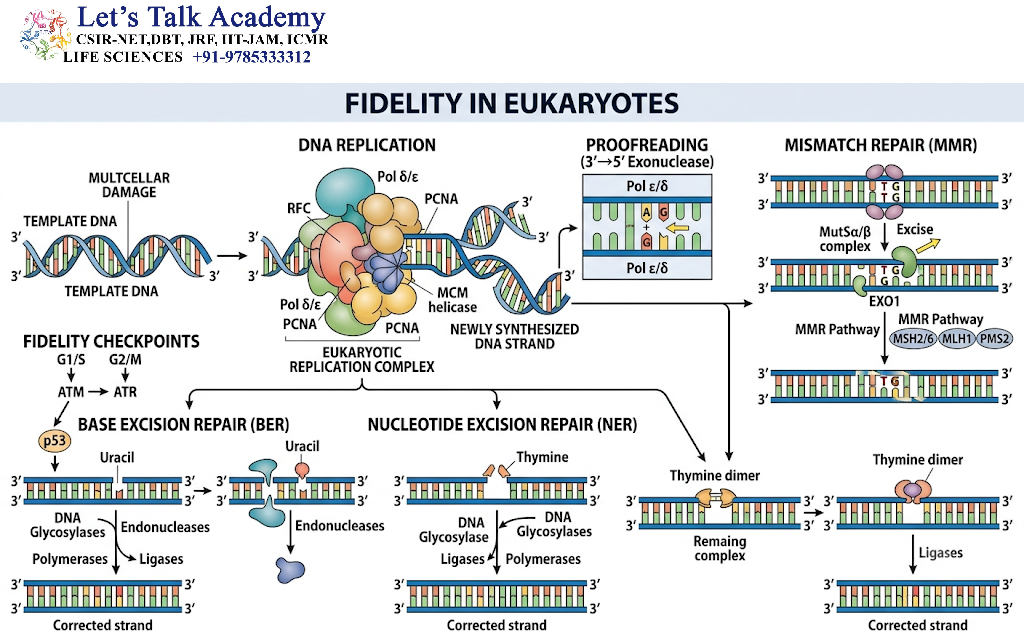
Eukaryotic DNA replication is more complex because eukaryotic genomes are larger and are organized into chromosomes.
Several DNA polymerases participate in DNA replication.
Important replicative polymerases include:
- DNA polymerase α
- DNA polymerase δ
- DNA polymerase ε
DNA polymerase α participates in the initiation of DNA synthesis, while DNA polymerases δ and ε play major roles in chromosomal DNA synthesis.
Many replicative polymerases possess proofreading activity, particularly polymerases involved in high-fidelity genome duplication.
Eukaryotic mismatch repair proteins further improve the accuracy of replication.
17. Role of DNA Polymerase α
DNA polymerase α functions primarily during the initiation of DNA synthesis.
It works in association with primase and helps generate the initial RNA-DNA primer.
Because polymerase α lacks the proofreading capability characteristic of the major high-fidelity replicative polymerases, it is not considered the principal enzyme responsible for maintaining replication fidelity throughout the genome.
18. Role of DNA Polymerase δ
DNA polymerase δ is a major replicative polymerase in eukaryotic cells and is particularly important for DNA synthesis on the lagging strand.
It possesses proofreading activity, which contributes significantly to replication accuracy.
19. Role of DNA Polymerase ε
DNA polymerase ε is another major replicative polymerase and has an important role in leading-strand DNA synthesis.
It also possesses proofreading activity and contributes to maintaining genome stability.
20. Replication Fidelity and the Leading and Lagging Strands

DNA replication occurs simultaneously on two template strands.
Because DNA polymerases synthesize DNA only in the 5′→3′ direction, the two strands are replicated differently.
20.1 Leading Strand
The leading strand is synthesized continuously.
20.2 Lagging Strand
The lagging strand is synthesized discontinuously through short DNA segments called Okazaki fragments.
The discontinuous nature of lagging-strand synthesis creates additional opportunities for processing and quality control.
However, both strands must ultimately achieve very high fidelity.
21. Structural Basis of Replication Fidelity

The structure of DNA polymerases is central to their accuracy.
A typical DNA polymerase contains a catalytic region that is often compared structurally to a hand, with domains resembling:
- Palm
- Fingers
- Thumb
The palm domain contains important catalytic residues.
The fingers domain helps position the incoming nucleotide.
The thumb domain interacts with DNA and contributes to processivity and proper positioning.
The conformational movement of the fingers domain helps distinguish correctly paired nucleotides from incorrect ones.
22. Role of Metal Ions in DNA Synthesis
DNA polymerization requires metal ions, particularly magnesium ions.
These metal ions participate in catalysis by helping:
- Position the incoming nucleotide
- Activate the 3′-OH group
- Stabilize negatively charged phosphate groups
- Facilitate phosphodiester bond formation
The correct structural arrangement of these components is important for accurate DNA synthesis.
23. Fidelity and the Geometry of Base Pairs

DNA polymerases are sensitive to the geometry of base pairs.
Correct Watson–Crick base pairs have a characteristic structure that fits efficiently into the polymerase active site.
Incorrect base pairs often have altered geometry and interfere with the proper positioning required for continued DNA synthesis.
Therefore, polymerase fidelity depends not only on chemical complementarity but also on the physical shape and structural compatibility of the DNA–nucleotide complex.
24. Tautomeric Shifts and Replication Errors
One source of replication errors is the temporary formation of rare tautomeric forms of DNA bases.
Normally, bases exist predominantly in particular chemical forms. Occasionally, a base can undergo a tautomeric shift, changing its hydrogen-bonding properties.
This may allow an incorrect base pairing to occur during replication.
For example, a rare tautomeric form can temporarily behave differently from the normal form and promote mispairing.
Once the base returns to its common form, the resulting mismatch may remain in the DNA.
This illustrates why replication fidelity requires mechanisms beyond ordinary base pairing.
25. Wobble and Mispairing

Although the genetic code allows wobble interactions during translation, replication requires much stricter base-pair discrimination.
Certain noncanonical base pairings can occasionally form during DNA synthesis.
DNA polymerases generally discriminate strongly against these incorrect interactions, but a small number may escape selection and proofreading.
26. Replication Errors and Mutations
A replication error becomes a permanent mutation only when it escapes all relevant correction mechanisms and is subsequently fixed in the DNA sequence.
For example:
Incorrect nucleotide incorporation → Proofreading escape → Mismatch repair escape → Replication of the mismatch → Permanent mutation
Thus, not every replication error becomes a mutation.
This distinction is essential when understanding genome stability.
27. Mutation Rate and Fidelity
The mutation rate reflects the frequency at which permanent changes arise in genetic material.
Replication fidelity is one of the major factors determining mutation rate.
A highly accurate replication system has a low probability of producing permanent replication-associated mutations.
However, mutation rates are also influenced by:
- DNA damage
- Environmental factors
- DNA repair efficiency
- Transposable elements
- Replication stress
- Polymerase defects
- Oxidative damage
Therefore, mutation rate and replication fidelity are related but are not identical concepts.
28. Replication Fidelity and Genome Stability
Genome stability refers to the preservation of the structure and sequence of genetic material.
High replication fidelity is one of the fundamental components of genome stability.
When replication errors increase or DNA repair mechanisms become defective, mutations can accumulate.
This may lead to:
- Base substitutions
- Insertions
- Deletions
- Frameshift mutations
- Chromosomal abnormalities
- Genomic instability
Cells therefore maintain multiple surveillance mechanisms to preserve DNA integrity.
29. Fidelity of Replication and Cancer
Cancer cells often exhibit abnormalities in DNA replication and repair.
Defects in proofreading or mismatch repair can increase the mutation rate of cells.
For example, mutations affecting mismatch repair genes can produce a phenotype characterized by increased microsatellite instability.
Similarly, alterations in proofreading domains of replicative DNA polymerases can increase the accumulation of mutations.
Thus, replication fidelity is closely connected with the prevention of genomic instability and tumor development.
30. Fidelity and Evolution
Replication fidelity also has an important evolutionary significance.
If DNA replication were completely error-free, genetic variation would be greatly reduced.
On the other hand, if replication were extremely inaccurate, genetic information would become unstable and essential biological functions could be lost.
Therefore, biological systems maintain a balance between:
Genetic stability and genetic variation
Occasional replication errors contribute to genetic variation, while high-fidelity replication prevents excessive accumulation of harmful mutations.
31. Fidelity of DNA Replication in Different Organisms
Replication fidelity varies among organisms and among different DNA polymerases.
High-fidelity DNA polymerases generally possess strong nucleotide-selection and proofreading mechanisms.
Some specialized DNA polymerases, however, are designed to replicate across damaged DNA. These are often called translesion synthesis polymerases.
They can tolerate damaged templates but generally have lower fidelity than the primary replicative polymerases.
This difference reflects an important biological trade-off:
Genome preservation vs. ability to bypass DNA damage
32. Translesion DNA Synthesis and Fidelity

When normal DNA polymerases encounter damaged DNA, replication may stall.
Specialized translesion polymerases can sometimes bypass the damaged region and allow replication to continue.
However, these polymerases generally have reduced fidelity and may introduce additional mutations.
Thus, translesion synthesis is an example of a cellular strategy in which survival of replication takes priority over maximum accuracy.
33. Fidelity of Replication and Processivity
Processivity refers to the ability of a DNA polymerase to add many nucleotides without dissociating from the DNA template.
High processivity is important because the genome must be copied efficiently.
Proteins such as sliding clamps increase the processivity of replicative DNA polymerases.
However, high processivity must be coordinated with proofreading so that the polymerase can efficiently correct errors without unnecessarily stopping replication.
34. Sliding Clamp and Replication Fidelity
In bacteria, the β clamp helps DNA polymerase III remain associated with DNA.
In eukaryotes, the corresponding protein is PCNA (proliferating cell nuclear antigen).
These sliding clamps increase polymerase processivity and also interact with several DNA replication and repair proteins.
PCNA is particularly important because it serves as a platform for coordinating DNA synthesis with DNA repair and replication-associated processes.
35. Replication Fidelity as a Multistep Process
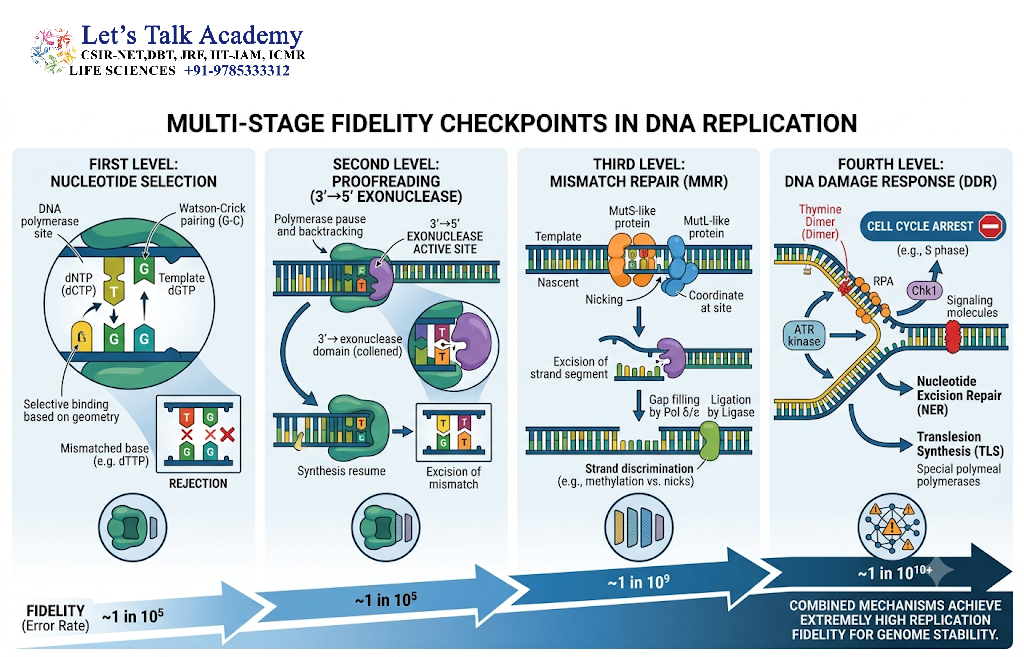
The accuracy of DNA replication can be understood as a series of checkpoints.
First Level: Nucleotide Selection
The polymerase preferentially chooses the correct nucleotide.
Second Level: Proofreading
Incorrectly incorporated nucleotides are removed by 3′→5′ exonuclease activity.
Third Level: Mismatch Repair
Errors that escape proofreading are detected and corrected after replication.
Fourth Level: DNA Damage Response
Additional pathways detect and respond to DNA damage and replication-associated problems.
Together, these mechanisms produce extremely high replication fidelity.
36. Factors Affecting Replication Fidelity
Several factors can influence replication fidelity.
36.1 DNA Polymerase Type
Different polymerases have different levels of accuracy.
36.2 Proofreading Efficiency
Polymerases with efficient proofreading generally have higher fidelity.
36.3 Template Damage
Damaged DNA can increase the likelihood of replication errors.
36.4 Nucleotide Pool Imbalance
Abnormal concentrations of cellular nucleotides can affect nucleotide selection and increase misincorporation.
36.5 Oxidative Stress
Reactive oxygen species can damage DNA bases and increase replication errors.
36.6 Replication Stress
Conditions that interfere with normal replication can increase the probability of errors and DNA damage.
36.7 DNA Repair Efficiency
Defective mismatch repair or other repair pathways can allow replication errors to persist.
37. Fidelity of Replication and Proofreading: A Conceptual Comparison
Replication fidelity refers to the overall accuracy of DNA duplication.
Proofreading refers specifically to the removal of incorrectly incorporated nucleotides by DNA polymerase-associated exonuclease activity.
Therefore:
Proofreading is one component of replication fidelity.
Replication fidelity is broader because it includes nucleotide selection, proofreading, mismatch repair, and other genome-maintenance mechanisms.
38. Important Molecular Directionality
A common source of confusion is the difference between DNA synthesis and proofreading.
DNA polymerase adds nucleotides only to the 3′-OH group of the growing strand.
Therefore:
DNA synthesis → 5′→3′
Proofreading removes the terminal incorrect nucleotide from the 3′ end.
Therefore:
Proofreading exonuclease → 3′→5′
Remembering this distinction is essential for understanding the mechanism of high-fidelity DNA replication.
39. Fidelity of Replication and Semiconservative Replication
DNA replication is semiconservative.
Each daughter DNA molecule contains:
- One parental strand
- One newly synthesized strand
The parental strand serves as a template for the new strand.
Because the new strand is synthesized using the parental strand as a template, complementary base pairing allows genetic information to be copied accurately.
However, the semiconservative nature of replication itself does not guarantee perfect fidelity. The polymerase and DNA repair systems are responsible for correcting errors.
40. Biological Significance of Replication Fidelity
The biological importance of replication fidelity can be summarized as follows:
- It preserves genetic information.
- It reduces harmful mutations.
- It maintains genome stability.
- It supports accurate cell division.
- It protects organisms from excessive genomic damage.
- It contributes to normal development and cellular function.
- It maintains species-specific genetic information.
- It provides controlled genetic variation necessary for evolution.


