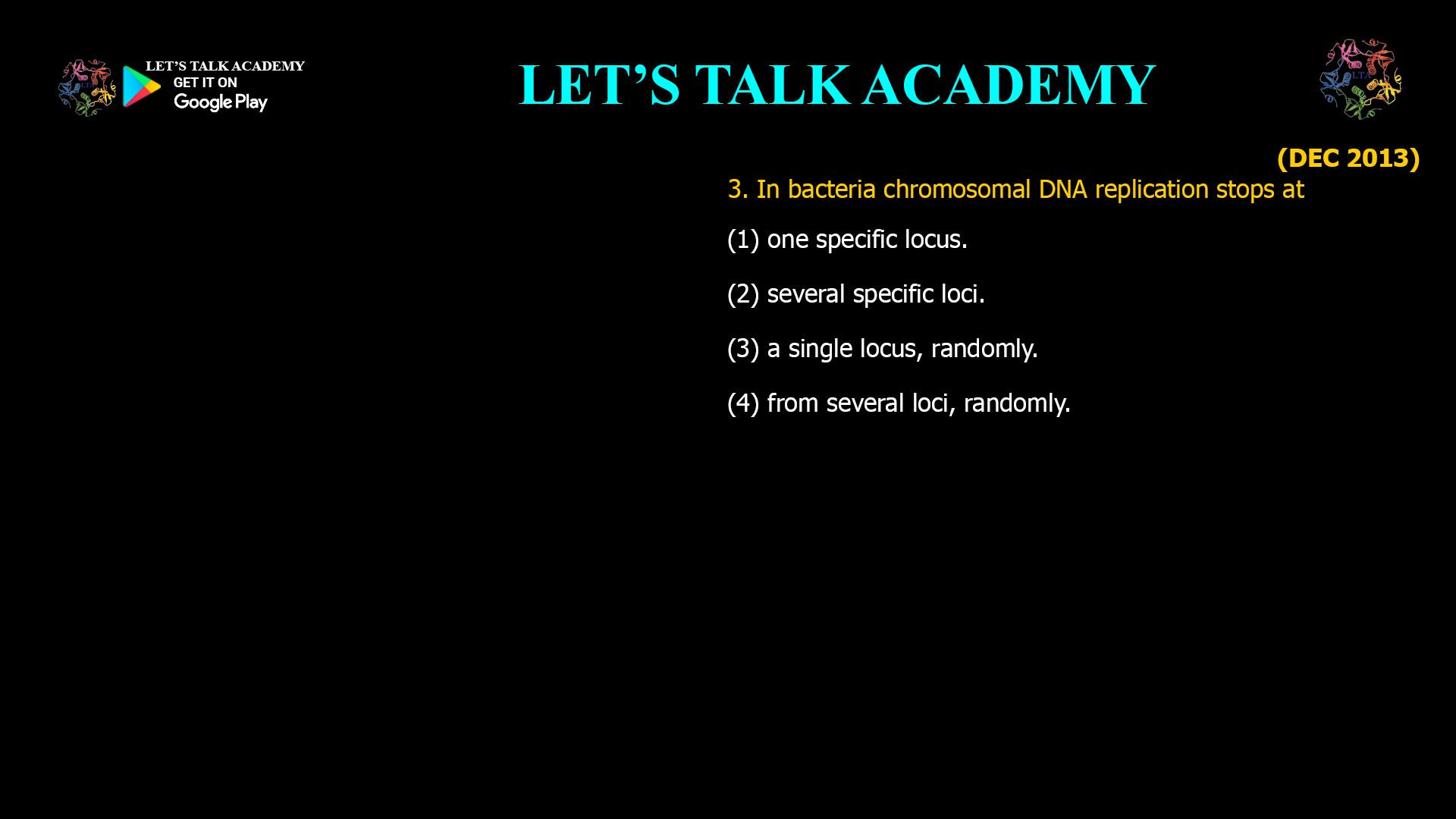
3. In bacteria chromosomal DNA replication stops at
(1) one specific locus.
(2) several specific loci.
(3) a single locus, randomly.
(4) from several loci, randomly.
Introduction
In bacteria, DNA replication is a highly regulated process that ensures the entire genome is duplicated accurately before cell division. While the initiation of replication occurs at a single origin (oriC), the termination of replication is a more complex event. Rather than stopping at a single specific locus, bacterial chromosomal DNA replication typically terminates at several specific loci within a defined terminus region. This article explores the molecular basis of replication termination in bacteria, the role of ter sites, and the replication fork trap mechanism.
Bacterial DNA Replication Overview
-
DNA replication initiates at the origin of replication (oriC).
-
Two replication forks proceed bidirectionally around the circular chromosome.
-
These forks eventually converge and terminate replication.
Termination at Several Specific Loci: The Terminus Region
-
The terminus region of bacterial chromosomes contains multiple termination (ter) sites.
-
These ter sites are specific DNA sequences that serve as binding sites for terminator proteins (e.g., Tus in E. coli).
-
The ter sites are arranged to form a replication fork trap, which ensures replication forks stop within a defined region opposite oriC.
Mechanism of Replication Fork Trap
-
Terminator proteins bind to ter sites and act as polar replication fork barriers.
-
They allow replication forks to pass in one direction but block them in the opposite direction.
-
This polarity ensures that replication forks are trapped and forced to meet within the terminus region.
-
The fork trap prevents over-replication and ensures proper completion of chromosome duplication.
Evidence for Multiple Specific Termination Sites
-
Studies in E. coli and B. subtilis show that replication forks pause and fuse within a region containing multiple ter sites rather than a single locus.
-
The termination sites are conserved and function cooperatively to regulate fork progression.
-
The dif site, involved in chromosome dimer resolution, is located within this terminus region, coordinating replication completion with chromosome segregation.
Why Not a Single Specific Locus?
-
The presence of multiple ter sites provides a robust termination system.
-
It accommodates variability in fork progression rates and prevents premature or incomplete termination.
-
The fork trap system ensures that forks meet within a controlled region, maintaining genome stability.
Summary Table
| Feature | Description |
|---|---|
| Termination Sites (ter) | Multiple specific loci within terminus region |
| Terminator Proteins | Bind ter sites, block replication forks polar |
| Fork Trap | Ensures forks meet within terminus region |
| Location | Opposite oriC on circular chromosome |
| Biological Importance | Prevents over-replication, coordinates segregation |
Conclusion
Bacterial chromosomal DNA replication terminates at several specific loci within a defined terminus region, rather than at a single site. The coordinated action of multiple ter sites and terminator proteins forms a replication fork trap that ensures replication forks converge properly. This system is crucial for maintaining genome integrity and coordinating replication with cell division.
Answer:
The correct option is (2) several specific loci.


38 Comments
Manisha choudhary
July 25, 2025Nice sir
Mahima Sharma
August 27, 2025Several specific loci
Diksha chhipa
July 29, 2025In prok the replication fork trap in ter sites .it prevent over replication.multiple ter site system is called robust termination system.it prevent in complete termination
Khushi Agarwal
July 29, 2025Answer is several specific loci ..
There is multiple but specific ter site present nd where ter Protein are bind and stop replication
anurag giri
July 29, 2025Termination sites are arranged to trap replication forks in a specific region. They are bound by a protein called Tus . Ensures that replication ends cleanly and symmetrically.
Vanshika Sharma
July 29, 2025Answer is several specific loci , bacterial chr.Dna replication terminates at several specific loci within a ter region rather than a single site
Surbhi Rajawat
July 29, 2025The replication stops at specific site known as termination site and a “site” involves many gene locus and specific ones. hence the answer is 2.
Priya Khandal
July 29, 2025Answer 2 is right serveral specific loci
Aafreen
July 30, 2025Bacterial chromosomal DNA replication stops at specific region known as terminus region which have several ter site . Hence ans is 2nd several specific loci
HIMANI FAUJDAR
July 29, 2025Ans – Replication stop at several specific loci at termination site which is ter site bounded by a tus protein
Khushi Mehra
July 29, 2025Dna Replication in bacteria terminates at ter site which contain many specific site to trap replication fork
The correct answer is 2
Priti Khandal
July 29, 2025Several specific loci is present for Replication stop
Khushi Mehra
July 29, 2025In bacterial Dna , replication stop at ter site where many specific regions are present to ensure termination
Thus , answer is 2
Heena
July 29, 2025In prokaryotes, termination of dna replication occurs at several specific ter sites to carry out proper termination process
Priya Khandal
July 29, 2025Answer 2 is right serveral specific loci
shruti sharma
July 29, 2025SEVERAL SPECIFIC LOCUS
Priyanka choudhary
July 29, 2025Bacteria chromosomal DNA replication ak one specific jagh hi stop hota hai so right answer is one specific locus,
Payal Gaur
July 30, 2025Several specific loci present on ter site (prevent from over replication)
Avni Besarwaria
July 29, 2025in bacterial chromosomal DNA replication stops at several specific loci in terminus region
Monika jangid
July 29, 2025Several specific loci
Priya dhakad
July 30, 2025In bacterial chromosomal DNA replication stop at several specific loci and tus protein are bound at ter site.
Sneha Kumawat
July 30, 2025Bacterial replication is stop at one specific site this site is known as ter site
Dipti Sharma
July 30, 2025Answer : several specific loci
Bacterial chromosomal DNA replication terminates at several specific loci bcz of various ter sites .
Deepika Sheoran
July 30, 2025Several specific loci
Bacterial chromosomal DNA replication
Terminates at multiple specific locations
Because of the presence of various ter sites.
Varsha Tatla
August 3, 2025Several specific loci.
Aman Choudhary
July 30, 2025Several specific loci because of ter site is present
Dharmpal Swami
July 30, 2025Replication terminates multiple specific locus the ter region where tus proteins are present
Replication forks will not cross each other at ter region
Komal Soni
July 30, 2025Ans 2
Shivani
July 31, 2025Ans is 2
Priyanka choudhary
August 1, 2025The right answer is option 2
Varsha tatla
August 2, 2025In bacterial dna ,dna replication stop at multiple specific loci.bcz multiple Ter site occurs in bac. Dna
Varsha tatla
August 2, 2025In bacterial dna ,dna replication stop at multiple specific loci.bcz multiple Ter site occurs in bacterialDna
Varsha tatla
August 2, 2025In bacterial dna ,dna replication stop at multiple specific loci.bcz multiple Ter site
Vijay Marmat
August 2, 20252 ✔️
Anjani sharma
August 5, 2025Answer 2 is correct-
serveral specific loci because of ter site is present.
Alec
August 30, 2025Dna replication stops at several specific loci.
Deepika Sheoran
November 6, 2025Bacterial chromosomal DNA replication terminates at multiple specific locations.
Because of the presence of various ter sites.
Juber Khan
March 11, 2026Bacterial chromosomal DNA replication terminates at several specific loci bcz of multiple ter sites .