
Stabilizing Interactions — Hydrogen Bonding
1. Introduction to Hydrogen Bonding
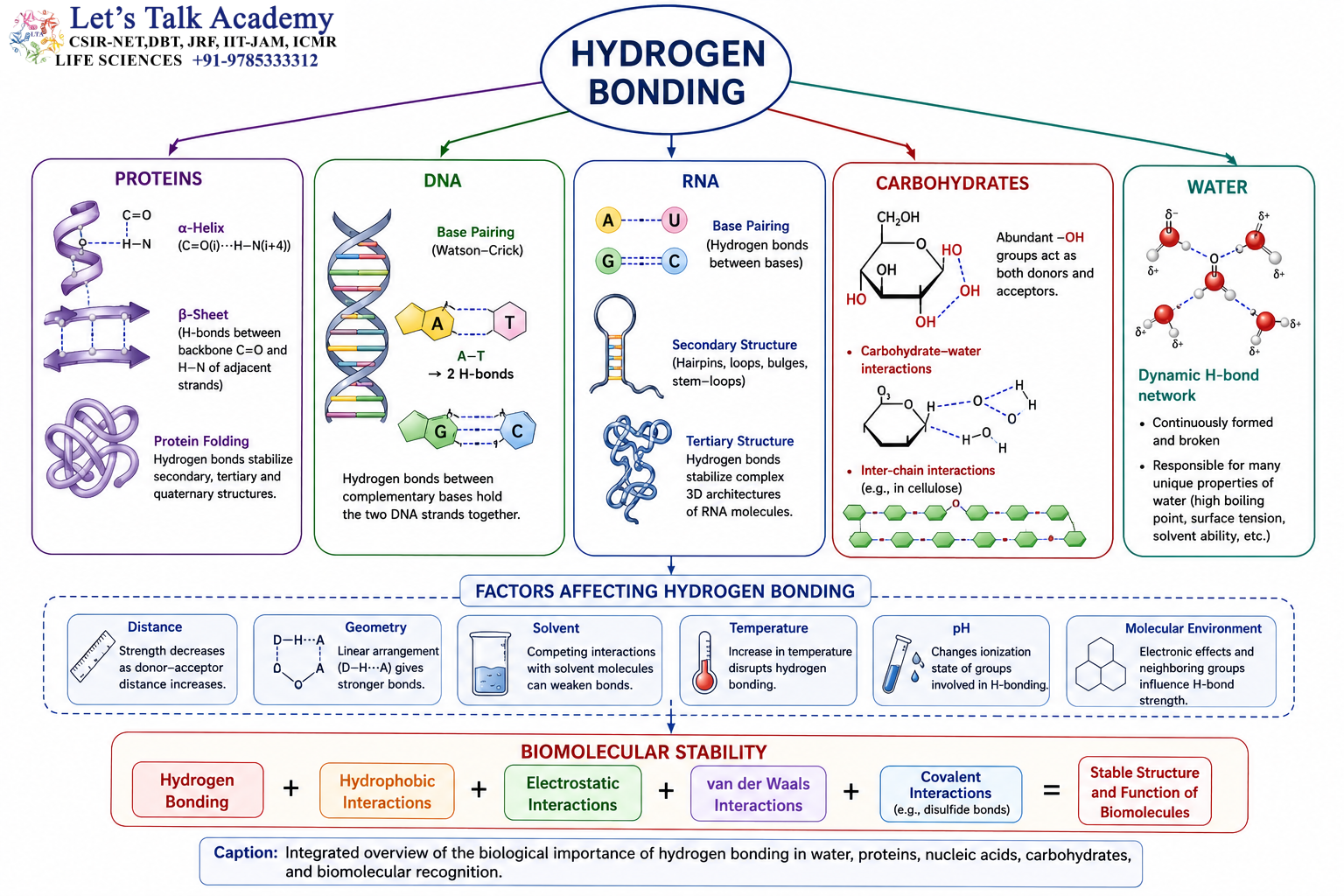
Hydrogen bonding is one of the most important non-covalent interactions involved in the structure, stability, recognition, and function of biological molecules. Although an individual hydrogen bond is much weaker than a covalent bond, large numbers of hydrogen bonds acting cooperatively can provide considerable stabilization to biomolecular structures.
Hydrogen bonds are particularly important in biological systems because living organisms contain a large amount of water, and water itself is extensively involved in hydrogen bonding. The properties of water, the folding of proteins, the formation of DNA double helices, RNA secondary structures, carbohydrate organization, and many molecular recognition processes are all influenced by hydrogen bonding.
Hydrogen bonding is therefore not simply a chemical interaction to be memorized. It is an important principle that connects molecular structure with biological function.
Hydrogen bonding is an important component of the topic “Biomolecules and Stabilizing Interactions.” Questions can be framed around hydrogen-bond donors and acceptors, hydrogen-bond geometry, protein secondary structure, DNA base pairing, water, molecular recognition, and factors affecting biomolecular stability.
2. What Is a Hydrogen Bond?
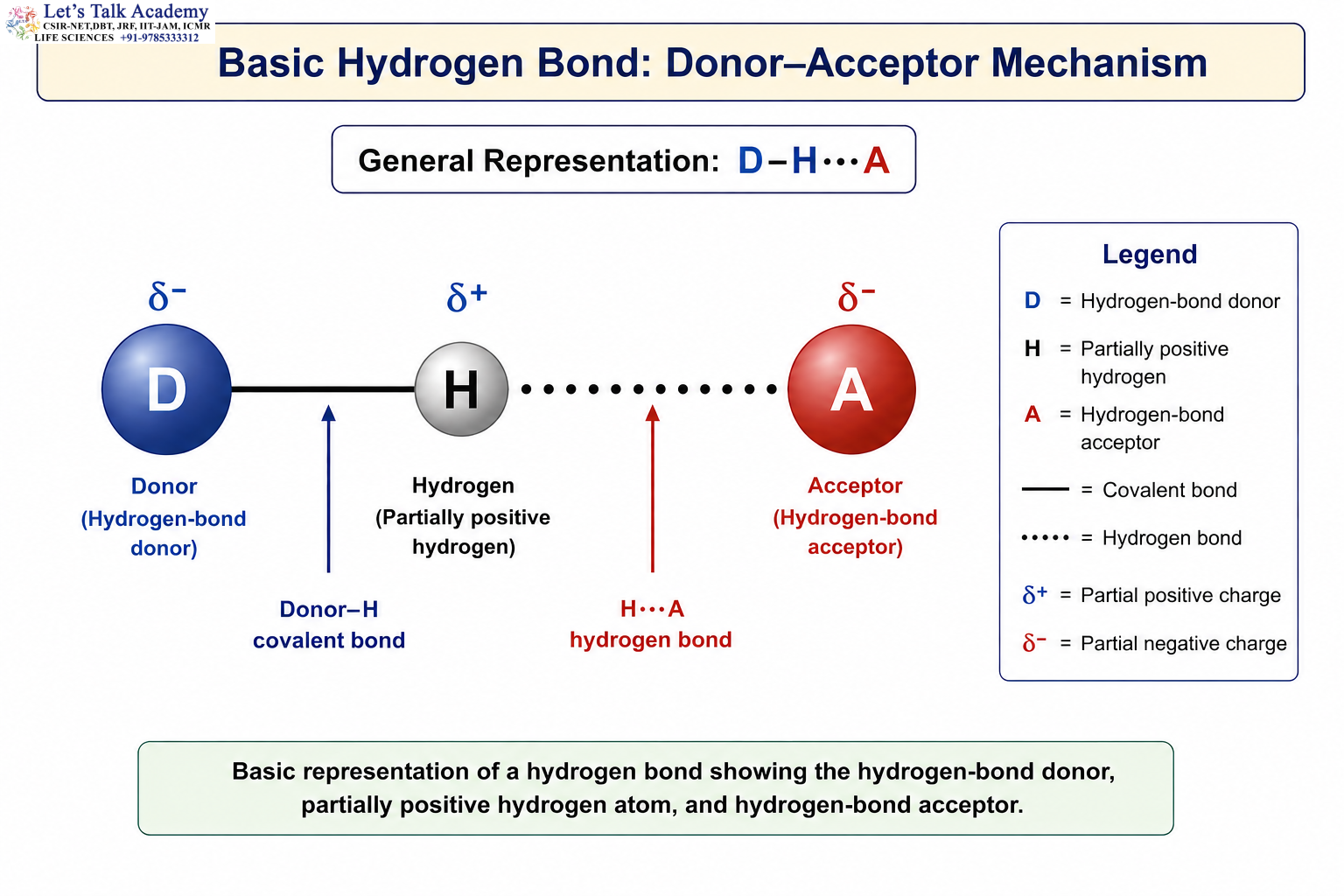
A hydrogen bond is a non-covalent interaction between a hydrogen atom that is covalently attached to an electronegative atom and another electronegative atom containing an available lone pair of electrons.
A general representation of a hydrogen bond is:
D–H···A
Where:
- D = Hydrogen-bond donor
- H = Hydrogen atom
- A = Hydrogen-bond acceptor
- ··· = Hydrogen bond
The donor is covalently attached to hydrogen, while the acceptor interacts with the partially positive hydrogen through its available electron density.
In biological systems, the most important electronegative atoms involved in hydrogen bonding are:
- Oxygen (O)
- Nitrogen (N)
- Fluorine (F)
Among these, oxygen and nitrogen are especially important in biomolecules.
3. Why Does Hydrogen Bonding Occur?
Hydrogen bonding is closely related to electronegativity and bond polarity.
When hydrogen is covalently attached to a highly electronegative atom such as oxygen or nitrogen, the shared electrons are attracted more strongly toward the electronegative atom.
As a result, the atoms acquire partial charges.
For example, in water:
Hδ+–Oδ−–Hδ+
Oxygen becomes partially negative, whereas hydrogen becomes partially positive.
The partially positive hydrogen of one water molecule can therefore interact with the partially negative oxygen of another water molecule.
This interaction produces a hydrogen bond:
O–H···O
The covalent O–H bond and the hydrogen bond are different interactions and should not be confused.
4. Important Characteristics of Hydrogen Bonds
Hydrogen bonds possess several characteristic properties that are important for understanding biomolecular structure.
4.1 Hydrogen Bonds Are Non-Covalent
Hydrogen bonds are classified as non-covalent interactions because they do not involve the sharing of electrons in the same manner as a conventional covalent bond.
They are therefore weaker individually than most covalent bonds.
However, biological molecules frequently contain many hydrogen bonds simultaneously. Their combined effect can be substantial.
4.2 Hydrogen Bonds Are Directional
Hydrogen bonds are not simply random attractions.
Their strength depends strongly on the relative orientation of the donor and acceptor.
A favorable donor–hydrogen–acceptor geometry generally produces a stronger interaction than a highly distorted arrangement.
This directionality is particularly important in:
- Protein secondary structures
- DNA base pairing
- Enzyme–substrate recognition
- Receptor–ligand interactions
4.3 Hydrogen Bonds Have Limited Range
Hydrogen bonding is strongly dependent on the distance between donor and acceptor.
As the distance increases, the interaction generally becomes weaker.
Therefore, biological molecules must adopt appropriate conformations to maintain favorable hydrogen-bonding interactions.
4.4 Hydrogen Bonds Are Environment Dependent
Hydrogen bonding does not occur in isolation.
Its strength can be influenced by:
- Solvent
- Temperature
- pH
- Ionic environment
- Molecular geometry
- Donor–acceptor distance
- Chemical environment of the donor and acceptor
This is particularly important in aqueous biological systems.
5. Hydrogen-Bond Donors and Acceptors
Understanding donors and acceptors is one of the most important concepts.
5.1 Hydrogen-Bond Donor
A hydrogen-bond donor is an electronegative atom that is covalently bonded to hydrogen and can donate that hydrogen for hydrogen bonding.
Common biological donors include:
- O–H
- N–H
Examples include hydroxyl groups and amino groups.
For example:
Protein–OH···O(H₂O)
Here, the protein hydroxyl group acts as the hydrogen-bond donor.
5.2 Hydrogen-Bond Acceptor
A hydrogen-bond acceptor is an electronegative atom possessing available electron density, usually in the form of a lone pair, that can interact with a partially positive hydrogen.
Common biological acceptors include:
- Carbonyl oxygen
- Ether oxygen
- Many hydroxyl oxygens
- Several nitrogen atoms
- Phosphate oxygens
For example:
Protein–C=O···H–O(H₂O)
Here, the carbonyl oxygen acts as the hydrogen-bond acceptor.
5.3 Donor–Acceptor Relationship
A simple way to remember the concept is:
Donor → provides H
Acceptor → provides electron pair
Therefore:
D–H···A
represents:
Donor–Hydrogen···Acceptor
This distinction is frequently tested in conceptual questions.
6. Important Exception: Amide Nitrogen
One of the important exceptions in biological chemistry is the amide nitrogen.
Although nitrogen atoms commonly participate in hydrogen bonding, the nitrogen of an amide group is generally a poor hydrogen-bond acceptor.
This occurs because the lone pair of electrons on the amide nitrogen is delocalized toward the carbonyl group through resonance.
Therefore, in a peptide bond:
C=O
the carbonyl oxygen is a good hydrogen-bond acceptor.
The:
N–H
group can act as a hydrogen-bond donor.
This property is fundamental to protein secondary structure.
7. Types of Hydrogen Bonds
Hydrogen bonds can be classified according to their location within or between molecules.
7.1 Intermolecular Hydrogen Bonds
An intermolecular hydrogen bond occurs between different molecules.
Water provides the most important biological example.
One water molecule can form hydrogen bonds with neighboring water molecules:
H–O–H···O–H
Intermolecular hydrogen bonding contributes to the physical properties of water and also occurs between biomolecules and solvent molecules.
Examples include:
- Water–water hydrogen bonding.
- Protein–water hydrogen bonding.
- DNA–water hydrogen bonding.
- Carbohydrate–water hydrogen bonding.
7.2 Intramolecular Hydrogen Bonds
An intramolecular hydrogen bond occurs between donor and acceptor groups located within the same molecule.
Such interactions can stabilize particular conformations and influence molecular shape.
Intramolecular hydrogen bonding is important because the three-dimensional structure of a molecule determines how it interacts with other molecules.
8. Hydrogen Bonding in Water
Water is perhaps the most biologically important example of hydrogen bonding.
Each water molecule contains:
- Two hydrogen atoms.
- One oxygen atom.
- Two O–H covalent bonds.
- Lone pairs of electrons on oxygen.
Because oxygen is highly electronegative, water is a polar molecule.
The oxygen atom carries a partial negative charge, while the hydrogen atoms carry partial positive charges.
Consequently, water molecules interact through extensive hydrogen bonding.
8.1 Hydrogen-Bonding Network in Water
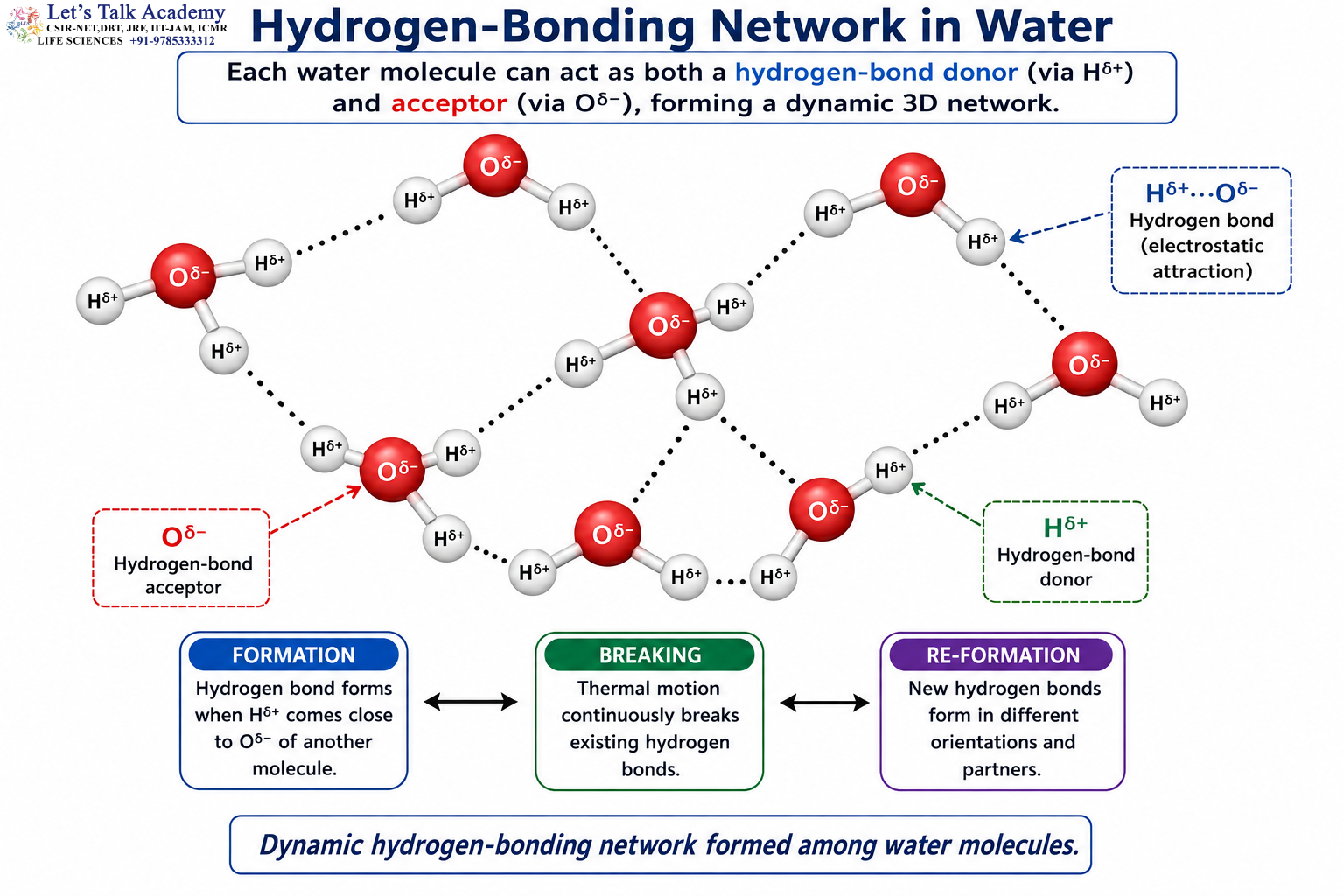
A water molecule can participate in multiple hydrogen-bonding interactions.
This creates a dynamic three-dimensional network.
The hydrogen bonds in liquid water are continuously:
formed → broken → re-formed
because thermal motion constantly changes molecular arrangements.
Therefore, the hydrogen-bonding network of liquid water is dynamic rather than permanently fixed.
This dynamic behavior is highly important in biological systems.
8.2 Biological Importance of Hydrogen Bonding in Water
Hydrogen bonding contributes to several properties of water.
8.2.1 High Boiling Point
Hydrogen bonding increases the energy required to separate water molecules.
Therefore, water has a much higher boiling point than would be expected for a molecule of such low molecular mass.
8.2.2 High Surface Tension
Strong cohesive forces between water molecules contribute to the high surface tension of water.
8.2.3 Excellent Solvent Properties
Water can interact effectively with many polar and charged molecules.
Hydrogen bonding between water and solutes contributes to the ability of water to dissolve and stabilize many biological compounds.
8.2.4 Thermal Regulation
The extensive hydrogen-bonding network allows water to absorb substantial amounts of heat, contributing to thermal stability in biological systems.
9. Hydrogen Bonding in Proteins
Hydrogen bonding is extremely important in determining and stabilizing protein structure.
Protein structure is commonly discussed at four levels:
- Primary structure
- Secondary structure
- Tertiary structure
- Quaternary structure
Hydrogen bonding is particularly important for secondary structure and also contributes to tertiary and quaternary organization.
10. Hydrogen Bonding in Protein Secondary Structure
The two major types of protein secondary structure are:
- α-helix
- β-sheet
Both are stabilized primarily by hydrogen bonds involving the peptide backbone.
10.1 Hydrogen Bonding in α-Helix
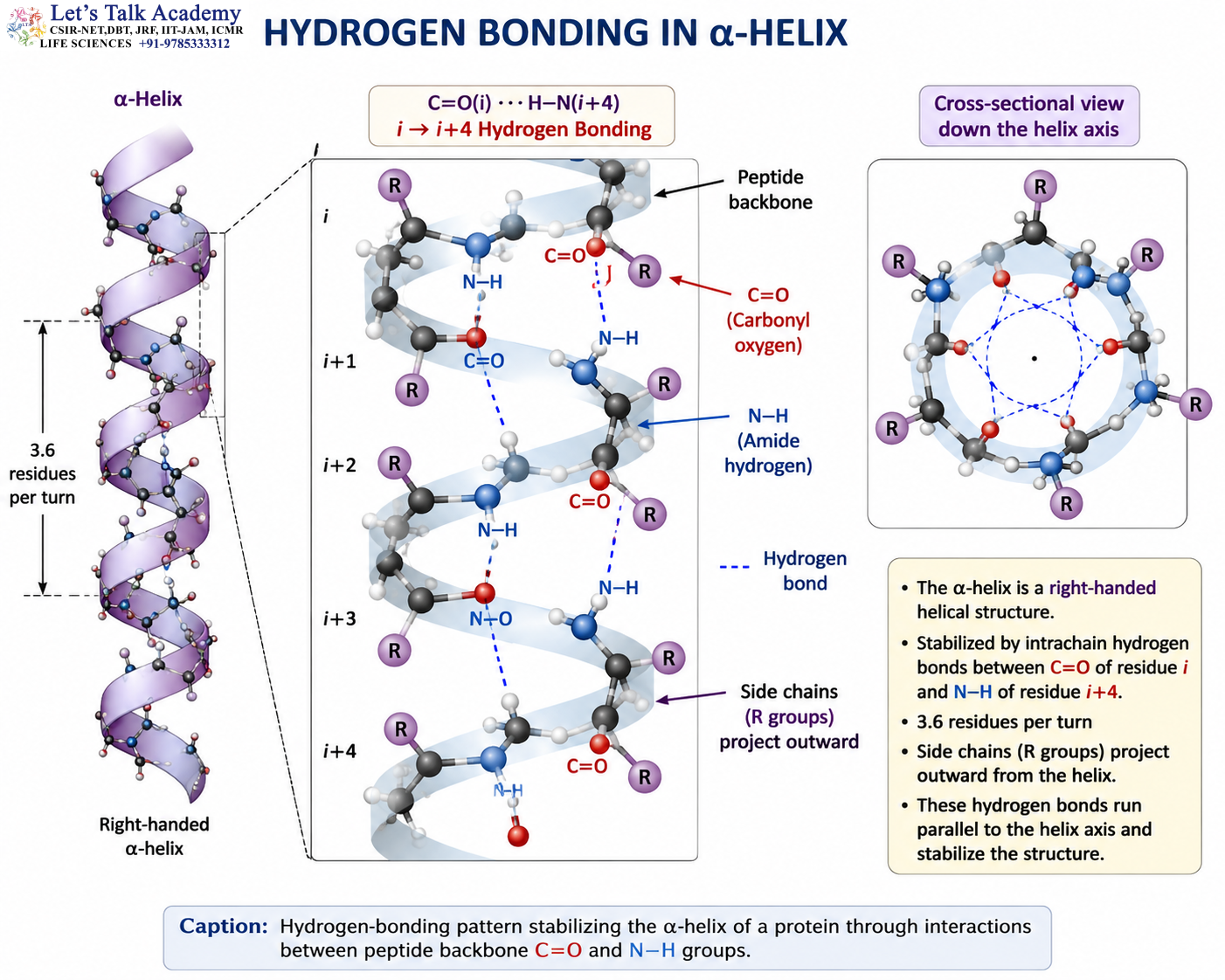
An α-helix is a regularly coiled structure in which the peptide backbone forms a helical arrangement.
The α-helix is stabilized by hydrogen bonds between:
C=O group of one amino acid
and
N–H group of another amino acid
A commonly used representation is:
C=O(i)···H–N(i+4)
This means that the carbonyl oxygen of residue i forms a hydrogen bond with the N–H group of approximately residue i+4.
The repeated pattern of these hydrogen bonds stabilizes the helical structure.
The hydrogen bonds stabilizing an α-helix occur mainly between backbone atoms, not between the side chains.
This is an important conceptual distinction.
10.2 Hydrogen Bonding in β-Sheet
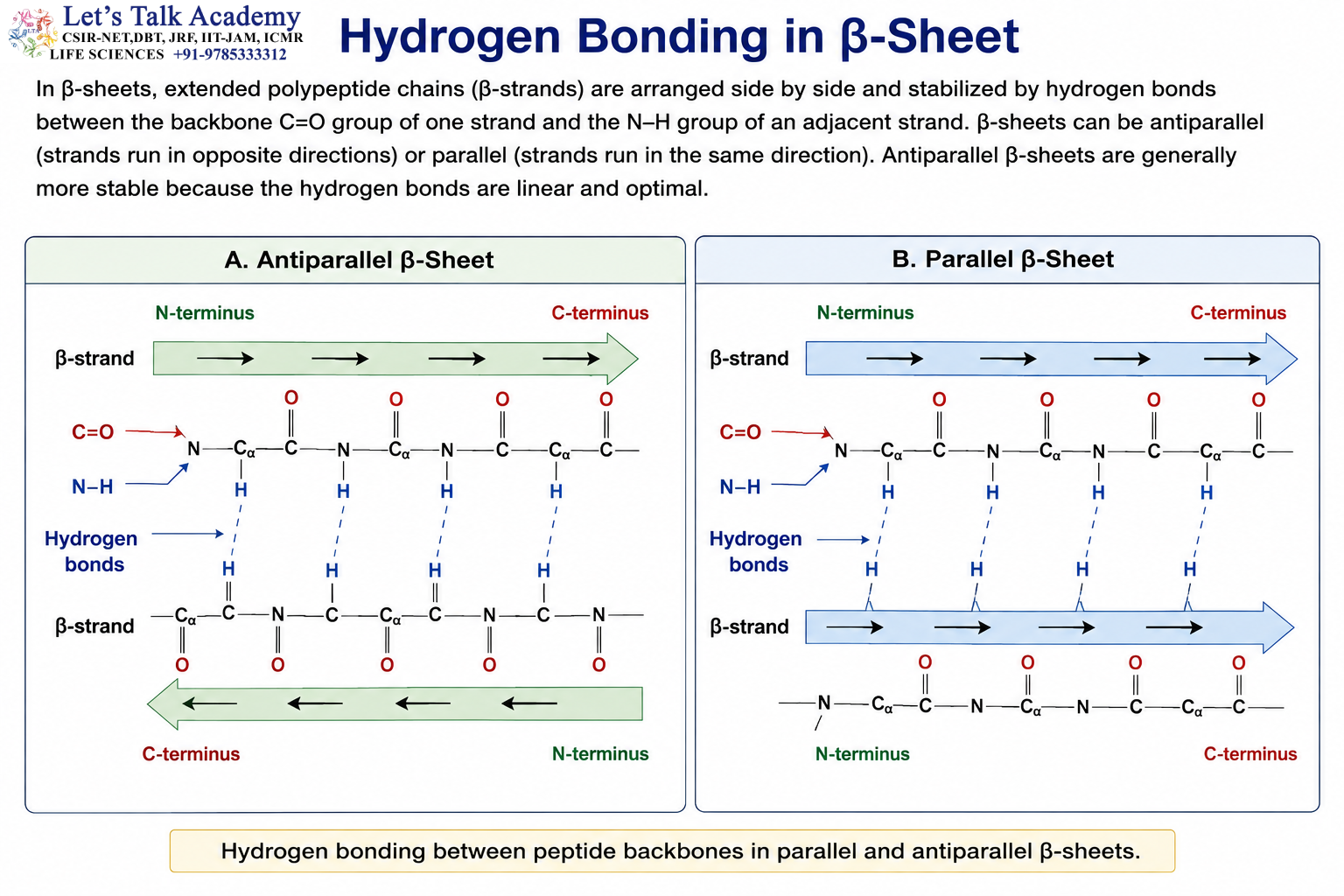
β-sheets are formed when extended polypeptide segments called β-strands associate through hydrogen bonding.
Hydrogen bonds form between:
C=O groups
and
N–H groups
of neighboring strands.
β-sheets can occur in two major arrangements:
- Parallel β-sheet
- Antiparallel β-sheet
The orientation of the polypeptide chains differs between these two arrangements.
Antiparallel β-Sheet
In an antiparallel β-sheet, neighboring strands run in opposite directions.
The hydrogen bonds are generally more geometrically favorable.
Parallel β-Sheet
In a parallel β-sheet, neighboring strands run in the same direction.
The hydrogen-bond geometry differs from that of an antiparallel sheet.
11. Hydrogen Bonding in β-Turns
β-turns are structural elements that allow a polypeptide chain to reverse its direction.
Hydrogen bonding can stabilize these turns.
A typical turn involves interactions between backbone groups that help maintain the compact geometry of the polypeptide.
β-turns are particularly important because they allow proteins to pack into complex three-dimensional structures.
12. Hydrogen Bonding in Protein Tertiary Structure
Hydrogen bonds can also contribute to tertiary protein structure.
A folded protein may contain hydrogen bonds between:
- Side chains.
- Backbone groups.
- Side chains and backbone groups.
- Protein and water.
For example, polar amino acid side chains can form hydrogen bonds with one another inside a protein.
However, hydrogen bonding is only one component of tertiary structure.
Other important interactions include:
- Hydrophobic interactions.
- Electrostatic interactions.
- van der Waals interactions.
- Disulfide bonds.
Therefore, protein stability results from the combined contribution of multiple interactions.
13. Hydrogen Bonding in DNA
Hydrogen bonding is fundamental to the structure of double-stranded DNA.
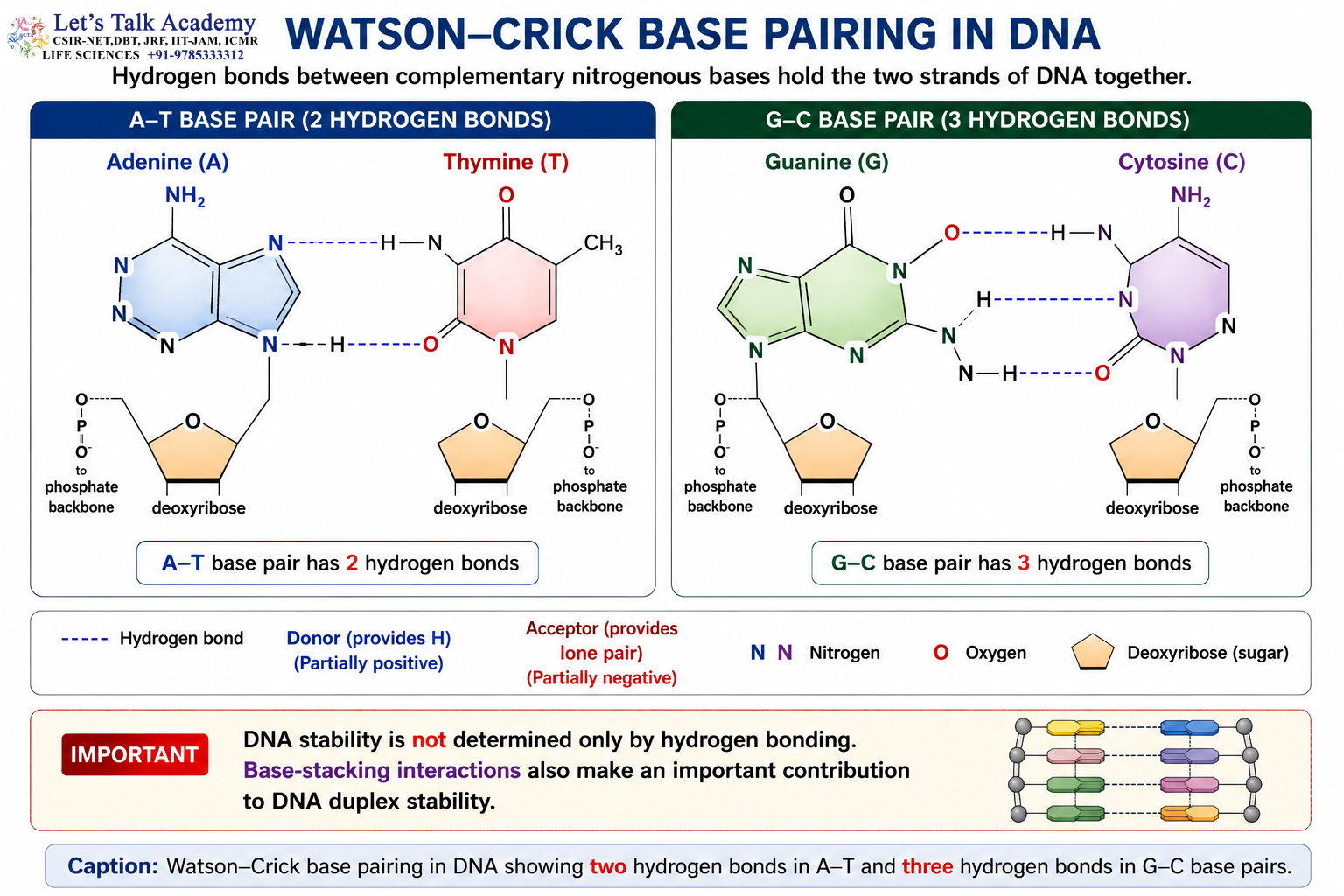
The two DNA strands are held together through complementary base pairing.
The major Watson–Crick base pairs are:
- Adenine–Thymine
- Guanine–Cytosine
13.1 Adenine–Thymine Base Pair
Adenine and thymine form two hydrogen bonds.
Therefore:
A = T
The two hydrogen bonds help maintain the specific pairing between the complementary strands.
13.2 Guanine–Cytosine Base Pair
Guanine and cytosine form three hydrogen bonds.
Therefore:
G ≡ C
The additional hydrogen bond contributes to the stability of GC-rich duplex regions.
However, it is important not to conclude that DNA stability depends exclusively on hydrogen bonds.
14. Hydrogen Bonding Is Not the Only Source of DNA Stability
A very important CSIR NET concept is that DNA duplex stability cannot be explained solely by hydrogen bonding.
Other interactions, particularly base stacking interactions, make major contributions to the stability of the DNA double helix.
Base stacking involves interactions between adjacent aromatic nucleotide bases and includes van der Waals forces and hydrophobic contributions.
Therefore:
DNA stability = Base pairing + Base stacking + Electrostatic effects + Solvent effects
Thus, the statement:
“GC-rich DNA is more stable only because G–C has three hydrogen bonds”
is an oversimplification.
15. Hydrogen Bonding in RNA
RNA is generally single-stranded, but it can fold into complex structures through intramolecular interactions.
Hydrogen bonding allows RNA to form:
- Hairpin structures.
- Stem-loop structures.
- Internal base-paired regions.
- Bulges.
- Complex tertiary structures.
RNA can form both canonical and non-canonical base-pairing interactions.
This structural flexibility is important for the biological functions of:
- tRNA
- rRNA
- mRNA
- Regulatory RNAs
- Ribozymes
Hydrogen bonding therefore contributes significantly to the structural organization and functional diversity of RNA.
16. Hydrogen Bonding in Carbohydrates
Carbohydrates contain multiple hydroxyl groups and other oxygen-containing functional groups.
These groups can participate in hydrogen bonding with:
- Water.
- Other carbohydrate molecules.
- Proteins.
- Nucleic acids.
- Other polar biomolecules.
Hydrogen bonding contributes to carbohydrate solubility, molecular recognition, and structural organization.
16.1 Hydrogen Bonding in Cellulose
Cellulose is a particularly important example.
Cellulose consists of long chains of glucose residues.
Hydrogen bonds between neighboring chains contribute to the organization and mechanical strength of cellulose fibers.
This helps explain why cellulose forms strong structural material in plant cell walls.
17. Hydrogen Bonding in Lipids and Biological Membranes
Hydrogen bonding is not the principal driving force for lipid bilayer formation, but it contributes to interactions involving membrane components.
Phospholipids contain:
- Hydrophilic head groups.
- Hydrophobic fatty-acid tails.
The polar head groups can form hydrogen bonds with water and other polar molecules.
Hydrogen bonding can also contribute to interactions between:
- Membrane proteins and lipid head groups.
- Membrane proteins and water.
- Polar lipid groups and neighboring biomolecules.
The overall organization of a membrane, however, is strongly influenced by the hydrophobic effect.
Therefore, hydrogen bonding and hydrophobic interactions should not be treated as identical mechanisms.
18. Hydrogen Bonding and Biomolecular Stability
Biomolecular stability is generally the result of several interactions acting simultaneously.
The major stabilizing interactions include:
- Covalent interactions.
- Hydrogen bonds.
- Electrostatic interactions.
- Hydrophobic interactions.
- van der Waals interactions.
- Disulfide bonds.
The importance of each interaction depends on the type of biomolecule and its environment.
For example, protein folding involves a complex balance between hydrophobic effects, hydrogen bonding, electrostatic interactions, and van der Waals interactions.
19. Hydrogen Bonding and Protein Folding
Protein folding converts an unfolded or partially unfolded polypeptide into a specific three-dimensional structure.
Hydrogen bonds help stabilize the folded conformation.
However, an important principle is:
Hydrogen bonding contributes to protein stability, but it does not act alone as the universal driving force for protein folding.
Hydrophobic residues tend to become buried away from water, while polar groups can form favorable hydrogen bonds with water or with other groups inside the protein.
Thus, protein folding represents a balance between:
Protein–protein interactions
and
Protein–water interactions
This is why understanding the aqueous environment is essential for understanding protein structure.
20. Hydrogen Bonding and Hydrophobic Interactions
Hydrogen bonding and hydrophobic interactions are frequently discussed together in biomolecular structure, but they represent different physical principles.
Hydrogen Bonding
Hydrogen bonding involves specific donor–acceptor interactions.
Hydrophobic Effect
The hydrophobic effect describes the tendency of nonpolar groups to become less exposed to water.
During protein folding, nonpolar side chains can become buried inside the protein, while many polar groups remain exposed or form hydrogen bonds internally.
Therefore, protein stability results from a balance of different energetic contributions.
21. Hydrogen Bonding in Enzyme–Substrate Interactions
Hydrogen bonds are important in enzyme–substrate recognition.
An enzyme active site contains amino acid residues arranged in a specific three-dimensional configuration.
These residues may form hydrogen bonds with the substrate.
For example:
Substrate donor → enzyme acceptor
and
Substrate acceptor → enzyme donor
These interactions can help:
- Position the substrate correctly.
- Increase binding specificity.
- Stabilize particular conformations.
- Assist transition-state stabilization in some enzymatic mechanisms.
- Orient reactive groups appropriately.
Thus, hydrogen bonding contributes not only to molecular structure but also to biological recognition and catalysis.
22. Hydrogen Bonding in Molecular Recognition
Biological recognition depends on the ability of molecules to distinguish specific partners.
Examples include:
- Enzyme–substrate recognition.
- Antigen–antibody interactions.
- Receptor–ligand binding.
- DNA–protein recognition.
- RNA–protein recognition.
Hydrogen bonds contribute to specificity because donor and acceptor groups must have appropriate positions and orientations.
Therefore, molecular recognition depends not simply on chemical groups being present but also on their three-dimensional arrangement.
23. Hydrogen Bonding in DNA–Protein Interactions
DNA-binding proteins frequently recognize specific nucleotide sequences using hydrogen bonds.
A protein may contain residues such as:
- Lysine
- Arginine
- Asparagine
- Glutamine
- Serine
- Threonine
These residues can interact with DNA bases or the phosphate backbone.
Hydrogen bonding can therefore contribute to:
- Sequence-specific recognition.
- DNA binding.
- Transcription-factor recognition.
- DNA packaging.
- Regulation of gene expression.
This illustrates how non-covalent interactions contribute directly to cellular regulation.
24. Hydrogen Bonding and DNA Melting
DNA strands can separate when thermal energy disrupts the interactions stabilizing the double helix.
This process is called:
DNA denaturation or DNA melting.
The temperature at which approximately half of a DNA duplex becomes denatured is commonly described as the melting temperature (Tm).
GC-rich sequences generally have higher melting temperatures than AT-rich sequences under comparable conditions.
However, Tm depends on several factors, including:
- Base composition.
- Base stacking.
- Ionic strength.
- DNA length.
- Sequence context.
- Solvent conditions.
Therefore, DNA melting should not be interpreted only in terms of the number of hydrogen bonds.
25. Factors Affecting Hydrogen Bond Strength
25.1 Electronegativity
The electronegativity of the donor and acceptor atoms strongly influences the polarity of the interaction.
Greater polarization can favor stronger hydrogen bonding.
25.2 Donor–Acceptor Distance
Hydrogen bonding becomes weaker as the donor and acceptor become farther apart.
An appropriate distance is therefore essential for effective interaction.
25.3 Bond Geometry
Hydrogen bonding is directional.
An appropriate donor–hydrogen–acceptor angle generally favors stronger interaction.
25.4 Solvent
Solvent molecules can compete with biomolecular hydrogen bonds.
Water can form hydrogen bonds with both donors and acceptors on biomolecules.
Therefore, a hydrogen bond that is favorable in isolation may behave differently in an aqueous environment.
25.5 Temperature
Increasing temperature increases molecular motion and can disrupt hydrogen-bonding networks.
This is particularly important in DNA melting and protein denaturation.
25.6 pH
Changes in pH can alter the protonation state of biological functional groups.
This can change whether a particular group can act as a hydrogen-bond donor or acceptor.
Therefore, pH can influence hydrogen-bonding patterns in proteins and nucleic acids.
25.7 Molecular Conformation
A donor and acceptor may be chemically capable of hydrogen bonding but unable to interact effectively if they are positioned incorrectly.
Thus, molecular conformation is a major determinant of hydrogen-bond formation.
26. Hydrogen Bonding and Aqueous Biological Systems
Most biological molecules function in an aqueous environment.
Therefore, hydrogen bonding must always be considered in relation to water.
A polar group on a protein can form hydrogen bonds with water:
Protein–OH···O(H₂O)
Similarly, a carbonyl group can interact with water:
Protein–C=O···H–O(H₂O)
During protein folding, some of these protein–water interactions may be replaced by protein–protein interactions.
This means that protein folding is not simply a process of “creating more hydrogen bonds.”
Instead, it involves a redistribution of interactions between:
Protein–water
and
Protein–protein
27. Hydrogen Bonding and Biomolecular Specificity
Hydrogen bonds can provide specificity because their formation requires complementary chemical groups.
For example:
Donor ↔ Acceptor
A molecule containing the correct arrangement of donors and acceptors can bind more effectively to a complementary binding site.
This principle is important in:
- Enzyme specificity.
- Receptor binding.
- Drug recognition.
- DNA recognition.
- Antibody recognition.
Therefore, hydrogen bonds are important contributors to the molecular basis of biological specificity.
28. Hydrogen Bonding and Drug–Target Interactions
Many drugs contain functional groups capable of hydrogen bonding.
When a drug binds to a protein target, hydrogen bonds can contribute to:
- Binding affinity.
- Binding specificity.
- Correct orientation of the drug.
- Stabilization of the drug–protein complex.
However, hydrogen bonds do not act independently. Hydrophobic interactions, electrostatic interactions, van der Waals interactions, and other forces can also contribute to binding.
This principle is important in structure-based drug design.
29. Biological Importance of Hydrogen Bonding
Hydrogen bonding has numerous biological functions.
29.1 Protein Structure
Hydrogen bonds stabilize α-helices, β-sheets, turns, and other structural features.
29.2 DNA Structure
Hydrogen bonding contributes to complementary base pairing.
29.3 RNA Structure
Hydrogen bonding supports RNA folding and secondary and tertiary structures.
29.4 Water Properties
Hydrogen bonding determines many unusual physical properties of water.
29.5 Molecular Recognition
Hydrogen bonding contributes to specific interactions between biological molecules.
29.6 Enzyme Function
Hydrogen bonds can assist substrate binding and transition-state stabilization.
29.7 Carbohydrate Structure
Hydrogen bonds influence carbohydrate solubility and structural organization.
29.8 Cellular Organization
Hydrogen bonding contributes to interactions among proteins, nucleic acids, carbohydrates, membranes, and water.
30. Hydrogen Bonding Versus Other Stabilizing Interactions
It is important to distinguish hydrogen bonding from other molecular interactions.
Interaction |
Basic Principle |
Major Biological Examples |
|---|---|---|
| Hydrogen bond | Donor–acceptor interaction involving H | DNA base pairing, protein secondary structure |
| Electrostatic interaction | Attraction between opposite charges | Salt bridges, DNA–protein interactions |
| Hydrophobic interaction | Association of nonpolar groups in water | Protein folding, membrane formation |
| van der Waals interaction | Short-range attractive interactions | Molecular packing |
| Disulfide bond | Covalent S–S bond | Stabilization of many extracellular proteins |
The same biomolecule may contain several of these interactions simultaneously.
31. Hydrogen Bonding and the Hierarchy of Protein Structure
Hydrogen bonding contributes differently at different levels of protein organization.
31.1 Primary Structure
Primary structure is determined by the amino acid sequence connected by peptide bonds.
Hydrogen bonds do not form the primary covalent backbone linkage.
31.2 Secondary Structure
Hydrogen bonding plays a major structural role.
Examples:
- α-helix
- β-sheet
31.3 Tertiary Structure
Hydrogen bonds between side chains and backbone groups can contribute to the final three-dimensional structure.
31.4 Quaternary Structure
Hydrogen bonds can also contribute to interactions between different polypeptide subunits.
Thus, hydrogen bonding can contribute at multiple levels of protein organization, although its role differs at each level.
32. Hydrogen Bonding Is Cooperative
A single hydrogen bond may provide limited stabilization.
However, many hydrogen bonds can act together.
This cooperative effect becomes particularly important in:
- Protein secondary structures.
- DNA duplexes.
- RNA structures.
- Water networks.
- Carbohydrate assemblies.
Therefore, the biological significance of hydrogen bonding often comes from large networks of interactions rather than one isolated hydrogen bond.
33. Hydrogen Bonding and Entropy
Biological interactions cannot be understood only by considering bond strength.
Changes in molecular organization also affect entropy.
For example, when molecules form an ordered hydrogen-bonding network, there can be changes in the freedom of molecular motion.
Similarly, when hydrophobic groups become buried during protein folding, water molecules associated with nonpolar surfaces may be released.
Therefore, biomolecular stability depends on the balance between:
Enthalpic contributions + Entropic contributions
34. Hydrogen Bonding and Thermodynamics
The stability of a biomolecular structure depends on the overall change in Gibbs free energy:
ΔG = ΔH − TΔS
Where:
- ΔG = Change in Gibbs free energy
- ΔH = Change in enthalpy
- T = Absolute temperature
- ΔS = Change in entropy
Hydrogen bonding can contribute favorably to enthalpic stabilization, but the overall biological process also depends on entropy and solvent effects.
Therefore, simply counting hydrogen bonds is not always sufficient to predict whether a biomolecular structure will be stable.
35. Conclusion
Hydrogen bonding is a fundamental stabilizing interaction that provides a molecular basis for many biological structures and processes. Its importance extends from the organization of water to the complex architecture of proteins and nucleic acids.
In proteins, hydrogen bonds stabilize important secondary structures such as α-helices and β-sheets. In DNA, they contribute to complementary base pairing, while in RNA they help generate diverse secondary and tertiary structures. Carbohydrates use hydrogen bonding extensively for interactions with water and neighboring molecules, and hydrogen bonds also contribute to molecular recognition and enzyme–substrate interactions.
An important principle is that no biomolecule should be considered stable because of one interaction alone. Biological structures arise from the combined effects of hydrogen bonding, hydrophobic interactions, electrostatic interactions, van der Waals forces, covalent bonds, solvent effects, and thermodynamic factors.
Therefore, hydrogen bonding should be understood not merely as a weak attraction between molecules but as a highly organized, directional, environment-dependent interaction that plays a central role in determining the structure and function of biomolecules.
Hydrogen Bonding → Molecular Recognition → Structural Stabilization → Biomolecular Function


