
Stabilizing Interactions – Hydrophobic Interaction
1. Introduction
Biomolecules are maintained in their biologically functional structures by several types of interactions. These interactions may be covalent or non-covalent and include hydrogen bonding, electrostatic interactions, van der Waals interactions, and hydrophobic interactions.
Among these, hydrophobic interactions are particularly important in determining the three-dimensional organization of biological macromolecules. They play a major role in protein folding, membrane formation, molecular recognition, protein–protein association, protein–ligand binding, and the organization of many cellular structures.
The term hydrophobic literally means “water-fearing.” Hydrophobic groups do not form favorable interactions with water comparable to those formed by polar or charged groups. Consequently, when non-polar groups are present in an aqueous environment, the surrounding water molecules reorganize around them. The tendency of non-polar groups to reduce their exposure to water gives rise to what is called the hydrophobic effect.
It is important to understand that hydrophobic interaction is not simply an attractive force between two non-polar molecules. Rather, it is largely a solvent-mediated phenomenon, strongly associated with the behavior of water around non-polar surfaces.
2. What Is a Hydrophobic Interaction?
A hydrophobic interaction is the tendency of non-polar groups or molecules to associate with one another in an aqueous environment, thereby minimizing their contact with water.
Hydrophobic groups generally contain bonds such as C–C and C–H and have little or no ability to participate effectively in hydrogen bonding with water.
Examples of hydrophobic groups include:
- Hydrocarbon chains
- Methyl groups
- Many non-polar amino acid side chains
- Long hydrocarbon portions of lipids
Important hydrophobic amino acid residues include:
Alanine (Ala), Valine (Val), Leucine (Leu), Isoleucine (Ile), Methionine (Met), Phenylalanine (Phe), Tryptophan (Trp), and Proline (Pro), although the degree of hydrophobicity varies among these residues.
In proteins, these residues frequently become enriched in the interior of globular proteins, where they are protected from the aqueous environment.
3. Hydrophobic Effect and Hydrophobic Interaction
The terms hydrophobic effect and hydrophobic interaction are closely related but should not be considered completely identical.
The hydrophobic effect describes the thermodynamic tendency of non-polar surfaces to minimize their exposure to water.
The term hydrophobic interaction is often used to describe the association of non-polar groups that occurs as a consequence of this effect.
Therefore:
Non-polar surface exposed to water
↓
Reorganization of surrounding water molecules
↓
Hydrophobic effect
↓
Association of non-polar groups
↓
Reduced non-polar surface exposed to water
4. Why Is Water Important?
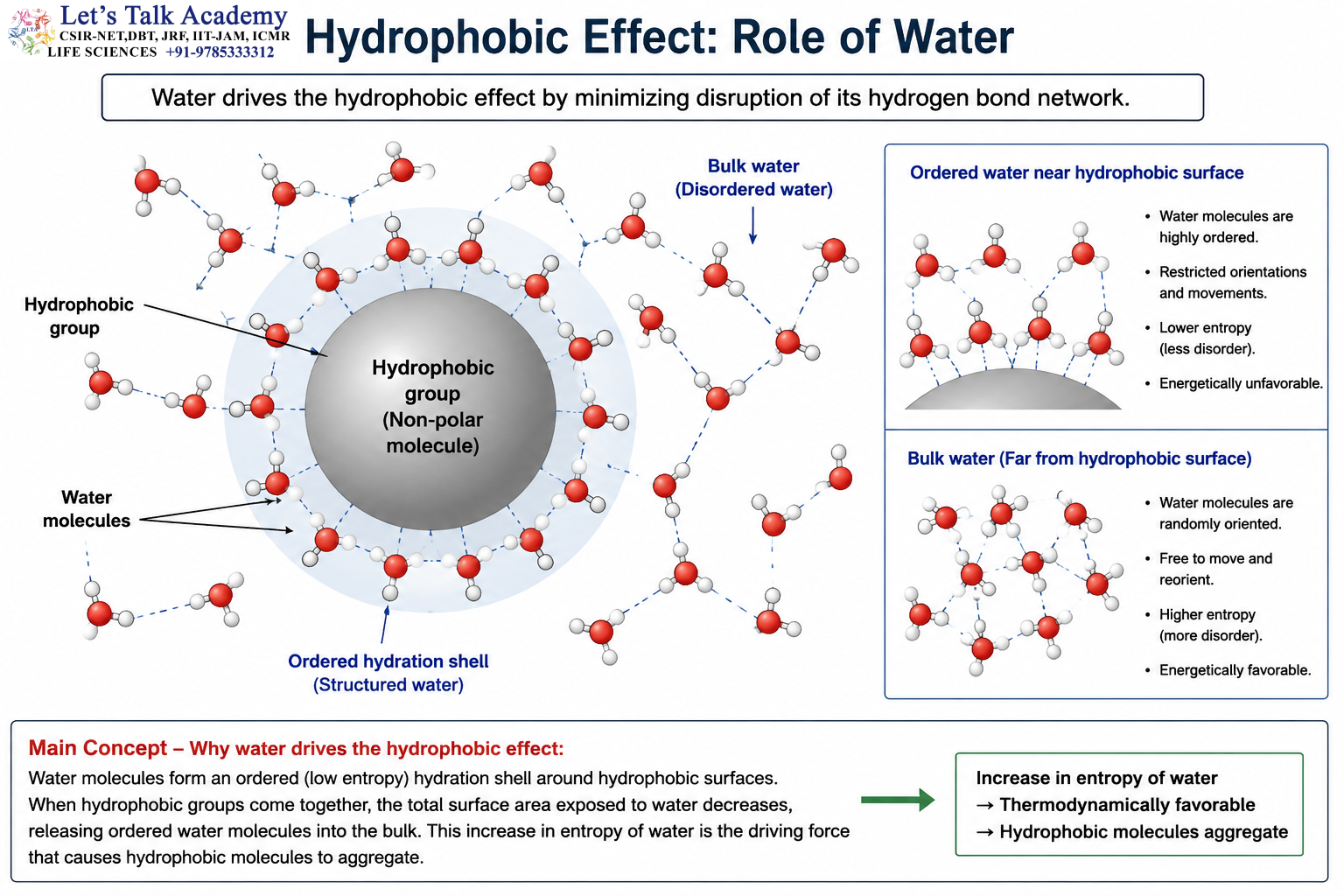
Water is the central factor responsible for the hydrophobic effect.
Water molecules are polar and can form extensive transient hydrogen-bonding networks with one another. When a non-polar molecule enters water, it cannot participate effectively in this hydrogen-bonding network.
As a consequence, water molecules near the non-polar surface become more organized than water molecules in the bulk solution.
This organization has an important thermodynamic consequence.
A useful conceptual sequence is:
Non-polar molecule enters water
↓
Water cannot hydrogen-bond favorably with the non-polar surface
↓
Water molecules reorganize around the non-polar group
↓
Hydration shell becomes relatively ordered
↓
Loss of configurational freedom of water
↓
Unfavorable entropy contribution
When two non-polar groups come together, the total non-polar surface exposed to water decreases.
Consequently, some of the ordered water molecules are released back into the bulk solvent.
This increases the freedom of water molecules and can produce a favorable entropy contribution.
5. Hydrophobic Effect Is Mainly a Solvent-Mediated Phenomenon
One of the most important concepts for competitive examinations is that hydrophobic association should not be imagined simply as two hydrophobic molecules “attracting” each other through a special force.
Instead, the surrounding solvent plays a major role.
Consider two hydrophobic groups separated in water.
Hydrophobic group A ← water → Hydrophobic group B
Each non-polar group affects the organization of surrounding water.
When the groups approach one another:
Hydrophobic A + Hydrophobic B
↓
Association
↓
Reduced exposed non-polar surface area
↓
Fewer water molecules required in ordered hydration environments
↓
Release of water molecules to bulk solution
↓
Favorable thermodynamic contribution
Thus, the hydrophobic effect is strongly influenced by water structure, solvent-accessible surface area, entropy, enthalpy, and temperature.
6. Hydrophobic Amino Acids
Hydrophobic amino acids contain side chains that interact relatively weakly with water.
The major non-polar amino acids are:
6.1 Alanine
Alanine contains a methyl side chain:
–CH₃
It is relatively small and moderately hydrophobic.
6.2 Valine
Valine contains a branched hydrocarbon side chain and is strongly associated with hydrophobic regions of proteins.
6.3 Leucine
Leucine contains a larger aliphatic side chain and is commonly found within hydrophobic protein cores.
6.4 Isoleucine
Isoleucine has a branched hydrocarbon side chain and contributes substantially to hydrophobic packing.
6.5 Methionine
Methionine contains a sulfur atom within a thioether group but is generally classified as a non-polar amino acid.
6.6 Phenylalanine
Phenylalanine contains an aromatic benzyl side chain and is strongly hydrophobic.
6.7 Tryptophan
Tryptophan contains a large indole ring system. Although its side chain contains a nitrogen atom capable of hydrogen bonding, much of the aromatic surface is non-polar.
6.8 Proline
Proline contains a cyclic side chain attached to the amino nitrogen. It is relatively non-polar and has unique structural effects on protein conformation.
7. Hydrophobicity of Amino Acid Side Chains
Hydrophobicity is not an absolute property that can be assigned identically under every condition.
The apparent hydrophobicity of an amino acid can depend on:
- Solvent
- Temperature
- Exposure of the side chain
- Molecular environment
- Nearby polar groups
- Protein conformation
- Solvent-accessible surface area
Therefore, amino acids should not always be treated as simply “hydrophobic” or “hydrophilic” without considering their structural context.
8. Hydrophobic Interaction in Protein Folding
Hydrophobic interactions are one of the major contributors to protein folding.
A newly synthesized polypeptide chain initially explores many possible conformations. In an aqueous environment, non-polar side chains tend to become less exposed to water.
This promotes hydrophobic collapse.
Hydrophobic collapse: is an early structural event in many protein-folding pathways. When a polypeptide chain is placed in water, hydrophobic side chains tend to become associated with one another. This reduces the total hydrophobic surface area exposed to water, causing the polypeptide chain to become more compact.
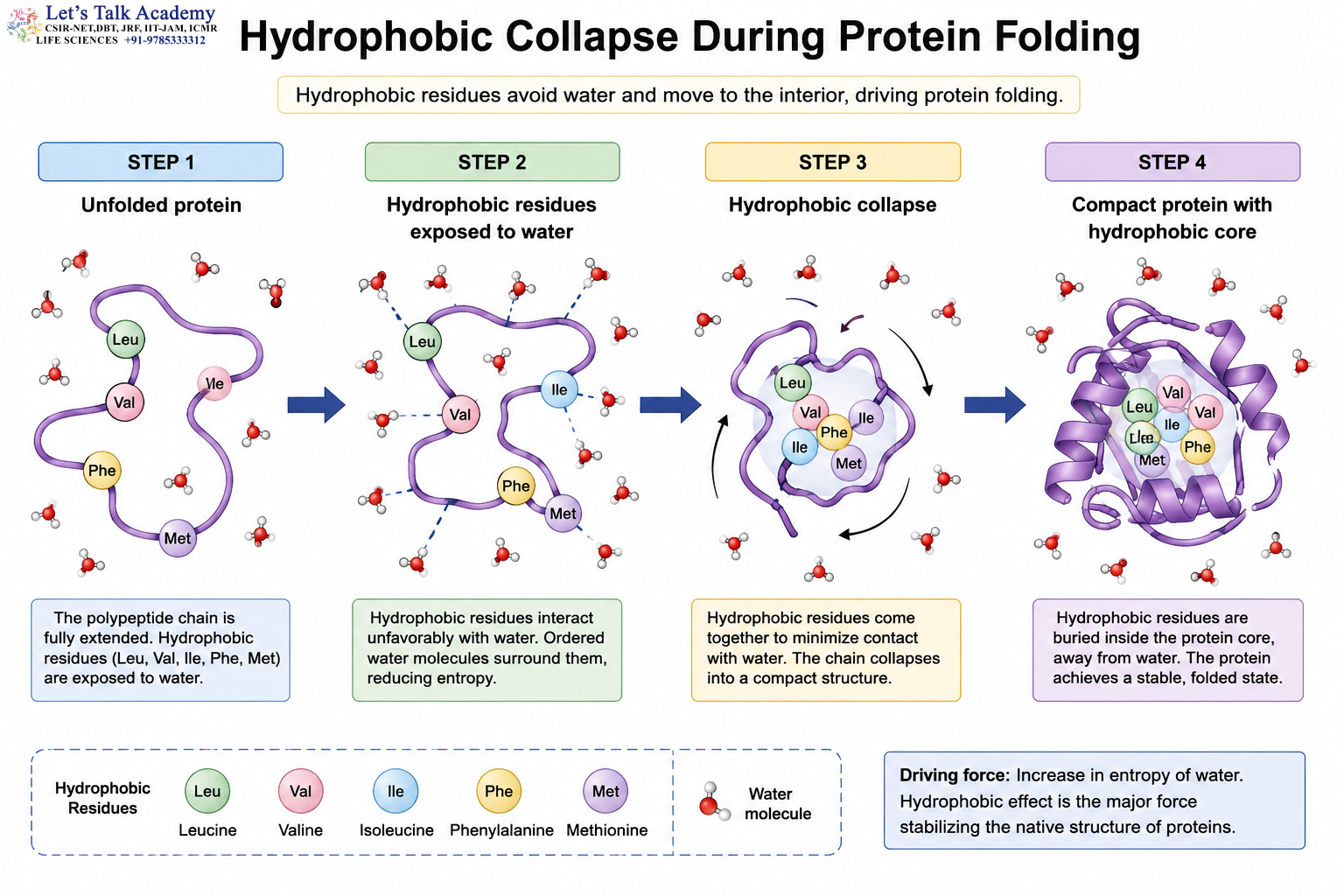
A simplified representation is:
Unfolded polypeptide
↓
Hydrophobic residues exposed to water
↓
Hydrophobic residues cluster
↓
Hydrophobic collapse
↓
Formation of compact structure
↓
Further rearrangement and packing
↓
Native protein structure
The resulting protein generally has:
Hydrophobic residues → more frequently buried inside
Polar and charged residues → more frequently exposed to solvent
However, this is a general tendency rather than an absolute rule. Some hydrophobic residues occur on protein surfaces, and some polar groups can be buried inside proteins when they form favorable interactions.
9. Hydrophobic Core of a Protein
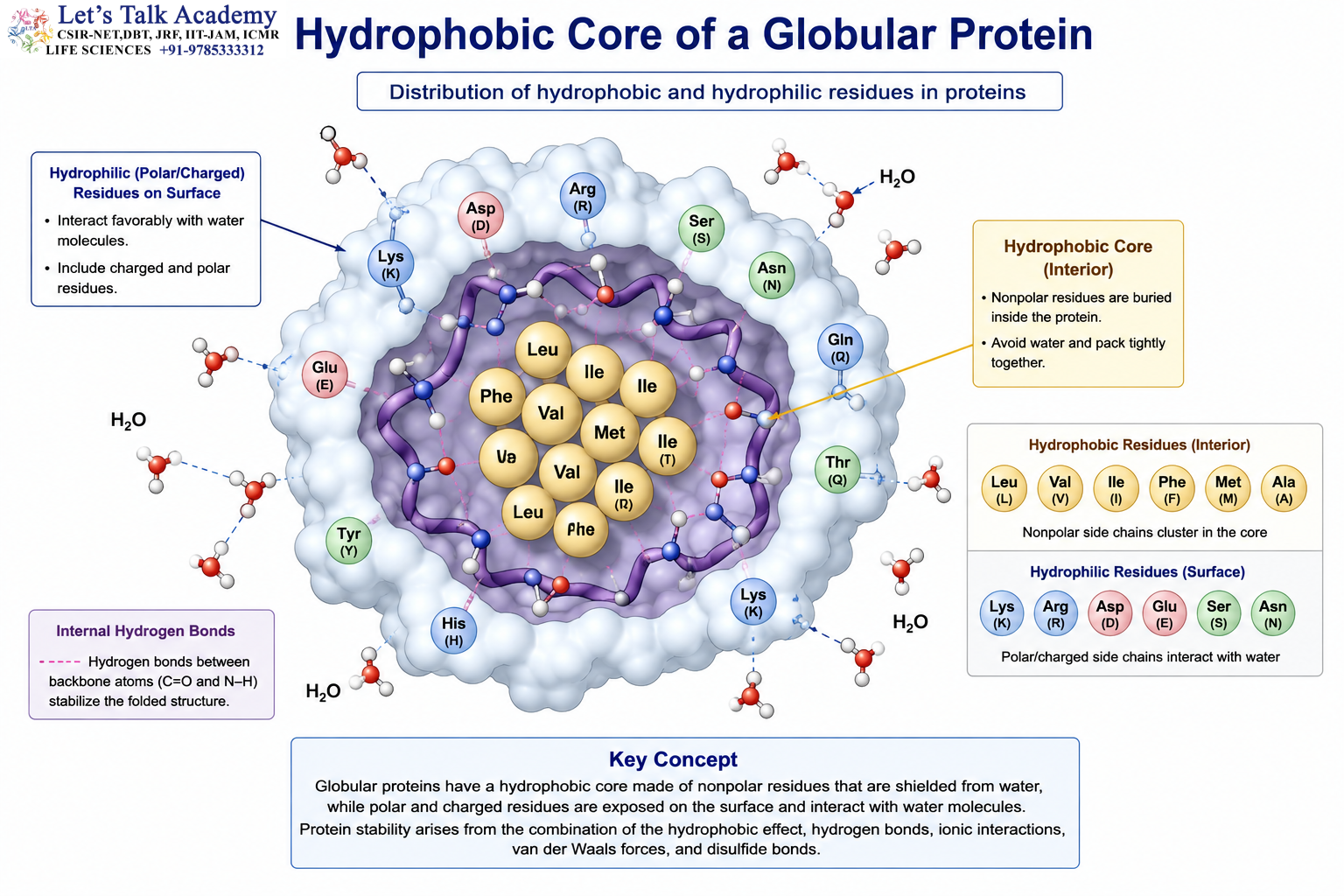
The interior of many globular proteins contains a hydrophobic core.
The hydrophobic core is composed largely of tightly packed non-polar side chains.
Examples include:
Leu – Val – Ile – Phe – Met – Ala
These side chains pack closely together and reduce their exposure to water.
The hydrophobic core is not simply an empty region filled with non-polar amino acids. It is a highly organized environment in which multiple interactions contribute to stability.
These include:
- Hydrophobic effect
- van der Waals interactions
- Hydrogen bonding
- Electrostatic interactions
- Proper side-chain packing
Thus, protein stability is produced by the combined effect of several interactions, rather than by one interaction alone.
10. Hydrophobic Collapse
Hydrophobic collapse is an early structural event in many protein-folding pathways.
When a polypeptide chain is placed in water, hydrophobic side chains tend to become associated with one another.
This reduces the total hydrophobic surface area exposed to water.
The chain therefore becomes more compact.
Extended chain
↓
Hydrophobic groups approach one another
↓
Non-polar surface becomes buried
↓
Water exposure decreases
↓
Compact intermediate forms
Hydrophobic collapse should not be confused with complete protein folding.
A collapsed protein may still lack the precise tertiary structure required for biological activity. Further rearrangement, side-chain packing, hydrogen-bond formation, and other interactions may be required to achieve the native conformation.
11. Thermodynamic Basis of Hydrophobic Interactions
Hydrophobic interactions are best understood using thermodynamics.
The fundamental relationship is:
ΔG = ΔH − TΔS
where:
- ΔG = change in Gibbs free energy
- ΔH = change in enthalpy
- T = absolute temperature
- ΔS = change in entropy
A process is thermodynamically favorable when:
ΔG < 0
During hydrophobic association, changes in the organization of water can contribute substantially to the entropy term.
When non-polar surfaces are buried, water molecules that were relatively constrained near those surfaces can return to the bulk solvent.
This may increase solvent entropy.
Therefore, the hydrophobic effect is often described as having an important entropic component, particularly under many physiological temperature conditions.
However, the hydrophobic effect is not purely entropy-driven under all circumstances. Its enthalpic and entropic contributions can vary with temperature, solute size, molecular geometry, and environment.
12. Entropy of Water and the Hydrophobic Effect
The role of water entropy is one of the most important concepts to understand.
Imagine a non-polar molecule surrounded by water.
The water molecules adjacent to the non-polar surface have restricted orientations compared with molecules in bulk water.
This creates a relatively ordered hydration environment.
If two non-polar surfaces associate:
Before association:
Hydrophobic A → ordered water
Hydrophobic B → ordered water
After association:
Hydrophobic A + Hydrophobic B
↓
Smaller total exposed surface
↓
Less ordered water required
↓
Water released to bulk
↓
Greater solvent freedom
This increase in solvent disorder can contribute favorably to the free energy of association.
13. Hydrophobic Interaction and Protein Stability
Protein stability depends on the difference in free energy between the folded and unfolded states.
A simplified representation is:
Unfolded protein
→ hydrophobic residues exposed to water
Folded protein
→ hydrophobic residues buried in the protein interior
The burial of non-polar surface can favor the folded state.
Experimental studies have shown that burying non-polar groups can make important contributions to protein stability. However, the energetic contribution depends on the size of the group, its environment, solvent exposure, packing, and other interactions.
Importantly, the stabilization of a protein does not arise from hydrophobic interactions alone.
The folded structure represents a balance among:
Hydrophobic interactions + hydrogen bonds + electrostatic interactions + van der Waals interactions + conformational entropy
14. Hydrophobic Interaction and van der Waals Interaction
Hydrophobic and van der Waals interactions are related in protein interiors but should not be considered identical.
Hydrophobic interaction
Primarily involves the effect of placing non-polar groups in an aqueous environment and reducing their exposure to water.
van der Waals interaction
Arises from short-range interactions between atoms due to induced and instantaneous dipoles, particularly when atoms are appropriately close.
When hydrophobic residues become buried:
Reduced water exposure
+
Close packing of non-polar atoms
↓
Hydrophobic contribution + favorable dispersion/packing interactions
Therefore, the stability of a hydrophobic protein core can involve both solvent-mediated hydrophobic effects and direct atomic interactions.
15. Hydrophobic Interaction and Hydrogen Bonding
Hydrophobic interactions and hydrogen bonds often cooperate during protein folding.
The protein backbone contains polar peptide groups.
If the backbone were buried in a hydrophobic interior without satisfying its hydrogen-bonding potential, the energetic cost could be unfavorable.
Therefore, proteins often satisfy buried backbone hydrogen-bond donors and acceptors through secondary structures such as:
- α-helices
- β-sheets
- Turns
A simplified concept is:
Hydrophobic residues → buried
Polar backbone groups → hydrogen bonded
Charged/polar side chains → often solvent exposed or internally compensated
This coordinated organization helps produce stable protein structures.
16. Hydrophobic Interaction in Membrane Formation
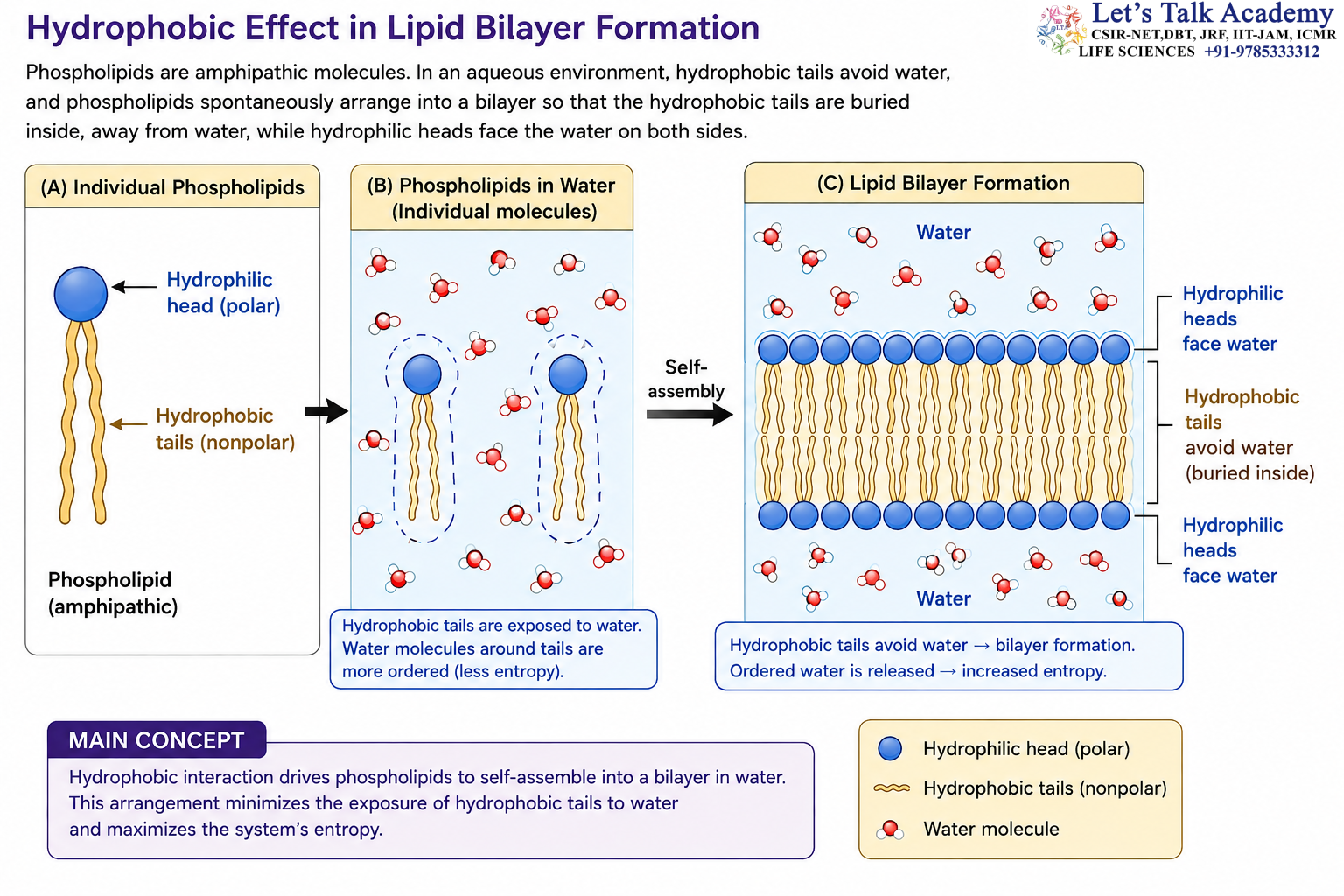
Hydrophobic interactions are fundamental to biological membrane formation.
Phospholipids are amphipathic molecules, meaning they contain both:
- Hydrophilic/polar regions
- Hydrophobic/non-polar regions
When phospholipids are placed in water, their hydrophobic tails tend to avoid contact with water.
This promotes spontaneous organization into structures such as:
Micelles
Bilayers
Vesicles
The lipid bilayer can be represented as:
Hydrophilic heads → water
Hydrophobic tails → membrane interior
Hydrophobic tails → membrane interior
Hydrophilic heads → water
Thus:
Amphipathic lipids + water
↓
Hydrophobic effect
↓
Tail sequestration
↓
Bilayer formation
This is one of the most important biological consequences of the hydrophobic effect.
17. Hydrophobic Interaction in Micelle Formation
In aqueous solution, amphipathic molecules can form micelles.
The hydrophobic tails become concentrated in the interior, while the hydrophilic head groups remain exposed to water.
This arrangement minimizes the exposure of hydrophobic surfaces to the aqueous environment.
Micelle formation is therefore an example of self-assembly driven strongly by the hydrophobic effect.
18. Hydrophobic Interaction in Lipid Bilayers
Biological membranes are primarily based on lipid bilayers.
The hydrophobic tails of phospholipids face inward, while polar head groups interact with the surrounding aqueous environment.
The arrangement can be represented as:
Water
↓
Polar head groups
↓
Hydrophobic tails || Hydrophobic tails
↓
Polar head groups
↓
Water
This organization provides the structural basis for cellular membranes.
The hydrophobic interior also creates a barrier to many ions and polar molecules, contributing to membrane permeability properties.
19. Hydrophobic Interaction in Protein–Protein Association
Hydrophobic interactions also contribute to protein–protein association.
When two proteins bind, hydrophobic surfaces may become buried at the interface.
This decreases the amount of non-polar surface exposed to water.
The binding process may therefore involve:
Protein A + Protein B
↓
Formation of complementary interface
↓
Burial of hydrophobic surfaces
↓
Release/reorganization of interfacial water
↓
Additional hydrogen-bonding/electrostatic/van der Waals contacts
↓
Stable complex
This principle is important in the formation of many protein complexes.
20. Hydrophobic Interaction in Enzyme–Substrate Binding
Hydrophobic interactions can contribute to enzyme–substrate recognition.
An enzyme’s active site often contains a combination of:
- Hydrophobic residues
- Polar residues
- Charged residues
- Hydrogen-bonding groups
- Aromatic residues
If a substrate contains a non-polar region, that region may fit into a hydrophobic pocket in the enzyme.
The resulting association can contribute to substrate binding.
However, hydrophobic interactions alone usually do not explain enzyme specificity. Specificity results from the combined effects of:
Shape complementarity
Hydrophobic interactions
Hydrogen bonds
Electrostatic interactions
van der Waals contacts
21. Hydrophobic Interaction in Molecular Recognition
Molecular recognition requires selective interaction between biomolecules.
Hydrophobic interactions can contribute significantly when complementary non-polar surfaces come together.
For example:
Hydrophobic ligand region
↓
Hydrophobic pocket in receptor
↓
Reduced water exposure
↓
Favorable binding contribution
This principle is important in:
- Enzyme–substrate recognition
- Receptor–ligand binding
- Protein–protein interactions
- Drug–target interactions
- Membrane-associated interactions
22. Hydrophobic Interaction and Ligand Binding
During ligand binding, a ligand may displace water molecules from a binding pocket.
If those water molecules were energetically unfavorable or highly constrained, their release into bulk solvent may contribute to binding.
Therefore, ligand binding can involve both:
Direct protein–ligand interactions
and
Changes in protein–water and ligand–water interactions
This makes water an active participant in molecular recognition.
23. Hydrophobic Interaction and Protein Aggregation
Hydrophobic interactions can also contribute to protein aggregation.
If hydrophobic residues become exposed because of:
- Mutation
- Misfolding
- Denaturation
- Environmental stress
- Chemical modification
they may interact with hydrophobic regions of other protein molecules.
This can promote:
Protein misfolding
↓
Exposure of hydrophobic surfaces
↓
Protein–protein association
↓
Oligomerization/aggregation
Therefore, proper burial of hydrophobic residues is important not only for protein folding but also for preventing inappropriate aggregation.
24. Hydrophobic Interaction and Protein Denaturation
Protein denaturation disrupts the native three-dimensional structure.
During unfolding:
Hydrophobic core becomes disrupted
↓
Non-polar residues become more solvent exposed
↓
Protein–water interactions change
↓
Hydration of hydrophobic surfaces increases
The balance between protein–protein and protein–water interactions therefore changes significantly.
Denaturation can be caused by:
- High temperature
- Extreme pH
- Chaotropic agents
- Organic solvents
- Detergents
- Certain chemical modifications
The exact effect of each denaturant depends on its mechanism.
25. Temperature Dependence of the Hydrophobic Effect
The hydrophobic effect is strongly temperature dependent.
Protein stability is influenced by the temperature dependence of hydration and the thermodynamics of non-polar surface burial.
At sufficiently high or low temperatures, proteins may undergo thermal or cold denaturation.
Therefore:
Protein stability ≠ simply increasing continuously with temperature
Instead, protein stability often reflects a complex temperature-dependent free-energy landscape.
The hydrophobic contribution to folding can change substantially with temperature because the properties of water and the heat capacity associated with exposing or burying non-polar surfaces are temperature dependent.
26. Heat Capacity and Hydrophobic Effect
One important thermodynamic characteristic of processes involving burial of non-polar surface is a significant change in heat capacity.
The change in heat capacity is represented as:
ΔCp
The hydrophobic effect is associated with characteristic heat-capacity changes during:
- Protein folding
- Protein association
- Ligand binding
- Transfer of non-polar solutes from water to non-aqueous environments
A large negative ΔCp is commonly associated with processes that bury non-polar surface area.
This provides experimental evidence for the role of the hydrophobic effect in biomolecular processes.
27. Solvent-Accessible Surface Area
The solvent-accessible surface area (SASA) is an important structural concept in understanding hydrophobic interactions.
SASA represents the surface area of a molecule that can be accessed by solvent.
During protein folding:
Unfolded state
→ larger exposed non-polar surface
Folded state
→ smaller exposed non-polar surface
Therefore:
Decrease in non-polar SASA
is strongly associated with the hydrophobic contribution to folding.
This concept is frequently useful when interpreting protein-folding experiments and computational structural biology studies.
28. Hydrophobicity Scales
Amino acids can be ranked according to experimentally derived hydrophobicity scales.
Different hydrophobicity scales may produce somewhat different rankings because hydrophobicity depends on:
- Measurement method
- Solvent
- Reference state
- Temperature
- Molecular environment
Commonly discussed hydrophobicity scales include those derived from partitioning or transfer experiments.
Remember that hydrophobicity is a quantitative property, not merely a binary classification.
29. Hydrophobic Interaction and the Cell Membrane
The hydrophobic effect is central to cellular organization.
The plasma membrane separates the aqueous cytoplasm from the external environment and provides a selective barrier.
The hydrophobic interior of the lipid bilayer makes it difficult for many charged molecules to cross freely.
This allows cells to maintain:
- Ion gradients
- Membrane potential
- Metabolic compartmentalization
- Signal transduction
- Selective transport
Thus, a molecular interaction involving water and non-polar surfaces has consequences at the level of the entire cell.
30. Hydrophobic Interaction in Membrane Proteins
Membrane proteins contain hydrophobic regions that interact with the lipid bilayer.
For example, transmembrane α-helices frequently contain hydrophobic amino acids that interact with the hydrophobic core of the membrane.
A simplified arrangement is:
Extracellular water
↓
Hydrophilic region
↓
Hydrophobic transmembrane segment
↓
Hydrophobic lipid core
↓
Hydrophilic region
↓
Cytoplasmic water
Hydrophobic matching between protein surfaces and membrane lipids contributes to membrane-protein stability.
31. Hydrophobic Interaction and Amphipathic Molecules
An amphipathic molecule contains both hydrophobic and hydrophilic portions.
Examples include:
- Phospholipids
- Many detergents
- Amphipathic peptides
- Certain membrane-associated proteins
The amphipathic nature of these molecules allows them to organize spontaneously in water.
A common principle is:
Hydrophilic region → interacts with water
Hydrophobic region → avoids water
This principle underlies many self-assembly processes in biology.
32. Hydrophobic Interaction and Detergents
Detergents contain both hydrophobic and hydrophilic portions.
They can interact with membrane lipids and membrane proteins.
Above a characteristic concentration known as the critical micelle concentration (CMC), many detergents form micelles.
The formation of micelles is strongly associated with the hydrophobic effect.
This principle is widely used in biochemical laboratories to:
- Solubilize membrane proteins
- Disrupt lipid bilayers
- Isolate membrane complexes
- Study membrane-associated proteins
33. Hydrophobic Interaction Is Not a Covalent Bond
Hydrophobic interactions are non-covalent and differ fundamentally from covalent bonds.
A covalent bond involves sharing of electrons between atoms.
Hydrophobic association does not involve the formation of a new conventional covalent bond between non-polar groups.
Instead, it arises largely from the thermodynamic consequences of placing non-polar surfaces in water and changing their exposure to solvent.
Therefore:
Covalent bond → strong chemical bond
Hydrophobic effect → solvent-mediated thermodynamic effect
34. Comparison with Other Stabilizing Interactions
Hydrophobic interaction
- Strongly influenced by water
- Involves non-polar surfaces
- Important in protein folding
- Important in membrane formation
- Often associated with favorable solvent entropy
Hydrogen bonding
- Involves donor and acceptor groups
- Provides directional interactions
- Important in secondary and tertiary structure
- Important in molecular recognition
Electrostatic interaction
- Occurs between charged groups
- Strongly affected by ionic strength and dielectric environment
- Important in protein stability and molecular recognition
van der Waals interaction
- Short-range interaction
- Depends strongly on atomic distance
- Important for close molecular packing
- Contributes to protein-core stability
All of these interactions can act simultaneously.
35. Hydrophobic Interaction and Ionic Strength
Ionic strength can influence biomolecular interactions by changing electrostatic screening and the overall solution environment.
Hydrophobic association itself is not simply controlled by ionic strength in the same manner as electrostatic interactions.
High salt concentrations can also produce phenomena such as salting-out, in which the solubility of certain proteins decreases. This phenomenon has relationships with solvent structure and protein hydration but should not be equated directly with the basic hydrophobic effect.
36. Hydrophobic Interaction and Chaotropic Agents
Chaotropic agents interfere with the organization of water and the non-covalent interactions that stabilize biomolecules.
Examples include:
- Urea
- Guanidinium salts
These compounds can promote protein unfolding by altering the balance between protein–protein, protein–water, and water–water interactions.
Therefore, the effect of denaturants cannot be explained only by “breaking hydrophobic bonds.” Hydrophobic interactions are not ordinary chemical bonds that are simply broken by denaturants.
Instead, denaturants alter the thermodynamic landscape of folding.
37. Hydrophobic Interaction in Protein Design
Understanding hydrophobic interactions is essential in protein engineering.
When designing a protein, hydrophobic residues are often positioned strategically within the protein core to promote proper folding and packing.
However, excessive exposure of hydrophobic surfaces can lead to:
- Poor solubility
- Misfolding
- Aggregation
- Reduced stability
Therefore, successful protein design requires a balance between:
Hydrophobic core formation
and
Adequate surface hydration
38. Hydrophobic Interaction and Protein Evolution
Evolution also shapes hydrophobic patterns in proteins.
Conserved hydrophobic residues are often important because they contribute to:
- Core packing
- Structural stability
- Folding
- Interaction interfaces
A mutation replacing a buried hydrophobic residue with a charged or strongly polar residue may destabilize a protein if the new residue cannot be accommodated without exposing unfavorable groups or disrupting packing.
Similarly, replacing one hydrophobic residue with another may have a relatively smaller effect, although the exact consequence depends on size, shape, packing, and local environment.
39. Hydrophobic Interaction in Molecular Biology Experiments
Several experimental techniques can provide information related to hydrophobicity and protein stability.
These include:
- Protein solubility studies
- Differential scanning calorimetry
- Isothermal titration calorimetry
- Fluorescence spectroscopy
- Circular dichroism spectroscopy
- Nuclear magnetic resonance spectroscopy
- X-ray crystallography
- Molecular dynamics simulations
These techniques help researchers investigate protein folding, stability, binding, conformational changes, and solvent interactions.
40. Hydrophobic Interaction and Protein Folding Energy Landscape
Protein folding can be represented as an energy landscape or folding funnel.
At the beginning:
Many conformations
↓
Hydrophobic collapse
↓
Reduction in conformational possibilities
↓
Formation of secondary and tertiary interactions
↓
Packing of the hydrophobic core
↓
Native-like conformations
↓
Native state
The folding funnel is not necessarily a single rigid pathway. Proteins may reach the native state through multiple microscopic routes.
Hydrophobic interactions contribute significantly to shaping this energy landscape.
41. Hydrophobic Interaction and the Hydrophobic Core–Surface Distribution
A general rule for soluble globular proteins is:
Hydrophobic residues → preferentially inside
Polar residues → preferentially outside
Charged residues → commonly solvent exposed
However, exceptions are common.
For example, hydrophobic residues can occur on protein surfaces when they participate in:
- Protein–protein interfaces
- Membrane interactions
- Ligand-binding sites
- Specific structural environments
Likewise, polar and charged residues can occur inside a protein if they are stabilized through hydrogen bonds, salt bridges, metal coordination, or other interactions.
Therefore, the chemical environment, not merely amino acid classification, determines structural behavior.
42. Hydrophobic Interaction and Protein–Protein Interfaces
Protein–protein interfaces often contain a combination of hydrophobic and polar regions.
When two proteins associate:
Burial of hydrophobic surface
may provide a favorable contribution.
At the same time:
Hydrogen bonds + salt bridges + van der Waals contacts
can provide specificity and additional stabilization.
Therefore, biological recognition usually depends on a combination of complementary interactions rather than a single interaction type.
43. Hydrophobic Interaction in Drug Discovery
Hydrophobic interactions are important in drug–target interactions.
Many drug molecules contain hydrophobic groups that can fit into non-polar pockets within proteins.
A drug may gain favorable binding contributions by:
- Occupying hydrophobic cavities
- Displacing water molecules
- Forming van der Waals contacts
- Establishing hydrogen bonds
- Establishing electrostatic interactions
Drug design therefore requires careful consideration of both hydrophobic and polar interactions.
An excessively hydrophobic drug, however, may suffer from poor aqueous solubility.
Thus, medicinal chemistry often involves balancing:
Hydrophobicity
with
Aqueous solubility
and
Target affinity
44. Important Factors Affecting Hydrophobic Interactions
Hydrophobic interactions are influenced by several factors.
44.1 Temperature
Changes in temperature alter water structure and the thermodynamics of hydrophobic association.
44.2 Surface Area
Larger exposed non-polar surfaces generally produce larger solvent effects.
44.3 Molecular Shape
The geometry and curvature of a hydrophobic surface can affect hydration and association.
44.4 Solvent
The hydrophobic effect is particularly important in aqueous environments.
44.5 Protein Environment
The local arrangement of polar, charged, and non-polar groups modifies the effective contribution of hydrophobic interactions.
44.6 Packing
Close packing of hydrophobic groups can additionally provide favorable van der Waals interactions.
45. Hydrophobic Interaction: Integrated Concept
The complete concept can be summarized as:
Non-polar groups encounter water
↓
Water reorganizes around non-polar surfaces
↓
Hydration of hydrophobic surfaces has an unfavorable thermodynamic component
↓
Non-polar surfaces tend to associate
↓
Exposed non-polar surface area decreases
↓
Some ordered/interfacial water is released to bulk solution
↓
Solvent entropy can increase
↓
Hydrophobic association becomes favorable
↓
Protein folding, membrane formation, molecular recognition, and biomolecular assembly are promoted
This is the central conceptual framework for understanding hydrophobic interactions in biomolecules.
46. Hydrophobic Interaction in Protein Folding
Protein folding is a highly coordinated process involving the formation of a stable three-dimensional structure.
Hydrophobic interactions help initiate and stabilize the process by promoting the sequestration of non-polar amino acid side chains away from water.
The resulting hydrophobic core provides a structural framework around which other interactions can develop.
However, a protein does not become stable simply because its hydrophobic residues are buried. The final native structure results from a balance among hydrophobic effects, hydrogen bonds, electrostatic interactions, van der Waals interactions, conformational entropy, and interactions with solvent.
Thus, the hydrophobic effect should be understood as one of the central thermodynamic principles governing biomolecular organization.
47. Hydrophobic Interaction Comparison
Feature |
Hydrophobic Interaction |
|---|---|
| Nature | Non-covalent |
| Major environment | Aqueous environment |
| Main groups involved | Non-polar groups |
| Major solvent involved | Water |
| Major biological role | Protein folding and biomolecular assembly |
| Protein location | Hydrophobic residues often buried in globular protein cores |
| Membrane role | Promotes sequestration of lipid tails |
| Thermodynamic basis | Strongly influenced by solvent entropy and hydration |
| Direct chemical bond? | No |
| Important concept | Reduction of non-polar surface exposed to water |
| Related process | Hydrophobic collapse |
| Major applications | Folding, membrane formation, ligand binding, molecular recognition |
48. Final Takeaway
Hydrophobic interaction is one of the most important stabilizing interactions in biomolecules.
Its importance comes primarily from the behavior of water around non-polar surfaces. When hydrophobic groups are exposed to water, the surrounding solvent undergoes structural and thermodynamic changes. Association of non-polar groups reduces their exposed surface and can release constrained water molecules into the bulk solution.
In proteins, this principle contributes strongly to the formation of the hydrophobic core and to the folding of polypeptide chains. In membranes, it drives the organization of amphipathic lipids into bilayers and other structures. It also contributes to protein–protein association, enzyme–substrate binding, receptor–ligand recognition, and many other biomolecular processes.
Hydrophobic interaction is not simply an attractive force between non-polar groups. It is predominantly a solvent-mediated thermodynamic effect arising from the behavior of water around non-polar surfaces.
Understanding this distinction makes it easier to connect hydrophobic interactions with protein folding, membrane structure, thermodynamics, molecular recognition, protein stability, and biomolecular self-assembly.


