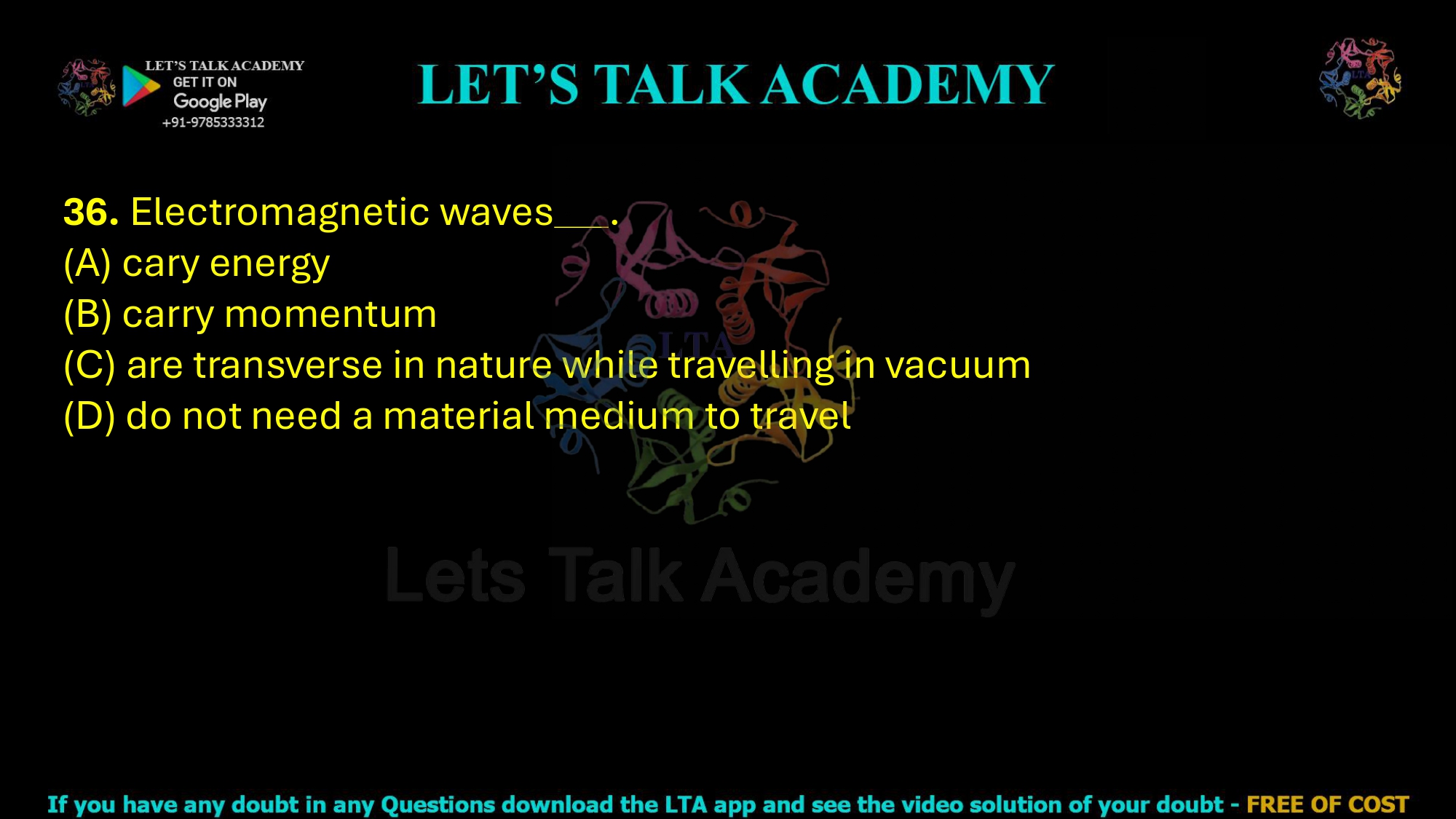
36. Electromagnetic waves .
(A) cary energy
(B) carry momentum
(C) are transverse in nature while travelling in vacuum
(D) do not need a material medium to travel
Electromagnetic Waves: Which Statements About Their Properties Are Correct?
Correct Answer: All statements (A), (B), (C), and (D) are correct.
Electromagnetic waves are among the most important concepts in physics because they explain the behaviour of light, radio waves, microwaves, infrared radiation, ultraviolet radiation, X-rays, and gamma rays. The statements given in this question describe four fundamental properties of electromagnetic waves. A careful analysis shows that every statement is scientifically correct.
What Are Electromagnetic Waves?
Electromagnetic waves are waves produced by changing electric and magnetic fields. An electromagnetic wave consists of an oscillating electric field and an oscillating magnetic field. These two fields are perpendicular to each other and also perpendicular to the direction in which the wave travels.
Unlike mechanical waves such as sound waves, electromagnetic waves do not require particles of a material medium for their propagation. This is why electromagnetic radiation can travel through the vacuum of space. Sunlight, for example, travels across the nearly empty space between the Sun and Earth and reaches us as electromagnetic radiation.
Option (A): Electromagnetic Waves Carry Energy
Option (A) is correct. Electromagnetic waves carry energy from one place to another. This is one of their most fundamental properties. When electromagnetic radiation interacts with matter, the energy carried by the wave can be transferred to atoms, molecules, or other particles.
A familiar example is sunlight. Energy produced by the Sun travels to Earth in the form of electromagnetic radiation. When sunlight falls on the surface of Earth, plants, solar panels, or human skin, its energy can be absorbed and converted into other forms.
The energy transported by an electromagnetic wave is associated with both its electric field and magnetic field. Therefore, electromagnetic waves are not simply disturbances moving through space; they are capable of transporting real physical energy.
Examples of Energy Transfer by Electromagnetic Waves
Solar radiation warms the Earth because electromagnetic waves transfer energy from the Sun to our planet. Microwave radiation transfers energy to food and causes heating. Infrared radiation is commonly experienced as thermal radiation, while solar cells convert the energy of electromagnetic radiation directly into electrical energy.
Therefore, the statement that electromagnetic waves carry energy is completely correct.
Option (B): Electromagnetic Waves Carry Momentum
Option (B) is correct. Electromagnetic waves carry not only energy but also momentum. This may appear surprising because electromagnetic radiation does not possess rest mass, but radiation can still have momentum.
When electromagnetic radiation falls on a surface and is absorbed or reflected, it can exert a force on that surface. The force produced by electromagnetic radiation is associated with the transfer of momentum and gives rise to a phenomenon known as radiation pressure.
For electromagnetic radiation, the relationship between energy and momentum can be written as:
p = E/c
where p represents momentum, E represents energy, and c represents the speed of light in vacuum.
This relationship clearly shows that an electromagnetic wave carrying energy also possesses momentum. The transfer of this momentum can produce measurable physical effects.
Radiation Pressure as Evidence of Momentum
When light strikes an object, momentum can be transferred to the object. As a result, electromagnetic radiation exerts pressure known as radiation pressure. Although this pressure is usually very small in everyday situations, it is a real and measurable physical effect.
The concept is also important in the working principle of solar sails, where the momentum of sunlight can produce a small continuous force on a large reflective surface. Therefore, option (B) is correct.
Option (C): Electromagnetic Waves Are Transverse in Vacuum
Option (C) is correct. Electromagnetic waves are transverse in nature while travelling through vacuum. In a transverse wave, the oscillations occur perpendicular to the direction of propagation of the wave.
Suppose an electromagnetic wave is travelling along a particular direction. Its electric field oscillates in a direction perpendicular to the direction of travel, while its magnetic field also oscillates perpendicular to the direction of travel. In addition, the electric field and magnetic field are perpendicular to each other.
The three directions can be understood as follows: the electric field, magnetic field, and direction of propagation are mutually perpendicular to one another.
Why Are Electromagnetic Waves Called Transverse Waves?
Electromagnetic waves are classified as transverse because their electric and magnetic field oscillations are perpendicular to the direction in which the wave moves. This property distinguishes them from longitudinal waves, in which particles or disturbances oscillate parallel to the direction of propagation.
The transverse nature of electromagnetic waves is also closely related to the phenomenon of polarization. Since electromagnetic waves can be polarized, this provides strong evidence for their transverse nature.
Therefore, the statement that electromagnetic waves are transverse in nature while travelling in vacuum is correct.
Option (D): Electromagnetic Waves Do Not Need a Material Medium
Option (D) is correct. Electromagnetic waves do not require a material medium for their propagation. They can travel through solids, liquids, gases, and, most importantly, through vacuum.
This property makes electromagnetic waves fundamentally different from mechanical waves. Sound waves, for example, require a material medium because they propagate through vibrations of particles. Sound cannot travel through a perfect vacuum because there are no particles available to transmit the disturbance.
Electromagnetic waves, however, consist of changing electric and magnetic fields. A changing electric field produces a magnetic field, while a changing magnetic field produces an electric field. This allows the electromagnetic disturbance to propagate through empty space without requiring matter.
How Does Sunlight Reach Earth Through Space?
The space between the Sun and Earth is largely a vacuum, yet sunlight reaches Earth continuously. This is possible because visible light is an electromagnetic wave and does not require a material medium for propagation.
The same principle applies to radio waves, infrared radiation, ultraviolet radiation, X-rays, and gamma rays. All electromagnetic waves can propagate through vacuum.
Therefore, option (D) is also correct.
Why Are All Four Statements Correct?
Each option describes a genuine property of electromagnetic radiation. Electromagnetic waves transport energy, and because they carry energy, they also possess momentum. Their electric and magnetic fields oscillate perpendicular to the direction of propagation, making them transverse in vacuum. Finally, they can propagate through empty space without any material medium.
Thus, none of the four statements is incorrect. If the original question is intended as a single-correct-option MCQ, then the question is incomplete or requires an additional option such as “All of the above.” Scientifically, statements (A), (B), (C), and (D) are all correct.
Final Answer
Electromagnetic waves carry energy, carry momentum, are transverse in nature while travelling in vacuum, and do not require a material medium for propagation. Therefore, all four statements—(A), (B), (C), and (D)—are correct.


